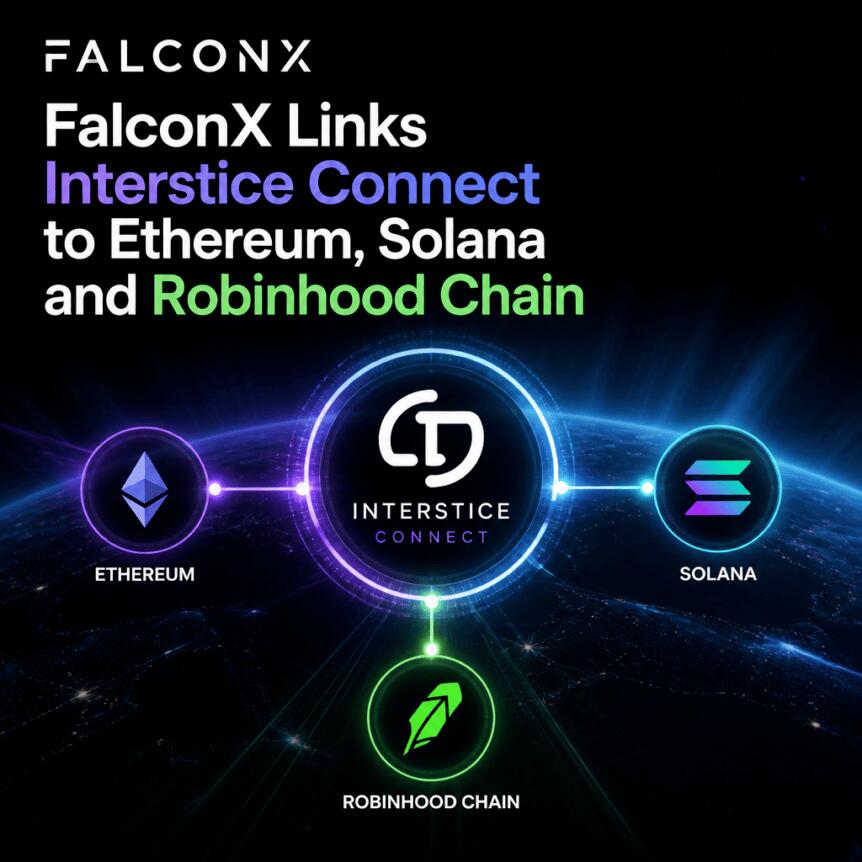
Interstice Digital has introduced a non-custodial cross-chain swap engine designed to connect the Canton Network with major public ecosystems, including Ethereum and Solana, using FalconX as its liquidity layer. The company says the system can route token swaps across all four networks without Interstice holding users’ assets or submitting transactions on their behalf.
The announcement positions Canton—an institutional-focused blockchain with privacy and permissioning controls—as a place where tokenized assets can interact with broader liquidity available on public chains. While Interstice did not disclose which tokens are supported at launch or provide any transaction volume metrics, the integration adds another piece to Canton’s push to make tokenized finance more usable for market participants.
According to Interstice’s announcement, the swap engine is built as a non-custodial mechanism. In practical terms, this means Interstice is not designed to hold user funds, and it is not presented as a service that executes trades on behalf of users. Instead, the engine is intended to enable cross-chain swaps while users retain control of their assets.
Liquidity is provided through FalconX, which the company describes as serving institutional investors through a prime-brokerage framework. The engine’s stated goal is to give users a path between tokenized assets on Canton—where institutional finance use cases have been expanding—and liquidity on public blockchains such as Ethereum and Solana.
Interstice did not specify which assets will be supported first. It also did not publish any swap volume figures tied to the engine, leaving market participants to assess adoption only after more operational details emerge.
Canton Network is described as a blockchain built for institutional finance, emphasizing privacy and permissioning to align with regulated transaction needs. The network’s ecosystem includes major financial institutions, and several publicized projects suggest that Canton is moving beyond experimentation toward more established workflows for tokenized assets and settlement.
The swap engine’s relevance to investors and market participants is straightforward: the more a tokenized asset ecosystem can connect to external liquidity, the more practical it becomes for trading and hedging. Canton’s value proposition has largely centered on regulated tokenization and settlement. Interstice’s announcement attempts to address the next bottleneck—how those tokenized assets can interact efficiently with liquidity pools and trading venues on mainstream public chains.
The cross-chain swap engine arrives as traditional financial institutions increase their engagement with Canton-based tokenization and blockchain settlement.
In July, electronic trading platform Tradeweb executed an onchain US Treasury trade on Canton. In that transaction, Franklin Templeton transferred a tokenized Treasury security to Virtu Financial in exchange for tokenized cash. Tradeweb said it was the first real-time purchase and sale of a tokenized US Treasury settled against USDCx, a USDC-backed stablecoin issued on Canton. Other participants included Societe Generale, Digital Asset, and Blockdaemon. Earlier coverage from Cointelegraph described the broader mechanics of that real-time flow, including how Tradeweb handled execution and price discovery while Canton synchronized settlement across the tokenized security and tokenized cash leg.
Beyond tokenized Treasuries, Societe Generale has also deployed euro- and dollar-denominated stablecoins on Canton for tokenized collateral, repo financing, and institutional settlement. Separate reporting noted that Visa tested private stablecoin settlement on the network, reflecting growing interest in privacy-preserving settlement models for stablecoins.
Additional initiatives mentioned alongside Canton’s ecosystem include a Japanese government bond collateral pilot involving Mizuho and Nomura, and S&P Dow Jones Indices placing its iBoxx US Treasuries Index on Canton. Collectively, these efforts suggest that Canton is building a portfolio of tokenized instruments—collateral, stablecoins, and indices—where cross-chain interoperability becomes increasingly valuable.
Cross-chain swaps can look simple on paper, but liquidity is often the determining factor for whether users can actually execute trades without friction. Interstice’s decision to use FalconX as the liquidity provider signals an attempt to reduce that gap between tokenized assets on Canton and tradable liquidity on public chains.
Still, important details remain unclear. Interstice has not disclosed which specific assets will be supported first, nor has it offered any early metrics that would help gauge real-world demand or execution quality. For traders and institutions evaluating Canton’s expansion, those missing specifics will likely matter more than the headline functionality.
Going forward, market participants should watch for (1) the initial asset list and stablecoin or token types included in the swap routing, (2) operational transparency such as settlement behavior and failure modes, and (3) whether the engine’s integration leads to measurable increases in active liquidity or repeat settlement activity between Canton-based tokenized assets and public chain venues.
This article was originally published as FalconX Links Interstice Connect to Ethereum, Solana and Robinhood Chain on Crypto Breaking News – your trusted source for crypto news, Bitcoin news, and blockchain updates.





