Which Crypto to Buy Today? The Definitive 2026 Guide to Market-Beating Portfolios
18-May-2026
Medium » Coinmonks
Introduction: The New Institutional Reality of Digital Assets
The cryptocurrency market in mid-2026 has fundamentally decoupled from the wild, speculative retail cycles of its formative years. Investors who look at today’s charts expecting the chaotic, meme-driven volatility of 2021 are missing the structural transformation that has occurred across the digital asset landscape. Capital is no longer just shifting between highly speculative tokens; instead, it is consolidating around projects with massive architectural utility, structural compliance, and proven institutional adoption.
With Bitcoin holding firmly above the critical $78,000 threshold and testing its historical resistance lines near $80,000, the broader macro environment has shifted from an erratic playground to an elite asset class. This definitive guide analyzes the top-performing crypto assets to buy today, supported by historical on-chain metrics, technical catalysts, and institutional insights from the world’s leading digital asset research firms.
Read this article for free
The Macro Environment: What’s Driving the 2026 Crypto Market?
Before executing any trades today, an investor must understand the underlying liquidity engines driving capital distribution across the space. The 2026 crypto market is governed by three primary forces:
Institutional Inflows via Spot ETFs: Spot Bitcoin and Ethereum ETFs have created permanent, structural buy pressure from traditional finance (TradFi), adding over $18 billion in net inflows this year alone.
Aggressive Sector Rotation: While Bitcoin serves as the ultimate macro anchor, capital is rotating rapidly into high-liquidity altcoins with clear narratives — specifically Artificial Intelligence (AI) operations, Real-World Asset (RWA) tokenization, and high-throughput Layer-1 networks.
M&A and Corporate Rails: Blockchain infrastructure has shifted from a theoretical utility to an active corporate battleground. Major mergers, such as corporate payment networks acquiring stablecoin infrastructure providers, prove that digital assets are being woven directly into global economic networks.
Every resilient digital asset strategy requires a foundational base of blue-chip assets. These protocols provide the liquidity, stability, and institutional defense mechanisms necessary to weather broader macroeconomic drawdowns.
Bitcoin (BTC): The Uncontested Macro Anchor
Bitcoin remains the premier cryptocurrency to buy today for both defensive wealth preservation and consistent upside exposure. As a flagship asset, its technical behavior dictates the health of the entire ecosystem.
Scarcity and Supply Mechanics: Following historical halving events, the available market supply of BTC continues to tighten, clashing directly with growing corporate treasury demand.
Technical Support Zones: Market data shows Bitcoin testing key support zones around $68,000, consolidating leveraged positions and preparing the foundations for a structural rally back toward the $80,000–$82,000 resistance bands.
Institutional Alignment: The normalization of spot investment vehicles means that asset management giants view BTC not as a speculative tech stock, but as an alternative reserve asset comparable to digital gold.
Ethereum (ETH): The Decentralized Operating System
Ethereum dominates the smart contract and decentralized application (dApp) landscape, maintaining roughly 75% of the total value locked (TVL) across decentralized finance (DeFi).
Ecosystem Scaling: Landmark updates, including the Dencun upgrade from earlier this year and the highly anticipated Prague release, have radically slashed transaction costs while boosting scalability through Layer-2 execution environments.
Corporate Tokenization Hub: Major asset managers like BlackRock have designated Ethereum as the base layer for their programmatic tokenization experiments, shifting billions of dollars of traditional yield instruments onto the mainnet.
Deflationary Economics: As network activity expands across decentralized exchanges (DEXs) and security layers, Ethereum’s proof-of-stake fee-burning mechanism acts as an ongoing supply sink, supporting long-term valuation.
2. Layer-1 Competitors: High-Throughput Networks
While Ethereum commands the institutional DeFi narrative, several alternative Layer-1 networks have carved out significant market share by addressing transaction speed, retail adoption, and computational efficiency.
Solana (SOL): The Retail and High-Frequency Execution Engine
Solana has completely recovered from historical infrastructure challenges to establish itself as the fastest and most capital-efficient layer-1 ecosystem in production today.
The Alpenglow Upgrade: Developed by ecosystem engineering group Anza, the Alpenglow consensus upgrade represents a massive step forward for the network. It replaces legacy Proof-of-History architectures with two fundamental components:
Votor: A ultra-low-latency finality engine capable of resolving blocks within 100 to 150 milliseconds.
Rotor: A highly optimized data relay protocol that completely streamlines network communication.
Firedancer Implementation: Running concurrently with Alpenglow, the highly anticipated Firedancer validator client scales network throughput capabilities past one million transactions per second, making Solana the network of choice for high-frequency trading and high-volume retail apps.
Real-World Remittances: Institutional validation has scaled rapidly, with mainstream payment systems and global remittance giants like Western Union aggressively testing Solana stablecoin architectures to bypass legacy banking rails.
Ripple (XRP): Corporate Cross-Border Settlement
XRP has maintained its position among top digital assets, capitalizing heavily on a series of regulatory victories.
Regulatory Certainty: Following definitive legal absolute resolutions, XRP stands out as one of the few alternative assets with clear regulatory status, minimizing institutional compliance risks.
On-Demand Liquidity (ODL): Ripple’s enterprise networks continue to absorb global banking partnerships, utilizing XRP as a real-time bridge currency to eliminate the need for pre-funded Nostro/Vostro accounts in cross-border settlements.
Binance Coin (BNB): The Ecosystem Utility Powerhouse
BNB powers the entire Binance Smart Chain (BSC) ecosystem, cementing its position as a high-volume utility token.
Deflationary Supply Shocks: Powered by a programmed quarterly auto-burn schedule, the circulating supply of BNB continuously decreases, creating structural scarcity regardless of market conditions.
Platform Dominance: As trading volumes across global spot and derivatives markets remain elevated, the utility of BNB in reducing trading fees, running launchpad allocations, and securing decentralized sidechains ensures deep, persistent market demand.
3. High-Alpha Narratives: Sector Rotations
For investors targeting market-beating returns, allocating capital to emerging structural narratives is paramount. In 2026, smart money is focused on the convergence of machine intelligence and tokenized tangible assets.
Narrative A: Decentralized AI Operations
The fusion of artificial intelligence and decentralized networks has moved past simple buzzwords into a fully realized sector.
Autonomous Portfolio Management: AI agents are now operating autonomously on-chain, executing complex yield-farming adjustments, managing multi-token portfolio balances, and mitigating risk faster than any human operator could manage.
Self-Optimizing Infrastructure: Machine learning protocols are being deployed directly to run blockchain nodes, proactively optimizing network throughput, identifying vulnerabilities, and lowering transaction latency.
Key Assets to Watch: Major infrastructure networks such as Fetch.ai (ASI) — which pioneered autonomous economic software agents — and momentum-driven projects like SKYAI represent the leading edge of this sector rotation.
Narrative B: Real-World Asset (RWA) Tokenization
The migration of multi-trillion-dollar traditional assets onto public ledgers is one of the most significant macro trends of this decade.
On-Chain Yield Generation: Institutional demand for tokenized sovereign debt and sovereign treasury bonds has exploded, as investors seek to capture low-risk yields natively within DeFi environments.
Market Leaders: Protocols like Ondo Finance have established definitive dominance by creating institutional-grade bridges between traditional money markets and decentralized applications.
As decentralized derivatives volumes match centralized exchanges, infrastructure layer protocols are gaining enormous capital traction.
Perpetual DEX Scaling: Networks like Hyperliquid (HYPE) are capturing substantial whale liquidity by offering professional-tier order books, institutional custody options, and ultra-low fees.
Market-Wide Performance Matrix
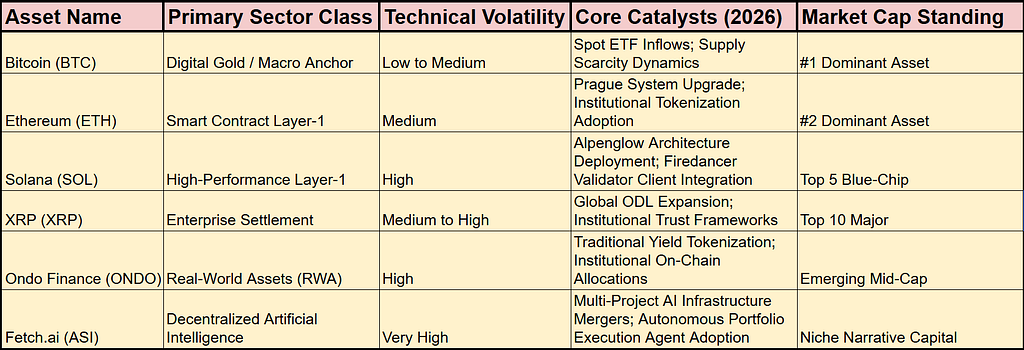
To accurately structure a portfolio today, an investor must weigh technical catalysts against current market valuations. The table below provides a multi-variable overview of the leading cryptographic assets based on current mid-2026 data.
Strategic Portfolio Allocation for 2026
Achieving consistent market-beating returns requires a risk-adjusted framework that balances defensive anchors with aggressive growth narratives. Top digital asset desks suggest a structured 50/30/20 allocation matrix to capture upside while hedging macro drawdowns:
The Institutional Blue-Chip Layer (50% Allocation)
Objective: Capital preservation, high liquidity, and foundational security.
Execution: Split evenly between Bitcoin (BTC) and Ethereum (ETH). This base ensures your portfolio benefits from the persistent liquidity engines of spot ETFs and programmatic corporate tokenization protocols without exposing your core wealth to project-specific failures.
The High-Performance Layer-1 Layer (30% Allocation)
Objective: Mid-cap capture of transactional volume, retail applications, and global payment rails.
Execution: Allocate heavily toward Solana (SOL) to leverage the rapid execution capabilities of the Alpenglow and Firedancer upgrades. Complement this with defensive allocations in XRP or BNB to benefit from cross-border banking settlements and centralized exchange infrastructure volumes.
The Narrative Alpha Layer (20% Allocation)
Objective: Maximizing exponential returns by identifying early stage structural shifts before they are priced in by broad retail markets.
Execution: Distribute capital across pure-play infrastructure projects. Prioritize tokenized treasury solutions like Ondo Finance to capture yield migration, and autonomous machine learning layers like Fetch.ai (ASI) to benefit from AI-driven optimization cycles.
Advanced Risk Management & Tactical Execution
When investing in digital assets today, entering positions randomly can severely impact performance. Professional asset managers apply distinct execution frameworks depending on an investor’s available time horizon and risk tolerance.
Swing Trading vs. Long-Term Position Building
💡 Key Industry Insight: Selecting Your Trading Strategy
Long-Term Position Building: Focuses exclusively on fundamental network health, regulatory status, and institutional integrations. Positions are built incrementally over months using Dollar-Cost Average (DCA) structures, ignoring near-term price fluctuations.
Swing Trading: Focuses on technical breakouts, capital rotation momentum, and volume profiles over a 3-to-14-day window. Traders capitalize on rapid asset expansions — such as an AI token breakout driven by ecosystem news — and use tight stop-losses to protect capital.
┌───────────────────────────┐
                     │ Which Strategy To Deploy? │
                     └───────────────────────────┘
                                   │
         ┌─────────────────────────┴─────────────────────────┐
         ▼                                                   ▼
┌─────────────────────────────────┐                 ┌─────────────────────────────────┐
│     Long-Term Position Asset    │                 │       Swing Trading Asset       │
└─────────────────────────────────┘                 └─────────────────────────────────┘
  • Time Horizon: 6–24 Months                         • Time Horizon: 3–14 Days
  • Driver: Institutional Rails & Regs                • Driver: Narrative Momentum & Techs
  • Targets: BTC, ETH, SOL (Core)                     • Targets: SKYAI, HYPE, MORPHO
  • Execution: Dollar-Cost Average                    • Execution: Technical Breakouts
Regardless of which execution path you select, capital protection must remain your primary focus. The historical reality that over 70% of altcoins eventually fail underscores the vital importance of strict diversification and regular profit taking.
Conclusion: Navigating the Modern Frontier
The question of which crypto to buy today is no longer about finding speculative tokens in unverified chat rooms. Success in modern digital asset markets requires aligning your capital with the same infrastructure networks, scaling protocols, and tokenized settlement layers that global banking networks and multi-billion-dollar asset managers are building on top of.
By anchoring your portfolio with a strong foundation of compliant blue-chip assets, establishing core positions in dominant high-throughput Layer-1 platforms like Solana, and managing a disciplined exposure to AI and RWA infrastructure rotations, you position your digital wealth to outperform the market. Diversify your exposure, monitor structural upgrades, and execute your trades with cold, programmatic discipline.
Which Crypto to Buy Today? The Definitive 2026 Guide to Market-Beating Portfolios was originally published in Coinmonks on Medium, where people are continuing the conversation by highlighting and responding to this story.