The inverted cup and handle is a bearish chart pattern that may signal a potential price decline. It is also called the reverse cup and handle or inverse cup and handle. The shape consists of a rounded inverted U followed by a small upward retracement known as the handle.
This pattern can appear in forex, stock, commodity, and CFD markets, often during a weakening uptrend. A confirmed break below the handle's lower boundary typically completes the formation and points to growing bearish pressure. The article covers identification, market psychology, common pitfalls, and trading considerations.
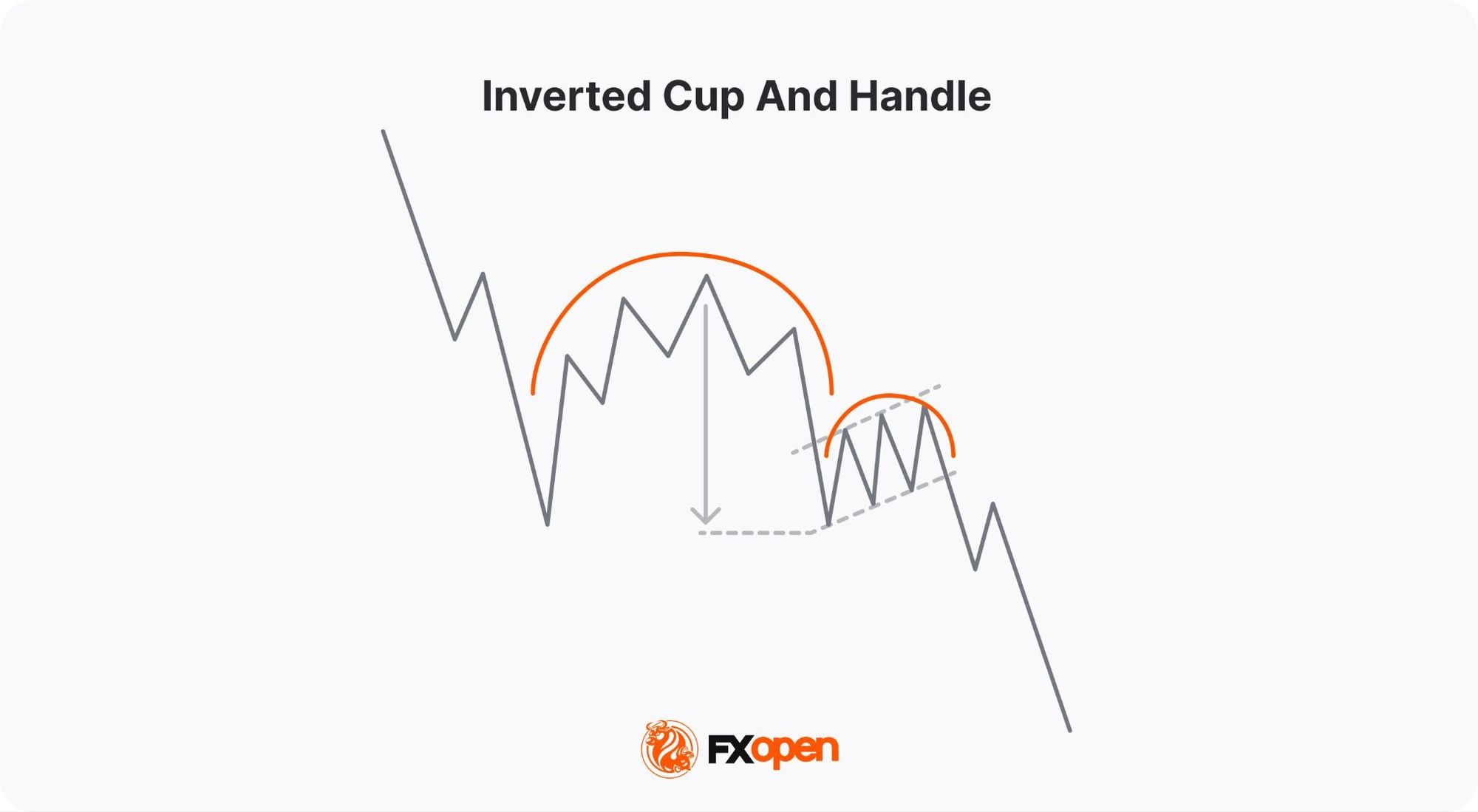
The inverted cup and handle, sometimes called an upside-down cup and handle pattern, is a bearish chart pattern that may appear during up- and downtrends. It is the opposite of the traditional cup and handle pattern, which is bullish. The inverse formation consists of three main parts: the "cup," which is an inverted U-shape, and the "handle," a small upward retracement following the cup, and a breakdown.
The pattern is the structural opposite of the cup and handle, which is a bullish chart formation. While the standard version signals a likely continuation of an uptrend, the inverted version points to potential weakness and a possible move lower once the neckline gives way. The pattern is recognised across many different asset classes and may appear on intraday, daily, and weekly charts.
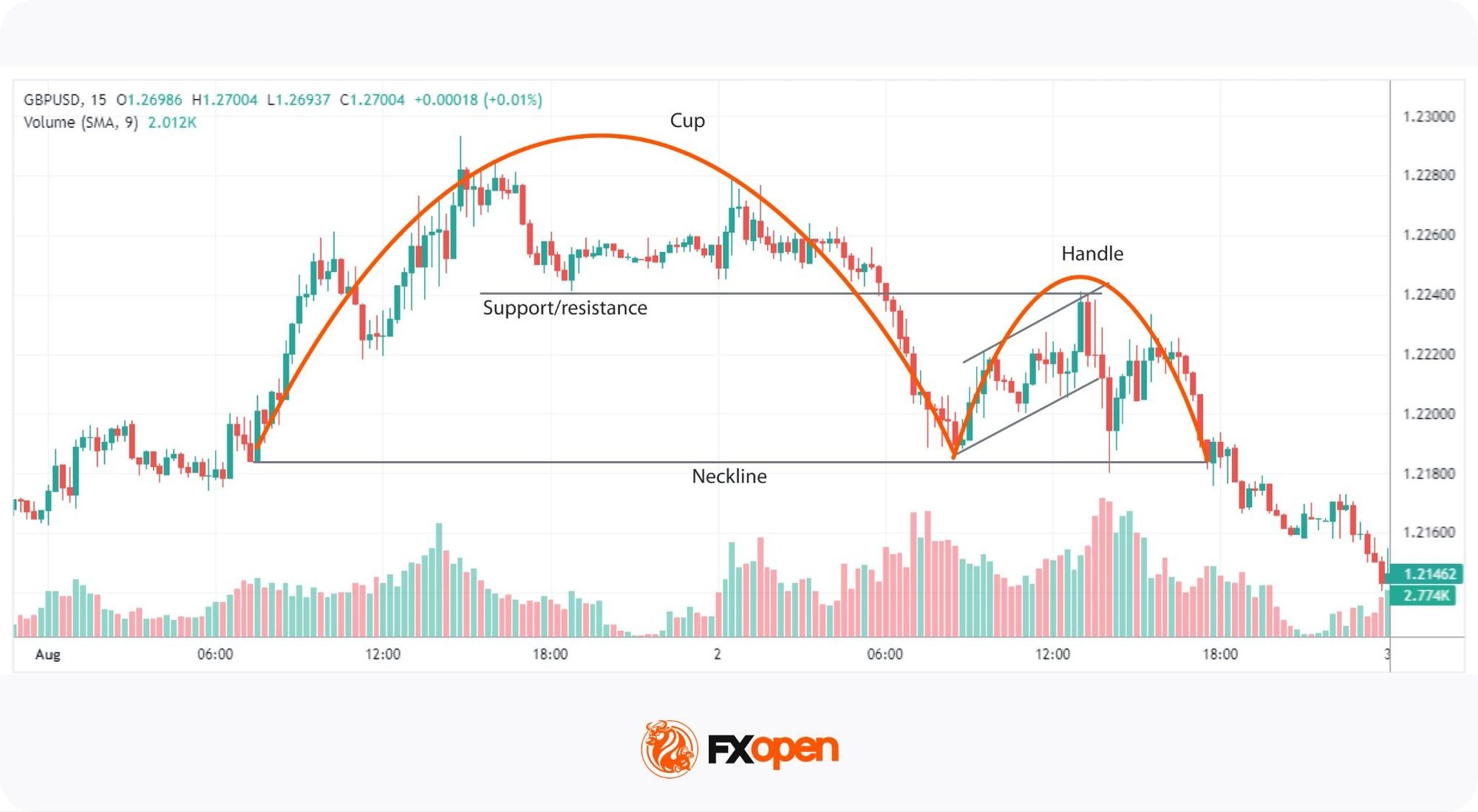
The inverse cup and handle pattern is built from three components — the cup, the handle, and the breakout — that develop in sequence. Typical rules are that the cup forms over a longer period than the handle (often a 3:1 to 5:1 duration ratio) and that the handle retraces no more than 50% of the cup's depth. Below, we’ll cover how to identify the reverse cup and handle pattern.
The cup begins with a gradual rise that flattens, consolidates, and then declines, forming an inverted U-shape. The top should be rounded rather than a sharp V, reflecting a gradual shift from buyers to sellers. Price action often shows narrowing volatility as the cup tops out, with the peak acting as a developing resistance level that sellers begin to defend on subsequent tests.
After the cup, prices retrace upwards to form the handle. An ideal handle pulls back no more than half the cup's depth and remains shorter in duration than the cup itself. The slope is usually slightly upward or sideways, and the handle often consolidates as a small flag or pennant before the eventual breakdown below the neckline.
The pattern is confirmed when prices break below the neckline (a line drawn through the two pivotal low points that frame the handle), ideally with a decisive bearish candle close and a notable increase in volume. Volume typically thins during the cup and handle and expands on the breakout, which may help validate the move. Prices sometimes retest the broken neckline as new resistance before continuing lower. Without these confirmations, false breakouts remain a risk, especially on lower timeframes.
The psychology of the reverse cup and handle pattern reflects a gradual shift from optimism to caution and then to outright bearish conviction.
The formation begins with a bullish strength, where demand drives prices higher. As the cup tops out, buyers thin out, profit-taking accelerates, and buying pressure weakens against firm overhead resistance. The rounded decline signals that conviction is fading rather than collapsing in a single move.
The handle is a brief upward retracement that often traps optimistic buyers expecting the uptrend to resume. It can act as a dead cat bounce, with liquidity drying up on the way up and re-emerging on the sell side. A break below the neckline tends to confirm the shift, with the volume surge reflecting sellers taking control and stranded buyers cutting positions.
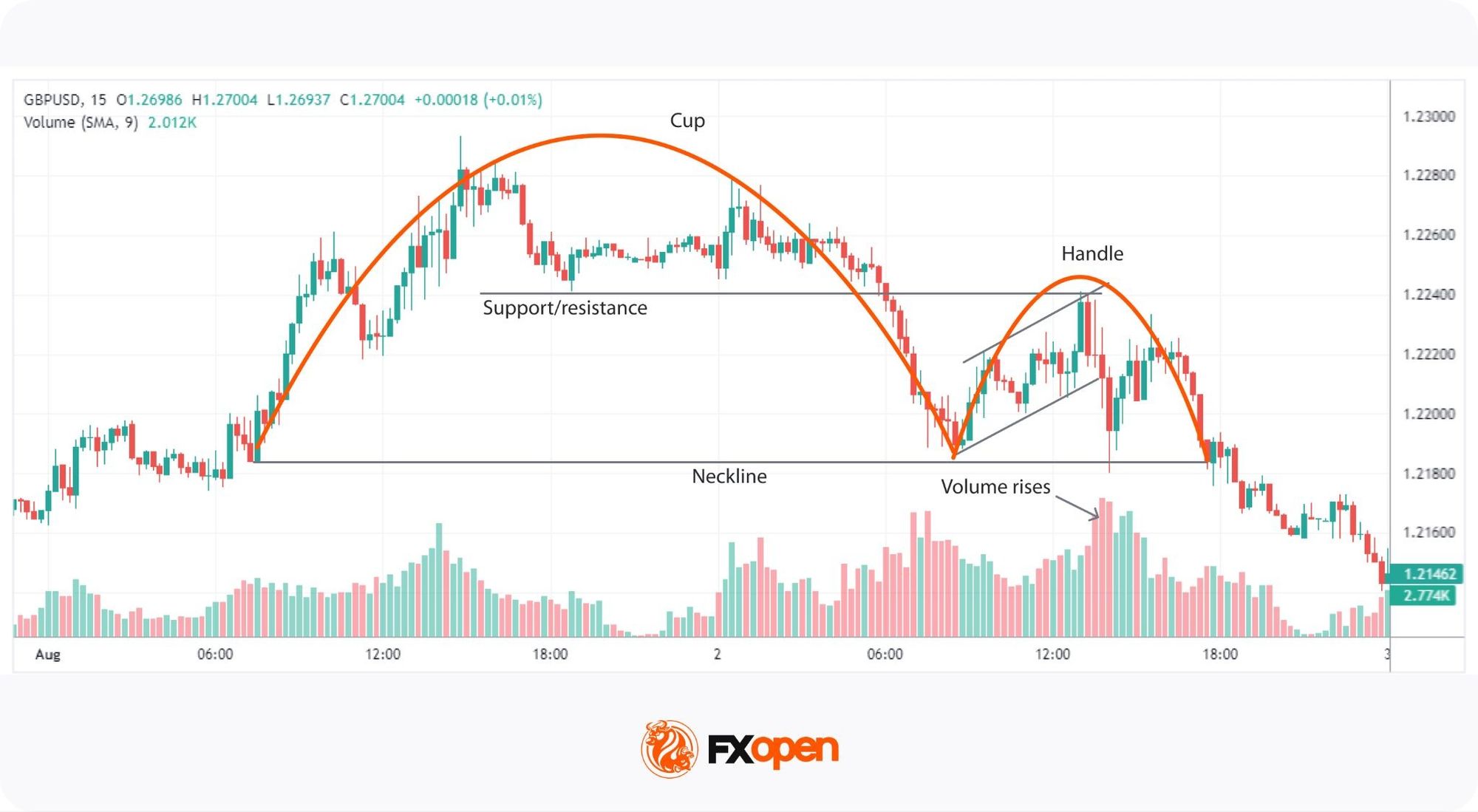
Trading the inverted cup and handle pattern involves careful identification and strategic decision-making to maximise its potential. This pattern presents two primary entry points for traders: during the handle formation or after the neckline break.
When trading the inverted cup and handle reversal pattern, several issues come up repeatedly:
Like any chart pattern in trading CFDs and forex, the bearish cup and handle offers a structured read on price action while still being subject to the probability-driven nature of technical analysis. Outcomes vary, and confirmation is never guaranteed.
The inverted cup and handle is a bearish formation made up of a rounded inverted U, a small upward retracement, and a breakdown below the neckline. Confirmation typically comes from a decisive close below the neckline, supporting volume behaviour, and alignment with broader market conditions.
Want to put this and other patterns to the test on live charts? You can consider opening a forex trading account with FXOpen and access the TickTrader platform to trade 700+ markets.
The inverted cup and handle in forex is a bearish chart pattern. It features an inverted U-shaped cup followed by a small upward retracement (the handle). This pattern suggests that sellers are gaining control, and prices are likely to decline further once the neckline is broken.
Traders often enter positions either on the break of the handle’s lower boundary or after the neckline break. Entering during the handle might offer a stronger risk-to-reward ratio, while waiting for the neckline break could provide stronger confirmation.
After the reverse cup and handle pattern is completed, the price typically moves downward strongly. This bearish movement is often confirmed by a strong breakout below the neckline or handle with increased volume, signalling a sustained decline in prices.
The opposite of a cup and handle is the inverse cup and handle pattern. While the cup and handle indicates a bullish movement, the inverse version signals a bearish trend.
The inverted cup and handle pattern is bearish. It indicates that the price will move downwards, suggesting that traders may open short trades.
Traders often combine the inverted cup and handle with the RSI or stochastic oscillator for momentum, moving averages for trend context, and volume analysis to validate the neckline break. No single cup and handle reversal pattern indicator confirms the setup, so traders typically look for confluence across two or three tools.





