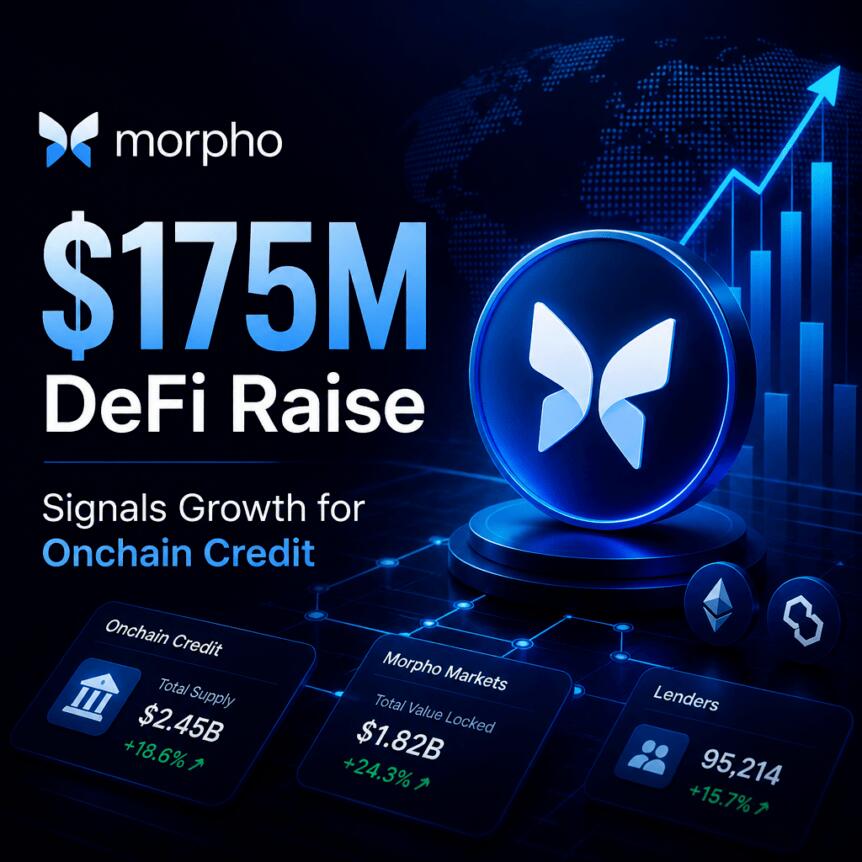
Investors are showing renewed interest in “onchain credit” and stablecoin-linked financial infrastructure, signaling a shift away from decentralized finance (DeFi) lending as a standalone retail product. That backdrop is helping a well-known lending protocol, Morpho Labs, raise fresh capital and frame its next phase as credit infrastructure for institutions.
According to Cointelegraph, Spark CEO Sam MacPherson said stablecoin growth is pushing the market to treat credit as a core layer in the onchain financial stack. He pointed to Morpho’s latest funding as an example of capital flowing toward stablecoin-enabled lending and credit tooling.
Morpho announced Tuesday that it raised $175 million in a round led by Paradigm, with a16z Crypto and Ribbit Capital also named as lead participants. While Morpho is already associated with DeFi lending, the company is using this round to pursue a broader role: becoming a credit infrastructure layer for more traditional finance players.
The concept centers on onchain credit markets—systems that let borrowers, lenders, and deploying institutions use blockchain-based assets to originate credit. In this framing, stablecoins and tokenized financial products provide the asset rails, while credit infrastructure provides the lending and deployment logic.
MacPherson, speaking to Cointelegraph, argued that as stablecoins scale, “credit becomes one of the most important pieces of infrastructure in the stack.” The implication for investors is straightforward: if tokenized money becomes more widely used, demand for the associated lending and credit services tends to follow.
One reason Morpho’s funding drew attention is the reported scale of its lending activity. The article cites DeFiLlama data showing Morpho with $6.72 billion in total value locked (TVL) and about $3.47 billion in active loans.
Sentora, in a Friday newsletter, interpreted these figures as evidence of “significant liquidity depth,” a point that matters because liquidity is often a key constraint for credit markets. Without sufficient borrowing and lending depth, credit products can struggle to scale in real-world conditions, particularly when institutions require consistent counterparties and stable execution.
Sentora also pointed to Coinbase’s use of Morpho smart contracts to originate more than $2.17 billion in corporate USDC loans. The underlying argument is that Morpho is increasingly being used for credit workflows that look more like institutional lending infrastructure than a purely retail DeFi application.
In that view, the shift isn’t isolated to crypto-native lending. Sentora said exchanges, custodians, and asset managers are actively evaluating blockchain-based lending systems to support credit products, while protocols compete to become the “underlying infrastructure” enabling business-to-business integrations.
Beyond raising capital, Morpho’s leadership said the real test will come from integration-driven growth over the next year to 18 months. Co-founder Merlin Egalite told Cointelegraph that the company aims to expand integrations with banks, asset managers, and large platforms, bring in more institutional capital, and roll out features inspired by traditional credit markets.
Egalite characterized the goal as building infrastructure rather than trying to replace existing competitors. “The problem we are trying to solve is less about replacing competitors and more about establishing ourselves as the credit infrastructure layer that banks, asset managers and fintechs build on,” he said in the report.
The timing of Morpho’s raise also reflects broader venture market dynamics. The article notes that venture capital is increasingly concentrating on a smaller set of established crypto infrastructure projects.
It cites CryptoRank’s Q1 2026 crypto fundraising report, which reported that capital allocated to Series C and later-stage rounds surged 1,020% year over year and 320% quarter over quarter. Those later-stage deals accounted for 28.4% of venture funding across nine deals, while seed and pre-seed funding fell 38.1% year over year and represented only 5.2% of total capital.
Against that backdrop, Egalite said he is not concerned about capital concentration, aligning with the thesis that durable infrastructure—protocols with measurable liquidity, integrations, and institutional usage—may be attracting disproportionate attention as the market matures.
For investors and builders watching onchain credit, the key question now is whether Morpho’s funding translates into sustained institutional integrations and repeatable credit origination. The next signal to track will be whether the protocol’s liquidity depth and contract-driven credit usage continue to grow alongside stablecoin adoption, and how quickly traditional finance partners operationalize blockchain-based lending at scale.
This article was originally published as Morpho’s $175M DeFi Raise Signals Growth for Onchain Credit on Crypto Breaking News – your trusted source for crypto news, Bitcoin news, and blockchain updates.





