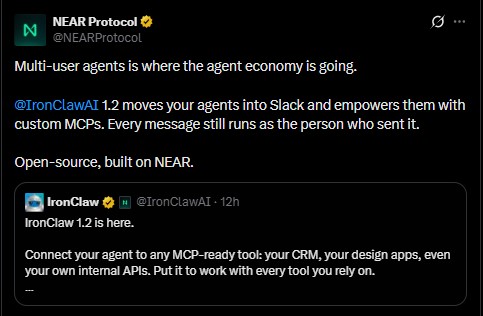
NEAR AI's open-source agent platform , IronClaw, has rolled out version 1.2.0, and this NEAR Protocol update brings a change that many teams using AI agents have been waiting for—one agent that an entire Slack channel or Telegram group can use together, without everyone sharing the same login.
Source: NEARProtocol on X
The update went live on August 13, 2026, according to the official GitHub release notes.
Until now, giving a whole team access to one AI agent usually meant a trade-off. Either everyone used the same account, which blurred who was actually asking for what, or the setup stayed limited to one person at a time.
Source: IronClawAI on X
IronClaw 1.2 tries to fix that by making shared access possible while still keeping each person's own identity attached to their own messages.
The core idea behind this release is simple to explain, even if the engineering behind it isn't.
Add IronClaw to a Slack channel or a Telegram group, and from that point on, anyone in that channel can talk to the agent and pick up right where a teammate left off.
But every message still runs as the person who sent it—their own memory, their own settings, and their own approval steps, not a shared or borrowed identity.
NEAR AI describes this design choice plainly in its release notes: shared access, not shared credentials.
That distinction is really what this update is about. It's not a new product—IronClaw has worked inside Slack and Telegram since its very first stable release, as NEAR AI explained when introducing IronClaw 1.0.
What's changed with this Near Protocol update is how a shared conversation behaves once more than one person is talking to the agent in it.
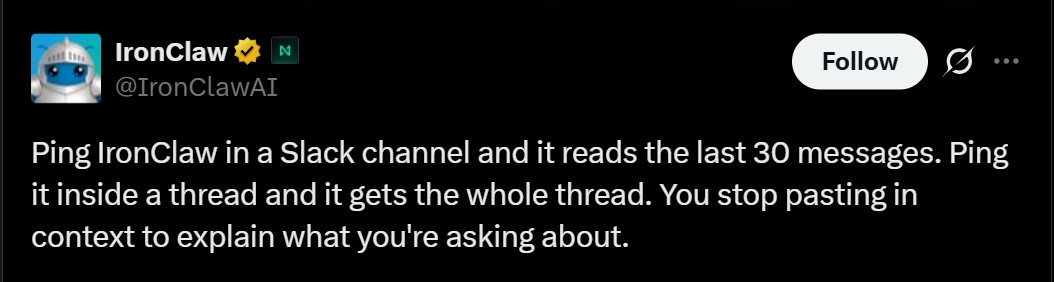
One of the more practical additions in 1.2 is context-awareness inside Slack. Ping IronClaw at the top of a channel, and it will pull in the last 30 messages so it understands what's being discussed.
Source: Iron-ClawAI on X
Ping it inside a thread instead, and it reads the whole thread, up to 100 replies deep. In everyday terms, that means less time spent explaining background information the agent could have simply seen for itself.
Telegram doesn't get quite the same treatment, and that's not a design oversight on NEAR AI's part — Telegram's own bot system doesn't allow reading past channel history the way Slack does.
So on Telegram, the agent only knows what it has personally been part of.
There's also a safety detail worth knowing about. Anything the agent reads from a public channel is treated as information to consider, not as a command to follow.
So if someone posts a message in a busy channel trying to trick the bot into doing something it shouldn't, that message is handled as ordinary conversation content—not an instruction the agent will act on.
NEAR Protocol AI's own notes put it well: reading the room doesn't mean taking orders from it.
Previously, admins had to manually approve which Slack channels or Telegram groups the bot was allowed to work in.
That allowlist step is gone in 1.2. Now, if the bot has been added to a channel, it's automatically able to respond there — nothing extra to configure.
It's a small change on paper, but it removes a step that used to slow teams down when rolling the agent out more broadly.
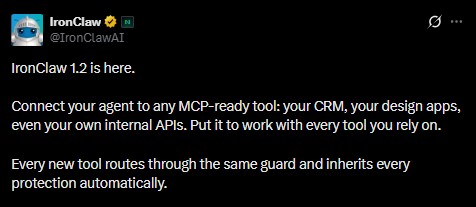
If you've seen IronClaw mentioned alongside phrases like "connect your agent to any tool," it's worth knowing that this particular capability—linking the agent to a company's CRM, internal software, or other systems through the MCP standard—actually arrived a version earlier, in Iranclaw 1.1, released on August 6, 2026.
What 1.2 adds is that these same tool connections now also work from inside a shared Slack or Telegram conversation, under the same per-person approval rules described above—rather than only in one-on-one chats.
| What changed | Version 1.2 (Aug 13) | |
| Connecting outside tools (MCP) | Introduced | Same, now usable in shared team chats |
| Adding the bot to Slack/Telegram | Needed manual channel approval | Works as soon as the bot is added |
| Reading channel context | Not available | Reads last 30 messages, or a full thread |
| Message identity in shared chats | Could route through one shared account | Always tied to the actual sender |
| Slack slash commands | Introduced | Unchanged |
| File attachments across channels | Introduced | Unchanged |
(Compiled from the official version-by-version release notes for 1.1.0 and 1.2.0.)
A visual worth considering: a simple graphic showing three teammates pinging the same Slack thread, each with a small icon showing their own identity attached to their own message, would make this "shared thread, separate identities" idea click faster than text alone.
It's fair to call this release simpler to deploy than before, but not completely configuration-free.
Slack still needs each person to connect their account through OAuth, and the bot itself needs a specific permission (called channels:history) switched on before it can read channel context at all.
Telegram pairing works through a code shared with each user. Installation itself is available through official installer scripts or downloadable builds for macOS, Windows, and Linux, all listed on the GitHub release page.
This isn't happening in isolation. NEAR AI has been building out IronClaw steadily—version 1.0 introduced Slack and Telegram support in the first place, version 1.1 added the ability to plug in outside tools, and now version 1.2 focuses on making those existing channels genuinely usable by a whole team at once, not just one person.
Each release has been narrower and more specific than the last, which is arguably a more sustainable way to ship agent's software than trying to do everything at once.
MCP (Model Context Protocol): A standard way for an AI agent's to plug into outside tools and data—like a CRM or internal software—instead of needing a custom integration for each one.
Agent's OS: A system that manages an AI agent's memory, permissions, and presence across different apps as one connected setup.
Approval gate: A pause point where a human has to say yes before the agent goes ahead with something sensitive.
Strip away the headlines, and IronClaw 1.2 turns out to be a fairly focused update: it lets a whole Slack or Telegram team share one agent without losing track of who's actually behind each message, and it removes some setup friction along the way.
The tool-connection story people often mention alongside this release actually started with the previous version. Either way, this Near Protocol update is a reasonable next step in NEAR AI's slow, version-by-version build-out of IronClaw—and anyone planning to deploy it.
This article is for educational and informational purposes only and should not be considered financial or investment advice. Cryptocurrency and equity markets are volatile, and figures cited reflect a specific point in time. Always conduct your own research and consult a licensed financial advisor before making investment decisions.





