Bitcoin has entered a deep bear-market valuation zone, meaning several on-chain and sentiment metrics now sit at levels that historically appear near major market bottoms. But "bottom valuation zone" is not the same as a confirmed bottom. As of mid-June 2026, the evidence is genuinely two-sided: Bitcoin looks historically cheap by on-chain measures, yet analysts warn that the hardest phase — a slow, grinding sideways market — may still lie ahead. The near-term direction likely hinges on the June 16–17 Federal Reserve meeting.
Here is what the data actually shows, metric by metric.
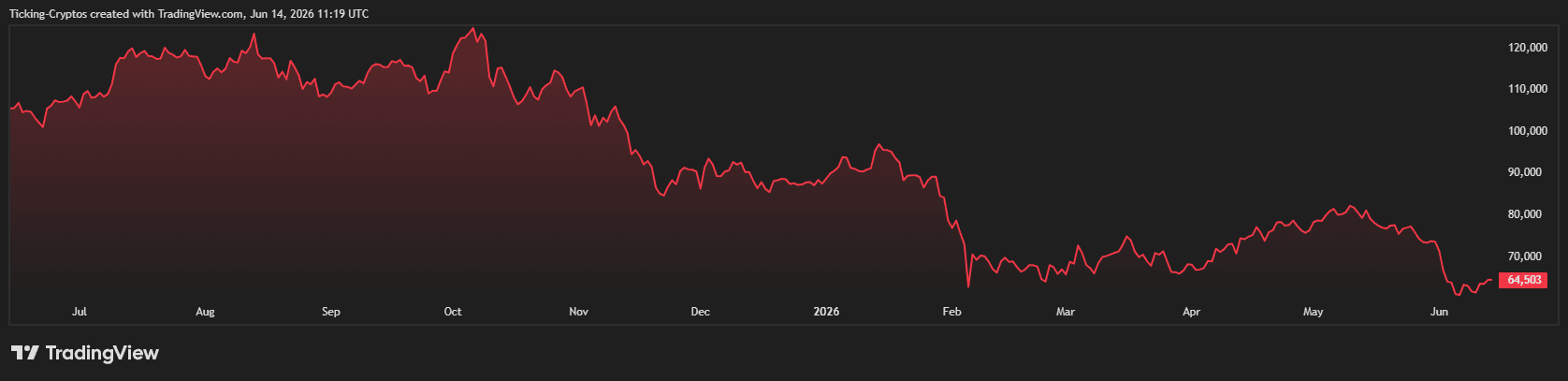
$Bitcoin recently hit its lowest levels in roughly two years. Bitcoin briefly fell below $60,000 for the first time since 2024 before rebounding to around $62,623, up 1.9% on the day but still posting a weekly loss. The price is now resting on a long-term support line that technical analysts treat as a generational floor. Bitcoin is trading near its historically depressed 200-week average, a level typically seen late in bear markets, even after the hottest U.S. inflation reading in three years.
The key support and resistance levels to watch are clear. Immediate support sits at $62,000–63,000, then the $60,000 psychological line, with $55,000–58,000 as the deeper stress zone; resistance is the $70,000–74,000 band, and a weekly close on either side of $60,000 is the near-term tell.
The strongest argument that Bitcoin is near a bottom comes from on-chain valuation, specifically the realized price — the average price at which all circulating Bitcoin last moved, which acts as the network's aggregate cost basis. Current on-chain data places Bitcoin's realized price near $54,000 and the average cost basis of long-term holders around $48,000 — levels that have historically served as critical support zones during previous market cycles.
This matters because of what trading below realized price signals. When Bitcoin trades below its realized price, the average holder is underwater, and prolonged trading below that level has been rare and often associated with major bear-market bottoms. Other valuation frameworks agree the discount is steep. Checkonchain places Bitcoin's current valuation in the bottom 10% of its historical range, a zone that has frequently appeared during the weakest phases of market cycles. Some analysts name a specific floor: CryptoQuant flags $53,600 as the structural bottom zone, with the 14-day RSI at 24, deep in oversold territory.
Market sentiment has washed out to levels that typically accompany capitulation. The Crypto Fear and Greed Index sits at 21, deep in extreme fear, down from 50 last month — readings that usually appear when price-sensitive sellers have already done most of their selling. Historically, fear readings have clustered near local and cyclical lows, because they indicate that the holders most likely to panic-sell have largely already exited.
Here is the crucial counterpoint, and the reason a "bottom valuation zone" is not a green light. A market bottom is usually a process that unfolds over months, not a single dramatic low. As on-chain analyst Checkonchain explains, bear-market bottoms are a process, not an event: first price-sensitive investors capitulate, then comes the harder phase of months of sideways action that slowly wear down the conviction of those who remain.
In practical terms, Bitcoin can be at a historic valuation discount while the time dimension of the bottom has not yet played out. That is the trap for impatient buyers: being correct on value, yet enduring an extended grind before any durable recovery begins.
Bitcoin is not falling in isolation, and the broader backdrop is pressuring all risk assets. Global equities fell to a more-than-one-month low as a technology-led selloff deepened and US forces struck multiple targets in Iran, collapsing the ceasefire that had held since April, while Brent crude rose toward $95 a barrel. Regulatory optimism has cooled too. Hopes for US regulatory clarity weakened again, with Polymarket odds of the Clarity Act passing in 2026 dropping from 62% to 48% in a week.
The single biggest near-term catalyst is the Federal Reserve. All eyes turn to the FOMC on June 16–17, with Wirex's head of trading saying Fed Chair Warsh's tone will be decisive in determining whether Bitcoin bounces toward $68–72K or breaks below $60K entirely.
By valuation, Bitcoin is in a zone that has historically rewarded patient buyers: realized price near $54,000, long-term holder cost basis around $48,000, sentiment at single-digit extreme fear, and price pinned to its 200-week average. By timing, the same analysts flagging that discount caution that bottoms are slow processes, and a months-long sideways grind is a more likely path than a clean V-shaped recovery. The honest answer is that Bitcoin is near a bottom valuation, but whether the price bottom is in depends heavily on macro conditions — with the June 16–17 Fed meeting and a weekly close around $60,000 as the immediate signals to watch.





