It is common knowledge that assets that show strength during corrections often lead the market when it turns. UChain isn’t just holding during this correction. It’s growing.
$UCN is UChain’s native L1 coin. Its rise rests on three factors:
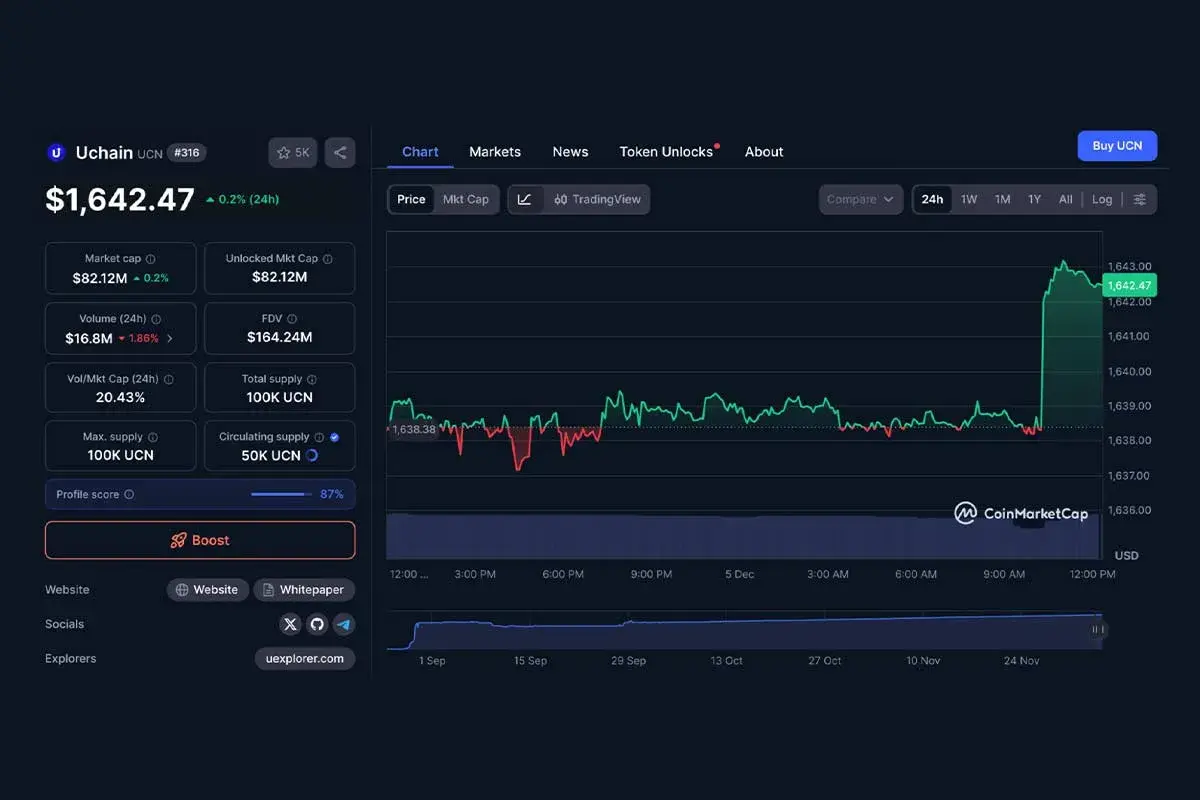
100,000 UCN. That’s the total supply. Forever. Additional minting is impossible because developers renounced contract ownership, as verified on UChain’s block explorer.
For context: Bitcoin has 21 million coins, which is 210 times $UCN’s supply. Most altcoins have billions or trillions in market caps, with no proof of backing.
Currently, 50,000 UCN circulate. The rest is locked in staking. UChain’s hyper-deflationary model gradually reduces the $UCN supply by burning tokens through transactions.
UChain is an L1 blockchain with its own suite of products for everyday use, both in crypto and real-world payments. Throughput exceeds 2,000 transactions per second, which is 100x faster than Ethereum, on par with Solana. Blocks form every 3 seconds.
The ecosystem includes:
The ecosystem offers different strategies: short-term algorithmic trading via UTrading and long-term investing through staking. Products link a card that tops up the wallet to a hardware key that protects it. Not just a collection of separate services. Infrastructure.
Solidity compatibility opens the network to developers: Ethereum dApps can port to UChain with minimal changes, gaining speed and lower fees.
$UCN serves three main functions within UChain:
With supply capped at 100,000 coins and a growing product base, $UCN usage is organic; it has functional demand, not speculative pump.
Several features are reportedly in the pipeline:
$UCN is a rare case. It has a hard supply cap, a working ecosystem, and organic demand.
Among smaller altcoins with unrealized growth potential, this combination is uncommon.
With a market cap of around $80M, there’s huge potential for asymmetric returns.
For those hunting asymmetric plays outside the top 20, $UCN might be an excellent choice.
To learn more about UChain, please visit: