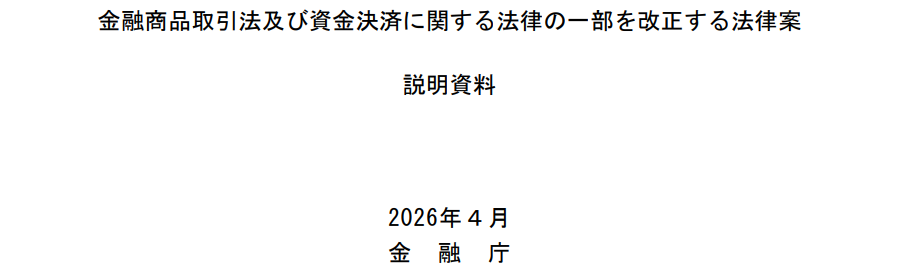
Japan crypto law in 2026 just cleared a major hurdle. On July 15, 2026, the House of Councillors approved amendments to the Financial Instruments and Exchange Act, moving digital assets out of payment-focused rules and into the same category as stocks and bonds.

Source: Official FSA Press Release
The bill passed the Lower House earlier this year. A full chamber vote in the Upper House now stands as a formality, since the ruling party holds control there.
This shift didn't happen overnight. Japan crypto rules first built in 2017 through the Payment Services Act, a response to the Mt. Gox hack that required exchanges to register, segregate user funds, and follow strict anti-money laundering checks.
By the mid-2020s, the government's stance changed direction. Officials began treating Web3 as a growth opportunity instead of a risk to contain, easing rules around corporate crypto holdings and setting the stage for this year's bigger reform.
Before this amendment, cryptocurrency sat under payment-focused oversight rather than securities law. That meant lighter disclosure requirements and no dedicated insider-trading rules for digital assets.
The new FIEA framework changes that setup directly. It expands the Financial Services Agency's oversight powers, bans insider trading tied to crypto assets, and requires mandatory issuer disclosures.
Penalties for unregistered firms and rule violations now reach up to 10 years in prison. Stablecoins and NFTs stay under the existing Payment Services Act for now, keeping their oversight separate from this new securities-style structure.
The reform itself takes effect in fiscal 2027. That timing opens a path for spot Bitcoin ETFs to list on the Tokyo Stock Exchange, with Japan Exchange Group targeting listings sometime in 2027, and some estimates pointing to late 2027 or 2028 for actual trading to begin.
Major financial firms are already preparing. SBI Securities, Rakuten, and Nomura are working on cryptocurrency investment trusts and ETF products ahead of the Bitcoin ETF launch date 2027 window.
Alongside the FIEA changes, Japan proposed cutting crypto taxes from a maximum rate of 55% down to a flat 20%. That new rate would match how stock market gains get taxed, starting January 1, 2028.
Right now, cryptocurrency profits count as miscellaneous income in Japan, which pushes rates as high as 55% for larger gains. A flat 20% rate removes that steep bracket entirely for qualifying digital asset gains.
Lower taxes tend to change investor behavior. Instead of rushing to sell before tax brackets climb higher, holders gain more reason to keep long-term positions and trade with a clearer sense of what they'll owe.
South Korea took its own step on July 14, 2026, announcing plans for a National Asset Basic Act. This would classify virtual assets as official national assets alongside land, real estate, and intellectual property, updating rules that date back to the 1950s.

Source: Yonhap Reporting (S. Korea Media Outlet)
Korea's approach leans more symbolic and asset-recognition focused. It builds on a 2024 user protection law and includes a planned 2027 pilot for tokenized government bonds through the Bank of Korea's digital currency system, plus new token securities rules starting February 2027.
Japan's path looks different in practice. It focuses on ETFs, tax alignment with stocks, and securities-style market rules, while Korea emphasizes legal recognition and infrastructure pilots for a retail trading base that already ranks among the world's largest by volume.
Detailed guidelines from the Financial Services Agency still need to arrive, covering disclosure standards, ETF product rules, and compliance requirements. The tax changes remain contingent on final legislative alignment before the 2028 start date.
Open questions remain around how regulators will handle decentralized protocols, how Japan coordinates internationally on anti-money laundering rules, and how NFT and stablecoin treatment might evolve separately down the road.
Startale Group's CEO has already called this shift the "Japanese Clarity Act," a nod to how directly it addresses long-standing questions about digital asset's legal status. What Japan's new cryptocurrency law means for investors comes down to one thing: clearer rules now stand between digital assets and the same regulatory treatment stocks and bonds have carried for decades, and the next two years will show how well that framework actually delivers.
Disclaimer: This article is for informational purposes only and does not constitute financial or investment advice. Cryptocurrency markets carry significant risk. Always do your own research before making any investment decisions.





