The wait is over. Kaskad has locked in its mainnet launch and MEXC launch dates. If you're watching the Kaspa space, this is a moment worth tracking.
Kaskad is a lending protocol. It lets users borrow and lend crypto on the Kaspa network without a bank or middleman. Think of it like a digital credit market — but fully open. No forms. No waiting.
It runs on Igra L2, Kaspa's Layer 2 network. The token is called KSKD and follows the ERC-20 standard.
Here's what's confirmed, date by date:
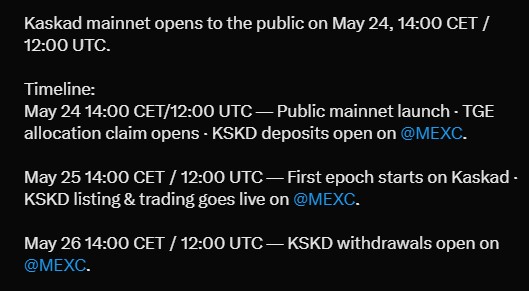
Source: X Post
May 24, 12:00 UTC — KSKD mainnet opens to the public. TGE allocation claims go live. Token deposits open on MEXC.
May 25, 12:00 UTC — First epoch begins. KSKD listing and trading starts on MEXC.
May 26, 12:00 UTC — KSKD withdrawals open on MEXC.
Each step is 24 hours apart. That's a tight, structured rollout. An "epoch" here means a 30-day operating cycle on the protocol — roughly one active lending period.
The total supply is 1,000,000,000 KSKD. That's 1 billion tokens. For context, Chainlink platform carries a similar token supply. It trades today at $9.17, with a market cap of $6.66 billion. Its all-time low was $0.1263. Its all-time high was $52.88.
Bullish case: If early demand is strong and the Kaspa DeFi space grows, it could list near $0.10. Medium-term, a move toward $0.50 is possible if adoption picks up.
Bearish case: New tokens often face selling pressure right after debut. Without steady protocol usage, it could list lower — closer to $0.01 to $0.05 — and stay flat in early weeks.
The listing price depends heavily on how many TGE holders sell on day one.
The first epoch starts on May 25. That's when the protocol actually begins operating.
Users can deposit, borrow, and earn yield. The real test begins then — not at listing.
Watch on-chain activity in the first epoch. That data will tell you more than any price chart.
The Kaskad listing date is May 25 on MEXC. The mainnet goes live a day earlier, on May 24 at 12:00 UTC. With a structured three-day rollout and a lending protocol backing the token, it enters the market with a clear use case. Whether prices follow depends on what happens inside that first 30-day epoch.





