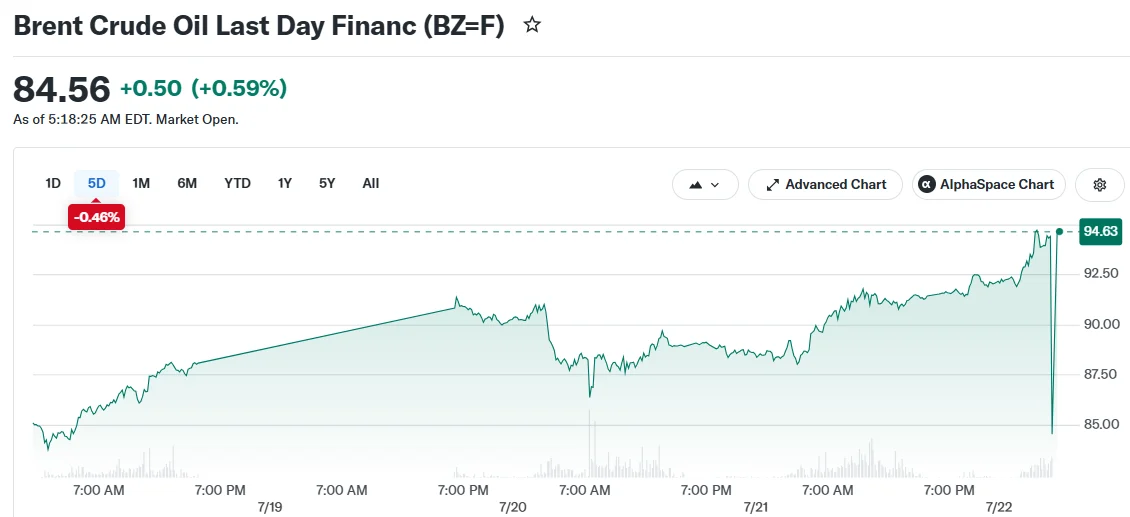
Global oil markets are experiencing a sharp rally. Brent crude surged to $94.13 per barrel while West Texas Intermediate touched $87.42, marking the highest prices for both benchmarks since June 11. The upward momentum represents the fourth consecutive day of increases, with gains recorded in six out of the past seven trading sessions.
The primary catalyst behind this price surge is the intensifying military confrontation between Washington and Tehran. On Wednesday, U.S. military forces conducted their eleventh consecutive night of operations against Iranian military infrastructure. The strikes targeted critical installations including missile batteries, drone launch facilities, command centers, and air defense networks.
Tehran has responded with its own military actions. Iranian forces executed counter-strikes against American military installations located in Bahrain, Kuwait, and Jordan. Additionally, Kuwaiti defense forces successfully intercepted Iranian unmanned aerial vehicles, further escalating regional instability.
During a Tuesday address, President Trump stated definitively that the United States has “no interest in meeting” with Iranian officials. Meanwhile, Secretary of State Marco Rubio indicated that diplomatic channels haven’t been completely closed, though he criticized Iran for violating agreements concerning passage through the Strait of Hormuz.
According to U.S. Central Command figures, Iranian forces have targeted over 30 commercial vessels during the previous three months. Despite American assurances that the Strait of Hormuz remains navigable, maritime insurance providers and energy traders remain skeptical without explicit guarantees from Iran to cease vessel attacks.
Energy markets face an additional challenge emerging from the Red Sea corridor. The Iranian-aligned Houthi movement in Yemen declared intentions to establish a blockade specifically targeting Saudi Arabian crude oil tankers traversing the Bab el-Mandeb Strait. Following this announcement, three Saudi vessels reversed their routes on Tuesday.
The implications for Saudi Arabia are significant. The kingdom had previously shifted tanker traffic away from the Strait of Hormuz due to Iranian military threats. The Red Sea passage represented one of the kingdom’s remaining viable export corridors.
Energy analysts at ING noted that any sustained blockade would necessitate routing tankers through alternative passages including the Suez Canal, substantially increasing voyage duration and transportation costs for Asia-bound shipments.
Supply chain concerns extend beyond Middle Eastern waters. Oil supplies from Kazakhstan encountered fresh obstacles when the Caspian Pipeline Consortium halted loading operations through Black Sea terminals. The suspension followed a series of attacks on tankers at a Russian export facility.
ING’s commodity analysts suggested that Brent crude trading just above $91 may not fully reflect current supply risks. “Particularly if these disruptions persist into August,” their analysis emphasized.
Regarding inventory levels, the American Petroleum Institute’s weekly report showed U.S. crude stockpiles increased by 2.6 million barrels, contrary to market forecasts predicting a drawdown. The official government statistics from the Energy Information Administration are scheduled for release Wednesday.
With ongoing military operations across multiple theaters and deteriorating shipping security surrounding both the Strait of Hormuz and Bab el-Mandeb, market analysts indicate that upward price pressure for crude oil is likely to intensify.
The post Crude Oil Surges to Six-Week Peak Amid Escalating U.S.-Iran Tensions appeared first on Blockonomi.





