The yellow metal continues its upward trajectory as market participants monitor forthcoming U.S. economic indicators and escalating diplomatic friction surrounding crucial Middle Eastern shipping channels.
Spot bullion advanced 0.4% to reach $4,407.79 per ounce during Tuesday’s trading session. Futures contracts gained 1.1% to settle at $4,467.59. This represents the metal’s strongest positioning in over eight weeks.
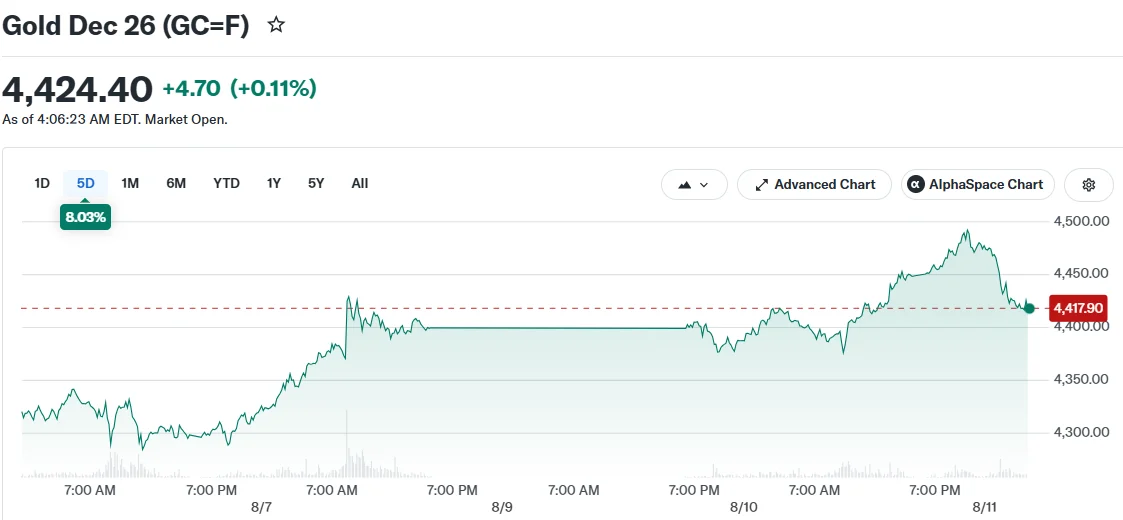
This upward momentum extends a robust two-day rally. The precious metal accumulated gains totaling 3.6% across Friday and Monday’s sessions, propelled by weaker-than-anticipated employment statistics for July.
Monday’s settlement around $4,390 represented the highest daily closing price in nearly ten weeks. The metal has staged an impressive comeback from its June nadir of $3,942.
Market participants are positioned ahead of Wednesday’s consumer inflation figures. Economic forecasters anticipate a modest 0.1% monthly increase for July, contrasting with the previous month’s 0.4% contraction.
The producer inflation index scheduled for Thursday will command equal attention. These combined datasets could significantly influence market expectations regarding the Federal Reserve’s monetary policy trajectory.
Current market pricing indicates a 52% probability of a rate increase in September, escalating to 81% likelihood by December, based on CME FedWatch analytics.
Beth Hammack, President of the Cleveland Federal Reserve, suggested that multiple rate adjustments may be necessary to achieve the 2% inflation target. She was among three policymakers who dissented from last month’s decision to maintain current rates.
Gold generates no yield, making it typically less attractive during periods of rising interest rates. Nevertheless, purchasing activity has resurged despite this conventional headwind.
Market strategists at IG attribute the rally to fear-of-missing-out sentiment, position closures by short sellers, and robust safe-haven appetite. Those who failed to capitalize on gold’s descent toward $4,000 are now pursuing the recovery.
The strategic waterway of Hormuz remains a significant concern. Iranian officials indicated progress toward an arrangement with Oman regarding alternative maritime routes, while emphasizing that Washington must satisfy additional prerequisites before the strait’s reopening.
President Donald Trump articulated fresh stipulations toward Iran during the week, diminishing prospects for an imminent resolution. Crude oil maintained a three-session winning streak in response.
Elevated oil prices amplify inflationary pressures, potentially compelling the Federal Reserve to sustain restrictive monetary conditions for an extended period. This dynamic presents a complex scenario for bullion investors.
Chinese demand continues to provide fundamental support. China’s central bank expanded its gold holdings in July by the largest margin since October 2023.
Chinese gold-backed exchange-traded products also registered heightened capital flows during the previous week, contributing additional buying pressure.
From a technical perspective, market analysts identify resistance within the $4,460 to $4,500 corridor. A decisive breach of this range could pave the way toward $5,000, though that target remains substantially above present valuations.
The precious metal still trades approximately 17% beneath levels observed before the Iran conflict commenced in late February.
The post Gold Surges Past $4,400 Mark Amid Inflation Concerns and Middle East Tensions appeared first on Blockonomi.





