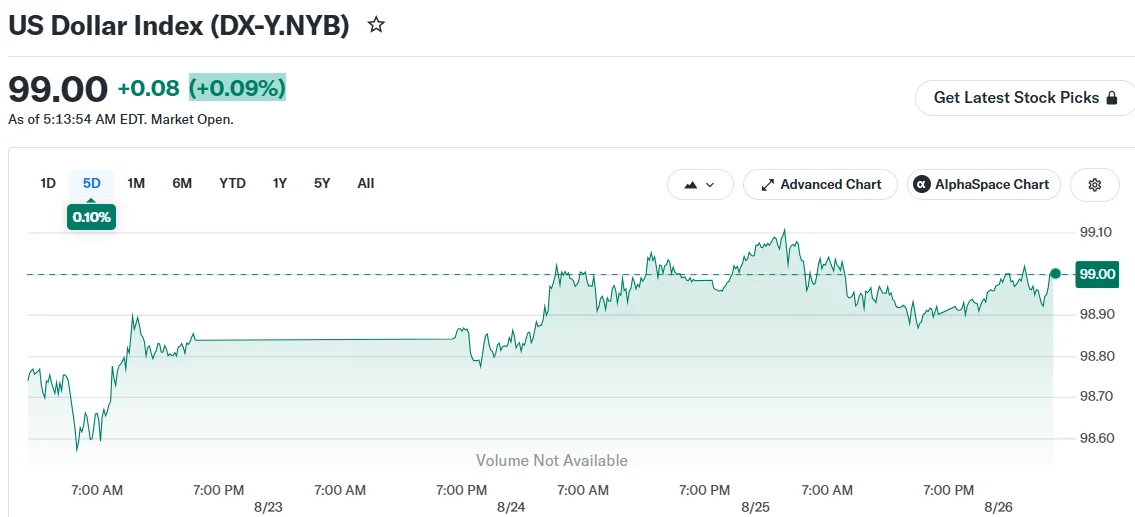
The greenback remained range-bound on Wednesday as market participants positioned themselves ahead of the Personal Consumption Expenditures price index release, widely regarded as the Federal Reserve’s favored inflation gauge. The U.S. Dollar Index consolidated around 99.00, maintaining proximity to the three-month trough established last week.
Consensus forecasts point to a 0.2% monthly increase in core PCE, maintaining consistency with the current annual trajectory. Currency strategists at ING noted that an on-target print would likely sustain the dollar’s current equilibrium, with minimal prospects for upward momentum.
This weekend’s Jackson Hole symposium remains firmly on the market’s horizon. The gathering may provide crucial insights into the Federal Reserve’s monetary policy trajectory.
While the U.S. Treasury’s enhanced debt repurchase initiative has provided modest relief to long-duration yields, market observers emphasize it fails to address fundamental concerns surrounding escalating sovereign debt levels and mounting interest obligations.
Australia’s currency emerged as a top performer during the trading session. The AUD/USD exchange rate advanced 0.3% to reach $0.718, marking its strongest level since early June.
Australia’s monthly consumer price index expanded 1.0% in July, surpassing the anticipated 0.8% increase. While the year-over-year rate moderated to 3.5% from 3.8%, it nevertheless exceeded consensus estimates of 3.2%.
The trimmed mean indicator, which serves as a key reference point for the Reserve Bank of Australia, posted a 0.5% monthly gain. Core inflation on an annual basis remained unchanged at 3.6%. Market pricing now reflects heightened expectations for a fourth RBA rate increase before year-end.
Canada’s currency continued to face headwinds. The USD/CAD exchange rate advanced 0.2% to C$1.39 following the collapse of bilateral trade discussions earlier this week.
The United States implemented 50% levies on approximately $20 billion worth of Canadian exports. Ottawa countered with proportional tariffs ranging from 15% to 50% on roughly $20 billion of American goods, scheduled to commence September 8.
Currency analysts at Danske Bank noted that these tit-for-tat measures introduce considerable uncertainty for enterprises across the border and threaten to disrupt pricing structures and logistics networks.
Japan’s currency held steady in the vicinity of 159.00. A recent Reuters survey indicated that the majority of economists now anticipate the Bank of Japan will tighten monetary policy earlier than previously projected, potentially as soon as September.
Gold declined below $4,630 after reaching a three-month zenith near $4,700 in the previous session. Brent crude surrendered over 2% to trade around $87 per barrel following Iran’s resumption of diplomatic engagement with Oman regarding the Strait of Hormuz, alleviating certain supply disruption concerns.
Nvidia is scheduled to release quarterly earnings following Wednesday’s market close, introducing another potentially significant catalyst to an already event-laden trading day.
The post Dollar Steadies Near 99.00 Ahead of Critical PCE Data and Nvidia (NVDA) Earnings appeared first on Blockonomi.





