Hyperliquid’s HYPE token reached an intraday high near $89.6 on September 6 before retracing back to $89.2 at the time of writing, reflecting 4.4% gain for the session after surpassing its previous peak near $86.71.
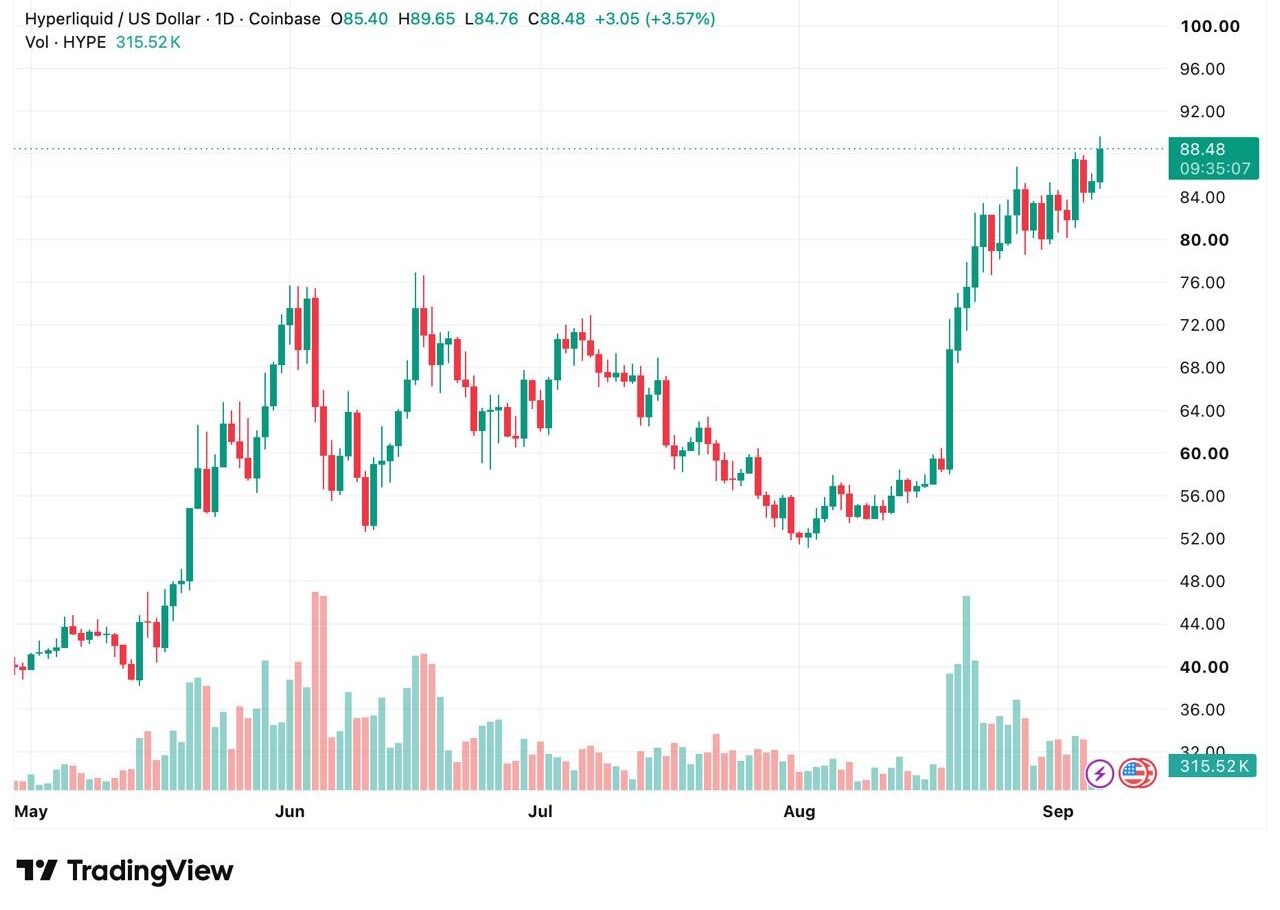
With no historical trading range above the former high, the chart cannot provide an established resistance level. The next round number is $90, but the daily close relative to $86-$87 will offer a more useful test than a brief move above that psychological threshold.
$86-$87
The previous high and closest support. Holding this area would keep the breakout intact.
$84-$85
This recent consolidation area becomes the next support if the former high fails.
$80-$82
A break below this range would erase most of the latest breakout.
Hyperliquid had generated more than $1.2 billion in cumulative trading fees by July. The relationship between that activity and the token was examined in an analysis of Hyperliquid’s $1.2 billion fee engine.
Under the protocol’s official fee rules, the Assistance Fund uses its allocation of fees to purchase HYPE automatically. The acquired tokens are burned, reducing both circulating and total supply.
This gives Hyperliquid’s trading business a measurable connection to HYPE. Continued activity can support purchases by the fund, although holders do not receive fee distributions or acquire a legal claim on the platform’s revenue. Only part of the fee stream reaches the Assistance Fund, with other portions directed to liquidity providers, market deployers and community-controlled components.
The mechanism supports the token’s utility case without explaining the timing of every price move. Its future effect will depend on trading activity, fee rates and the share allocated to HYPE purchases.
President Donald Trump brought Hyperliquid into the U.S. policy discussion in August when he said the Commodity Futures Trading Commission was working to bring the platform into the country in a compliant and legal form. The comment appeared among Trump’s wider remarks on Hyperliquid and U.S. crypto policy.
A compliant route could expand Hyperliquid’s addressable market, but Trump’s statement did not initiate or approve one. Hyperliquid Strategies later cited the remark in an SEC-filed release while acknowledging that no application, registration, exemptive relief or rulemaking involving Hyperliquid had been granted or, to its knowledge, was pending before the CFTC.
Bitcoin was trading near $79,500 as gains spread across several large-cap cryptocurrencies. The improvement had already moved beyond BTC when the broader crypto market returned to positive territory earlier in September.
Zcash provided another example of that widening participation. After an earlier ZEC rally pushed the token toward $1,000, its September 6 session showed another 13% gain and an intraday high above $1,200.
The simultaneous advances show that the recovery was not confined to Bitcoin, although they do not establish that capital moved directly from BTC into HYPE or ZEC. The tokens also carry different investment cases: HYPE is connected to exchange activity and token burns, while demand for Zcash includes a separate focus on financial privacy.
Broader market strength can help a token sustain a breakout, but it also creates shared downside risk. A reversal in Bitcoin or a wider reduction in demand for speculative assets could pressure HYPE even if activity on Hyperliquid remains healthy.
This article is provided for informational purposes only and does not constitute investment advice. Cryptocurrency prices and market data can change rapidly after publication.
The post HYPE Hits New All-Time High Near $90 – Can the Breakout Hold? appeared first on Coindoo.