Key Takeaways:
CME Group, one of the world’s most important derivatives exchanges, halted trading after a cooling failure at its CyrusOne data centers. The interruption hit every futures and options contract on the Globex electronic platform including crypto-related derivatives that institutions rely on for hedging and price discovery.
The incident instantly created one of the most disruptive moments for institutional crypto markets this year.
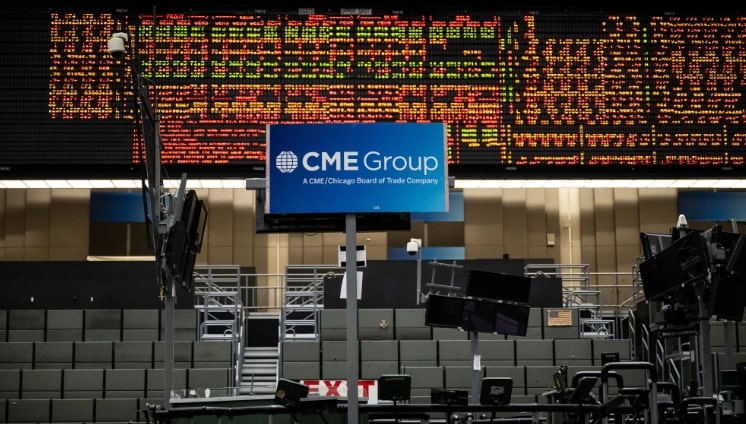
CME announced the halt on its official X account, stating that markets were paused while engineers worked to restore operations at the affected data centers. Although outages in traditional financial markets do happen, a full freeze of CME’s crypto complex is unusually rare and it happened during a high-volatility period for digital assets.
The outage caused Bitcoin and Ethereum futures to stop printing fresh prices. For institutions that rely on CME products for regulated exposure, the freeze meant no ability to roll positions, hedge intraday risk, or adjust basis trades.
BTC futures last updated around 21:44 ET, leaving traders effectively blind on one of the most liquid crypto derivatives globally. Options were frozen as well, interrupting market-making activity tied to implied volatility curves.
Offshore platforms quickly became the temporary fallback. Binance, OKX and Bybit all saw sharp increases in order flow within 20 minutes of the CME stall, according to liquidity-tracking dashboards used by institutional desks. Spreads widened, signaling the stress placed on crypto markets when a major price reference suddenly disappears.
Read More: Polymarket Gets CFTC Green Light – Crypto Prediction Markets Re-Enter U.S. with Full Regulation
Despite the 24/7 crypto trades, institutional investors continue to use the CME futures as a reference point on their prices. For example:
A stop on CME thus has many consequences much further than the exchange itself.
Arbitrageurs that operated between CME and offshore markets were caught unawares. Having frozen CME prices meant that spread models were broken and without warning delta-neutral trades turned directional.
Some of the derivatives desks indicated that they had to turn off automated trading systems by hand to prevent exposing themselves to mispricing. Bots that rely on CME inputs such as options skew and surface volatility inputs failed to behave normally.
Another unusual problem that risk managers have encountered was the absence of any solid futures curve to consult as the crypto spot markets kept floating. This prompted certain institutions to either de-leverage or shut positions until CME gave signals of a pre-open schedule.
Read More: Coinbase Pulls DeFi Power Players – Poaches Opyn Team to Supercharge On-Chain Derivatives Push

Cooling failures are not common, but when they occur inside high-density trading environments, servers must be powered down to prevent hardware damage. CME relies on CyrusOne facilities, which operate dozens of data centers worldwide. Even a short temperature spike can force immediate shutdowns.
In modern derivatives markets, physical infrastructure issues can freeze digital trading just as effectively as software bugs. Over the past decade, major exchanges in Europe and Asia have experienced outages tied to hardware failures, though none caused a freeze as broad as CME’s halt this week.

The disruption also affected the EBS foreign-exchange platform, another key pricing venue. While FX traders can easily switch to alternative platforms, crypto traders had fewer options because CME plays a specific role as the regulated benchmark for institutional digital-asset derivatives.
Within 30 minutes of the outage, Bitcoin’s spot price briefly whipsawed as liquidity routed to offshore markets. While the moves were not catastrophic, the behavior illustrated how dependent the crypto ecosystem has become on CME’s institutional rails.
The post CME Outage Freezes Over $2 Trillion in Crypto-Linked Futures as Cooling Failure Halts Trading appeared first on CryptoNinjas.





