Bitcoin struggled to hold above $80,000, an area that already overlaps with a broader on-chain supply wall and the aggregate cost basis of US spot ETF holders. Two CryptoQuant readings add another layer to that resistance, although they measure different parts of the market.
Bitcoin held in wallets labeled as belonging to Binance rose from approximately 617,000 BTC in late April to about 685,000 BTC at the end of August, according to CryptoQuant data. That was the exchange’s highest reserve reading of 2026.
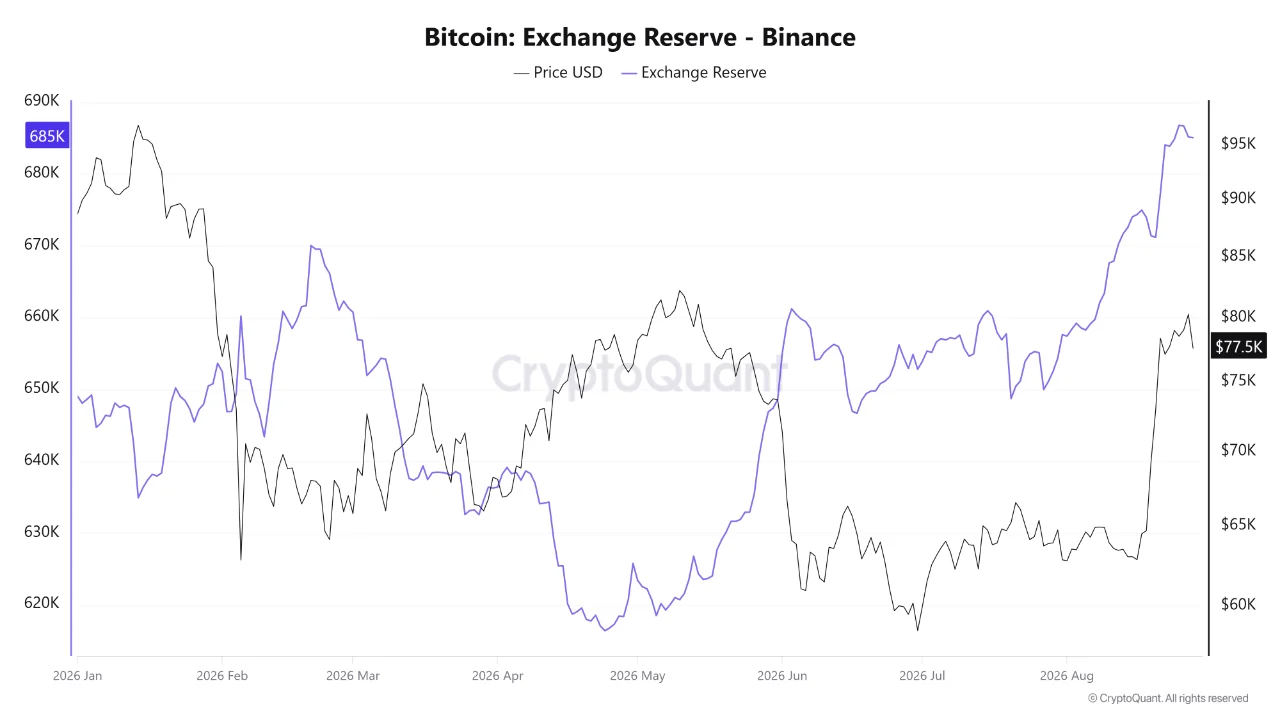
The increase matters because more Bitcoin is available within Binance’s exchange infrastructure. Holders can transfer those coins into the spot market more easily than assets kept in self-custody.
However, an exchange reserve is not an order-book measure. It does not show how much Bitcoin has been offered for sale or at what price. Wallet reorganizations, custody transfers, collateral movements and market-making activity can also change the balance.
The reserve increase therefore raises the market’s capacity to sell; it does not prove that a sale has occurred. Confirmation would require supporting evidence from net inflows, large deposits and spot trading volume.
The Short-Term Holder Spent Output Profit Ratio tracks Bitcoin spent after being held for between one hour and 155 days. A reading of 1 means those coins moved at their aggregate cost basis. A reading above 1 indicates realized profit, while a reading below 1 indicates realized loss.
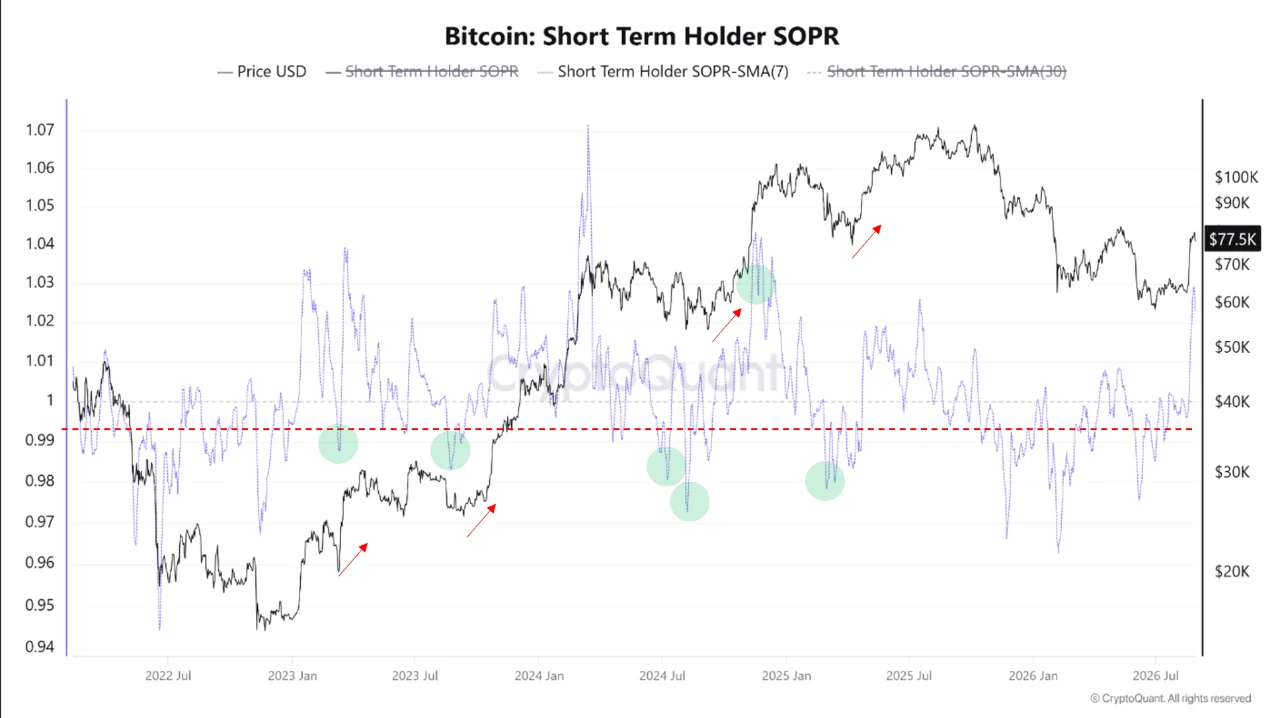
Bitcoin’s seven-day average STH-SOPR recently climbed to approximately 1.03, according to a separate CryptoQuant analysis. In simple terms, the short-term coins being spent were realizing an average profit rather than hovering at breakeven.
That is a sign of increasing profit-taking, but it is not enough to declare a market top. STH-SOPR covers only coins that moved, not every coin held by a recent buyer. It also does not identify the owner as a retail trader, show where the Bitcoin went or confirm that it was sold on an exchange.
| Metric | What it measures | Latest cited reading | What it cannot prove |
|---|---|---|---|
| Binance Bitcoin reserve | BTC held in Binance-labeled wallets | About 685,000 BTC | That the coins are listed for sale |
| STH-SOPR, seven-day average | Profit or loss realized by recently acquired coins when spent | About 1.03 | Who spent the coins or where they went |
The reserve figure measures location: more Bitcoin sits inside Binance’s wallet network. STH-SOPR measures behavior: recently acquired coins are moving at a profit.
The two readings can rise together without describing the same transaction. Some profitable short-term coins may be heading to Binance, but the figures alone do not establish that link. Presenting them as opposite forces creates a conflict that the data does not show.
The reserve and STH-SOPR readings become more useful when other data confirms whether available supply is reaching the market.
The bearish case would strengthen if Binance reserves continue rising while net inflows, large deposits and spot sell volume accelerate. A sustained STH-SOPR above 1 would then show that profitable short-term coins are adding to the pressure.
The warning would weaken if Binance reserves level off or decline while spot demand absorbs profit-taking near $80,000. That combination would suggest the market is processing available supply rather than building an increasingly crowded exit.
Bitcoin does not face a proven “supply wall” simply because Binance’s reserve balance reached a yearly high. The data shows that more BTC is available inside the exchange and that recently acquired coins are being spent at a profit. It does not show that all of those coins are waiting to be sold.
The next useful signal will come from how the market responds. If spot buyers absorb the available supply and Bitcoin holds above resistance, the reserve increase may prove manageable. If deposits and realized profits keep rising while price repeatedly fails near $80,000, the risk of a deeper pullback becomes harder to dismiss.
Disclaimer: This article is for informational purposes only and does not constitute financial or investment advice. Cryptocurrency markets are volatile, and readers should conduct independent research before making financial decisions.
The post Bitcoin Selling Risk Flashes Across Two On-Chain Metrics appeared first on Coindoo.





