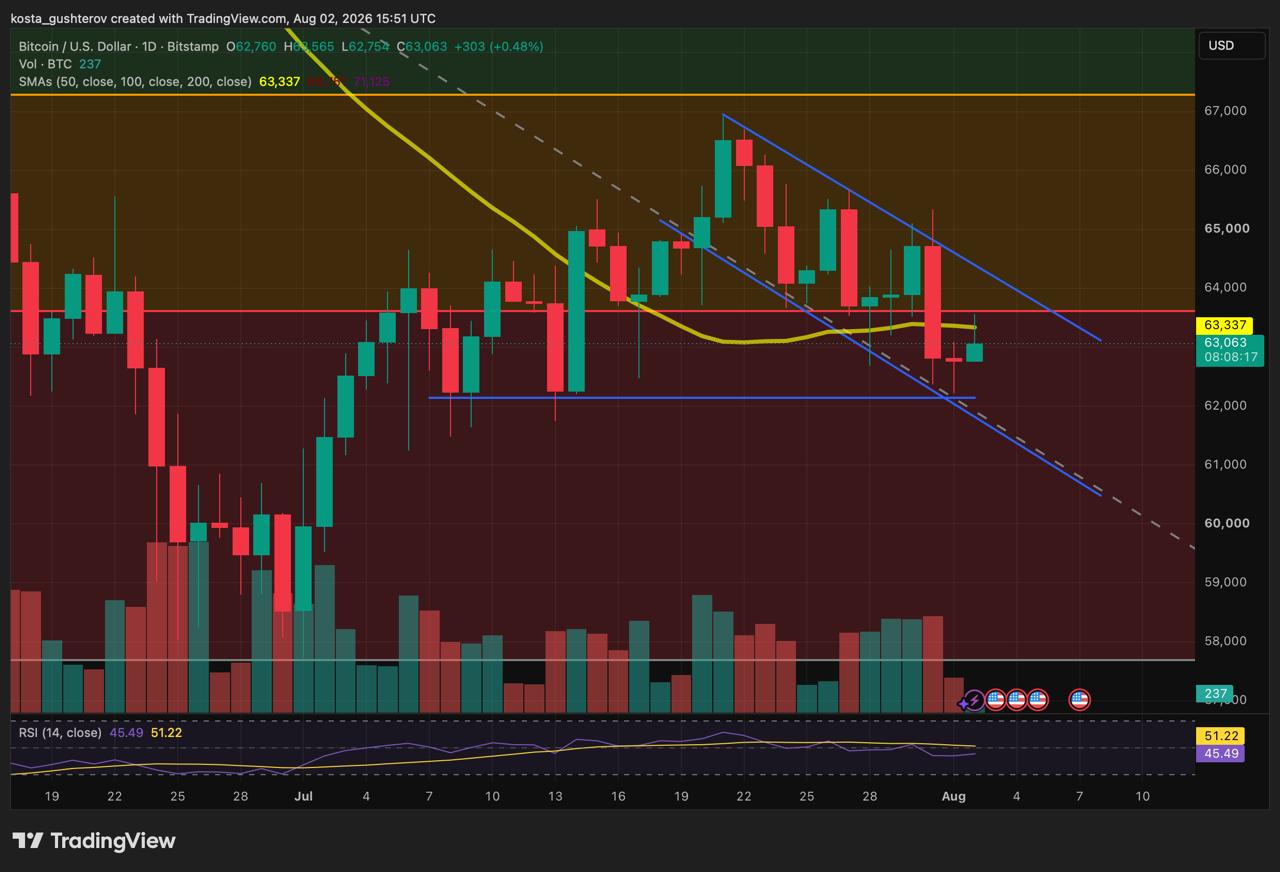
Bitcoin’s August 1 decline stopped near the support highlighted in our previous analysis.
The horizontal level around $62,100 had already stopped pullbacks on July 9 and July 14. It also sat close to the lower boundary of the descending channel, creating a narrow support area rather than an exact overlap.
Bitcoin began the August 2 session near $62,700 and moved up to test the 50-day simple moving average around $63,300. Price has since returned to approximately $63,050 at the time of writing, leaving the daily candle below the average.
The 0.236 Fibonacci retracement near $63,600 was not reached and remains intact as resistance, leaving Bitcoin inside the descending channel that has guided price lower since July 21.
The weak follow-through came alongside a sharp increase in exchange inflows from coins that had remained inactive for between two and seven years, according to a CryptoQuant analysis. The data does not prove that these transfers caused the failed rebound, but it shows that more dormant supply was becoming available while US spot demand remained subdued.
Inflows from the three-to-five-year cohort rose approximately 595% above their quarterly baseline, while the five-to-seven-year group increased by around 1,016%.
Those percentages were amplified by relatively low starting levels, but the increase appeared across several age groups. Spending from the two-to-three-year cohort represented approximately $315 million in realized value, while the three-to-five-year group accounted for another $216 million.
An exchange deposit does not prove that the holder will sell. It places the coins where they can be traded more easily.
Coinbase recorded net flows approximately 1,423% above its 90-day baseline, while inflows from three-to-five-year-old coins rose by about 1,014%.
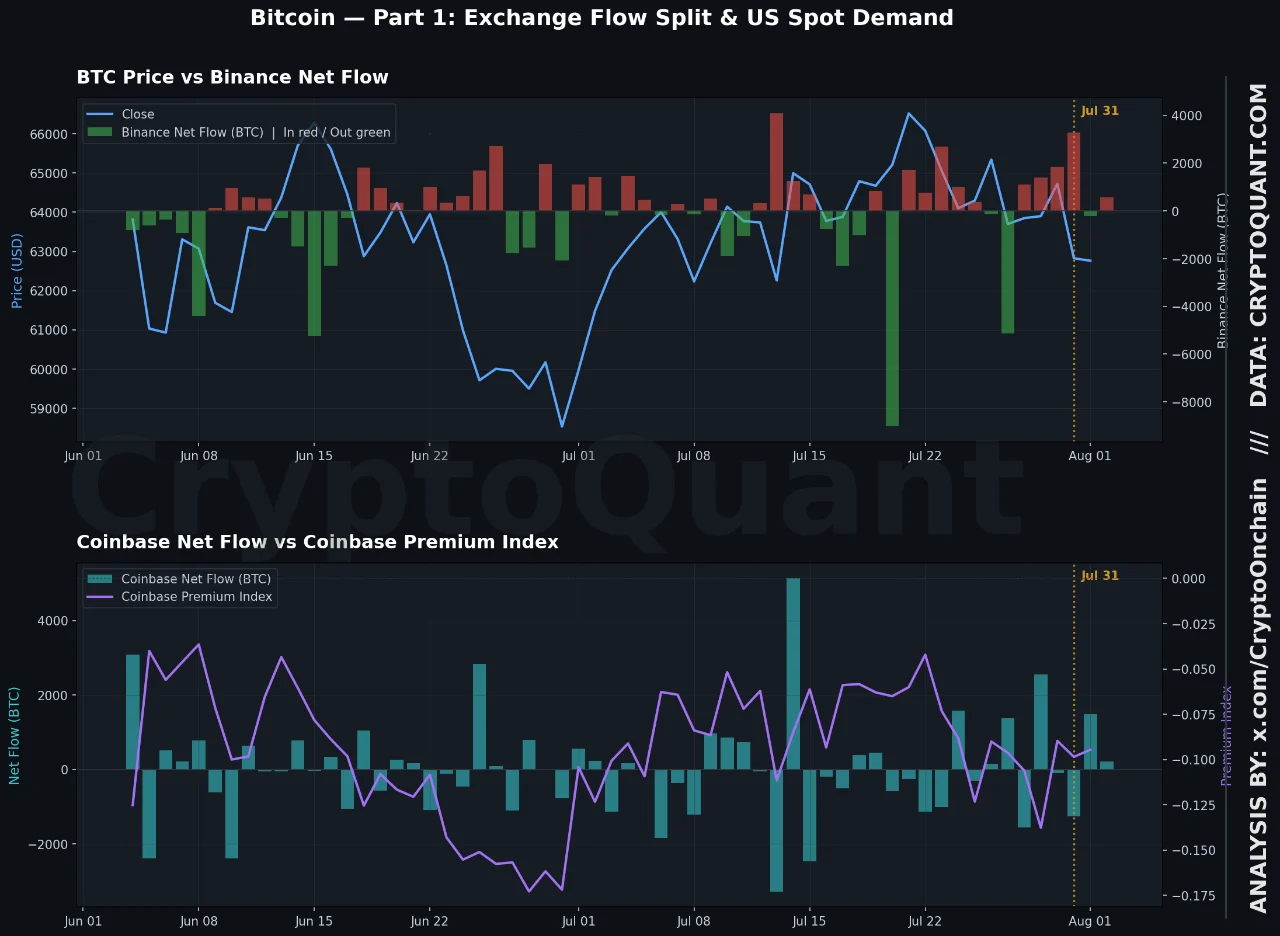
During the same period, the Coinbase Premium remained between -0.09 and -0.14, its weakest stretch in two weeks. The negative reading means Bitcoin traded more cheaply on Coinbase than on comparable offshore markets, indicating weaker demand from US spot buyers.
More dormant supply was therefore reaching Coinbase while buyers on the platform were not paying a premium. That could make rebounds harder to sustain, although it does not prove that the inflows caused Bitcoin’s rejection at the moving average.
The activity also falls short of showing a broad exit by long-term holders. Binance recorded steadier inflows rather than the same concentrated increase, suggesting that part of the movement may have been specific to Coinbase.
Binance funding remained close to neutral at between 0.00 and 0.01, showing that traders had not built a heavily leveraged position in either direction.
The current weakness is therefore developing without the liquidation pressure normally associated with a crowded futures market.
The duration of the aged-coin inflows now matters more than the initial percentage increase. A brief rise may be absorbed, while continued deposits alongside a negative Coinbase Premium would leave more available supply facing weak US spot demand.
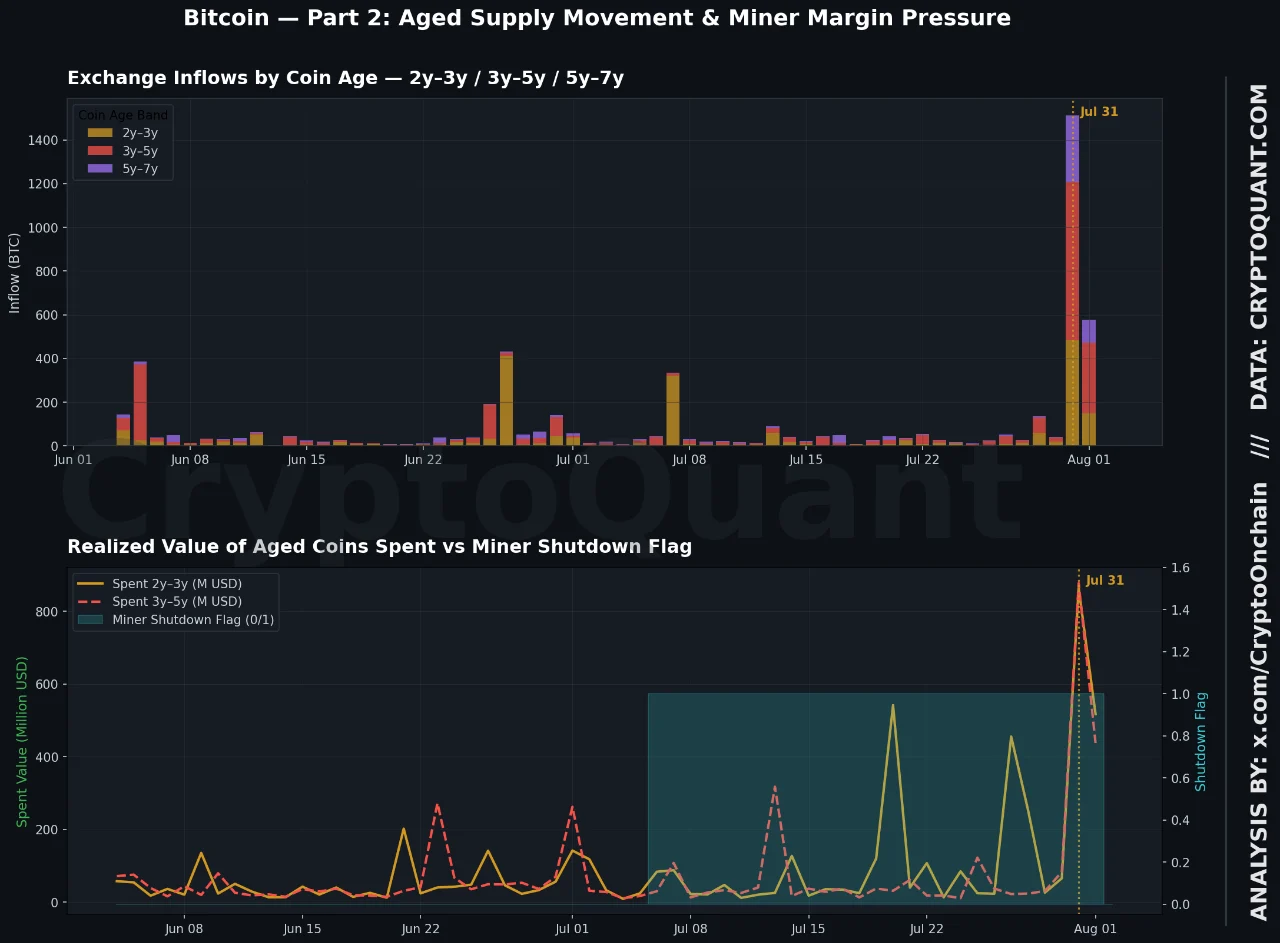
CryptoQuant’s miner shutdown indicator moved to 1, rising 50% above its monthly baseline and 350% above its quarterly average.
The signal suggests that some marginal mining capacity is operating below breakeven. Less efficient miners may respond by shutting down machines, cutting expenses or selling part of their reserves to cover operating costs.
One reading does not show that miners are already selling enough Bitcoin to affect the market. The indicator becomes more relevant if weak profitability persists and miner outflows begin to increase.
For now, it identifies another possible source of supply alongside the movement of older coins to exchanges.
The first recovery hurdle is the 50-day SMA near $63,300, which Bitcoin tested on August 2 before slipping back below it.
The 0.236 Fibonacci retracement near $63,600 sits above the moving average. Reclaiming both levels would repair the late-July breakdown, although Bitcoin would still remain inside the descending channel until it clears the upper boundary.
Support remains near $62,100, with the channel floor running slightly lower. RSI stands around 45, below the neutral 50 level and its signal line near 51, reflecting the weak momentum behind the rebound.
For now, older-coin inflows and subdued Coinbase demand continue to limit follow-through.
The post Bitcoin Tests Recovery Levels as Dormant Coins Wake Up on Coinbase appeared first on Coindoo.





