The contrast is stark, and the money flow data makes the reason fairly clear: capital that once chased crypto is now chasing AI infrastructure stocks, and the rotation has been aggressive enough to leave Bitcoin nursing a roughly 20% loss year-to-date while tech hyperscalers surge. Ten consecutive weeks of record-breaking equity gains, driven almost entirely by a handful of megacap names, have reshaped where institutional capital wants to be – and Bitcoin is not currently on that list.
The US technology sector has rallied 42% over the past two months – the largest two-month gain in 24 years, surpassing even the dot-com mania of 2000. Amazon, Alphabet, Meta, and Microsoft alone are projected to spend a combined $630 billion in capital expenditures on AI infrastructure this year. Chipmakers and cloud providers are printing record revenues quarter after quarter, and institutional allocators are following earnings rather than conviction stories about digital scarcity.
BREAKING: The US technology sector has rallied +42% over the last 2 months, the largest 2-month gain in 24 years.
This also marks the 2nd-strongest rally this century, surpassing even the +40% gain seen during the 2000 Dot-Com Bubble.
The surge has been largely fueled by chip… pic.twitter.com/UZZzgMUhvy
— The Kobeissi Letter (@KobeissiLetter) June 2, 2026
The problem for Bitcoin is that institutional liquidity is finite. When the choice is between a non-yielding asset sitting in a drawdown and a tech monopoly reporting explosive AI-driven revenue growth, most portfolio managers are not agonizing over the reallocation. High interest rates compound the pressure further – when investors can lock in meaningful risk-free returns in government bonds, the hurdle rate for holding volatile assets with no yield rises considerably. Gold has maintained a strong upward trajectory as a traditional safe haven through all of this. Bitcoin has not, increasingly behaving as a high-beta tech proxy during corrections while being left behind when equities rally on strong earnings.
While most of crypto Twitter is calling for $50,000 Bitcoin, one indicator is pointing in the opposite direction. Alphractal’s Accumulation-Distribution Cycle Index – a macro-level tool that tracks whether Bitcoin is in a distribution phase, a trend phase, or an accumulation phase – has just dropped into the low 20s, a zone it has only reached three times in the past decade. Each of those three instances marked a cycle bottom: the 2018 low preceded a 250% rally, the March 2020 COVID crash preceded a 650% rally, and the late-2022 post-FTX bottom preceded a 400% rally. Three readings at this level, three multi-year bull runs within eight months.
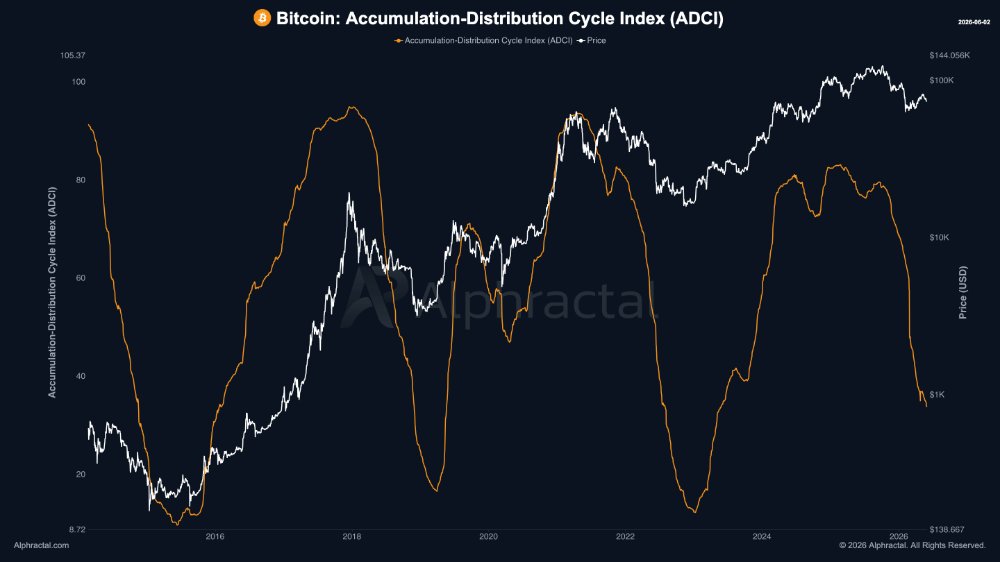
Alphractal’s interpretation is that the current fear – the ETF outflows, the liquidations, the extreme sentiment readings – is not confirmation of further downside but rather the exact conditions under which smart money absorbs supply before retail conviction completely breaks. The crowd reads the negative headlines as a reason to sell. The indicator reads them as a textbook accumulation signature.
According to Farside Investors, outflows on May 27 alone reached $733.4 million, with BlackRock’s IBIT shedding $527.8 million in a single session. May 18th saw $648.6 million leave the market. The pattern repeated across the following days, culminating in a $483.8 million outflow on June 1st. Total outflows across all spot Bitcoin ETFs have surpassed $23 billion, representing a severe deficit in the institutional accumulation needed to sustain price levels.
Over the same period, on-chain data from CoinGlass showed $1.48 billion liquidated in 24 hours, with $800 million in Bitcoin longs alone getting flushed. Santiment recorded market sentiment at its lowest since April 5th, with social media signaling extreme fear across retail trader communities. Previous crypto cycles relied on speculative retail capital to absorb institutional selling – with that retail liquidity largely exhausted after months of market churn, the capital floor needed to lift Bitcoin out of its current range simply is not there.
Bitcoin lost the $70,000 support level and has not been able to reclaim it, sitting around $67,000 – while social media sentiment has flipped to extreme fear, with traders turning sharply against BTC according to Santiment data.
😱 With Bitcoin falling as low as $66.9K today, sentiment across social media is signaling that the average trader is in ’Extreme Fear’ mode. Traders have turned on $BTC after seeing the lowest market values since April 5th, and Saylor’s @Strategy selling has been a prime… pic.twitter.com/P7VQiz7ZF5
— Santiment Intelligence (@SantimentData) June 2, 2026
The derivatives market is not helping: instead of long-term spot accumulation, which typically drives sustained bull markets, institutional activity has shifted toward short-term hedging and perpetual futures positioning. The $1.23 billion in liquidations over a single 24-hour window – $633 million of that in Bitcoin longs alone – reflects a market where leveraged positioning is getting unwound rather than fresh capital entering. Until spot buyers show up with enough conviction to push price back above $70,000, the technical picture does not give bulls much to work with.
Two high-profile names added fuel to the bearish narrative in quick succession. Mark Cuban told the Front Office Sports podcast on May 21st that he had sold most of his Bitcoin, arguing that gold’s outperformance during the Iran conflict proved Bitcoin had failed as a store of value. Escalating US-Iran tensions pushed oil past $100 a barrel, sparking inflation fears that drove allocators into traditional defensive havens – and Bitcoin was not among them.
Then came the SEC filing from Strategy, disclosing that the company sold 32 Bitcoin between May 26th and May 31st at an average price of $77,135, raising $2.5 million to fund distributions on its preferred stock STRC, a perpetual preferred paying an 11.5% annual dividend. For a firm holding 843,706 BTC, the sale represents 0.0038% of total holdings. The headline that “Saylor sold Bitcoin” rattled sentiment regardless of the scale.
Strategy needed cash to meet dividend obligations during a quarter when Bitcoin’s price drawdown triggered a temporary net loss. Rather than diluting shareholders by issuing new equity – the outcome short sellers had been betting on – the firm trimmed a microscopic fraction of its Bitcoin position to clear the liability. Saylor has been explicit on this: proving Strategy can service obligations directly from its Bitcoin stack defeats the core bearish thesis critics have built against the company. His long-term conviction has not shifted.
Fundstrat’s Tom Lee was blunt in response to Cuban, calling it a rage quit and noting that similar capitulations have historically marked cycle bottoms. “Crypto has been disappointing because crypto should move with equity markets, and it should be rallying with software,” Lee said on CNBC. “Software has really started to rally big, and crypto hasn’t moved.” His argument is that investors abandoning the asset class now are prematurely exiting a long-term trend, not making a structurally sound call.
TOM LEE: Mark Cuban selling all his Bitcoin is a sign of rage quitting, something we see at the bottom of every crypto winter. pic.twitter.com/1lfn9DDPfW
— Bitcoin News (@BitcoinNewsCom) June 2, 2026
The institutional picture is more nuanced than the outflow headlines suggest. Binance Research data shows that since the launch of spot Bitcoin ETFs, only 435,000 BTC has been mined, while institutions have absorbed 1.63 million – nearly four times the new supply. Institutional holdings now represent 12.7% of circulating supply, growing from 921,000 BTC at ETF launch to 2.56 million today. Those are not the numbers of an asset class being abandoned.
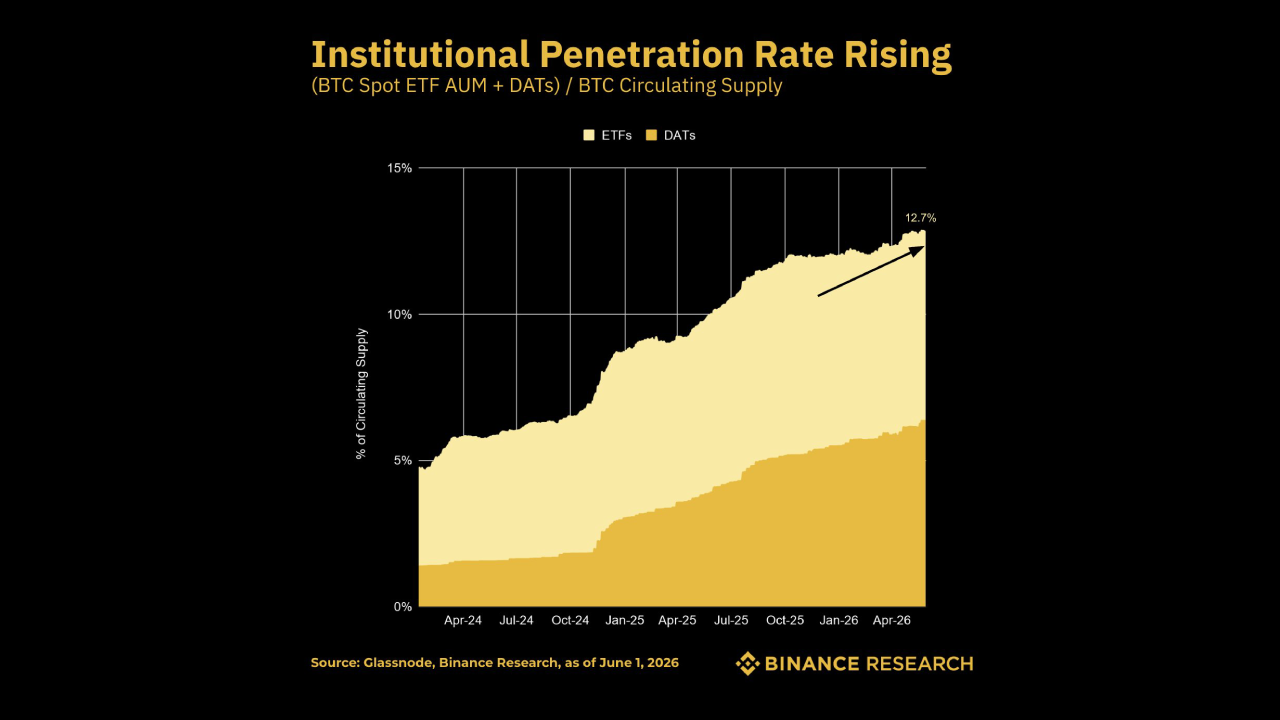
Earlier this year, Bitcoin ETFs suffered a $4.5 billion multi-week outflow streak, only to snap back with $1.1 billion in three-day inflows the moment a technical bottom formed. Capital did not leave permanently – it stepped aside and came back at lower levels. Analysts tracking ETF behavior describe the current dynamic as macro-driven tactical rebalancing: geopolitical shocks trigger risk-off pivots, AI equity gains pull capital toward better-performing assets, and hot inflation prints trigger automated trimming of non-yielding positions. In each case, the capital remains within institutional ecosystems, waiting rather than gone.
When AI stocks eventually enter a correction phase – and a sector that has now surpassed dot-com era two-month gains is not immune to gravity, especially with most index gains concentrated in fewer than ten names – risk appetite could rotate to crypto. In previous cycles, tactical outflows have reversed when the catalyst cleared — and the institutional infrastructure now holding 12.7% of circulating supply is not the kind that exits permanently.
The post Bitcoin Loses Ground as Wall Street Goes All-In on AI appeared first on Coindoo.