U.S. forces carried out drone strikes against two Iranian launchers on Larak Island on August 30. U.S. officials said Islamic Revolutionary Guard Corps personnel were preparing rocket launchers and sea mines near the Strait of Hormuz, according to Reuters.
The attack was the first known U.S. strike on Iranian territory since late July. Iran responded by firing ballistic missiles toward a U.S. base in Jordan. U.S. officials said nearly all were intercepted and that the base suffered no substantial damage. The Associated Press described the exchange as the end of a month-long lull in a war that began in late February.
Larak sits beside a shipping route that carried roughly one-fifth of global oil shipments before the war. The immediate market question is therefore not how many launchers were destroyed, but whether the exchange leads to renewed mine-laying or another sustained decline in vessel traffic.
According to OilPrice.com, Brent crude climbed 2.9% to $90.67 per barrel at the time of writing, while West Texas Intermediate rose 2.7% to $85.66. Asian shares edged lower and government bond yields remained elevated, Reuters reported.
For Bitcoin, the danger runs through inflation and interest rates. More expensive energy raises costs for businesses and consumers. If that pressure keeps inflation elevated, central banks may hold rates high or raise them, making financing more expensive and cash yields more competitive with risk assets.
At about the same time, CoinGecko placed Ether near $2,436, Solana at $102.5 and XRP at $1.36. Their respective 24-hour lows were $2,395, $100.6 and $1.34, which shows that selling had not pushed these large-cap assets back to their lowest prices of the session.
At 06:00 UTC on August 31, Bitcoin traded at $77,950 on Bitstamp, below the rising 50-period simple moving average at $78,460. The latest four-hour candle reached $78,130 but failed to clear the average.
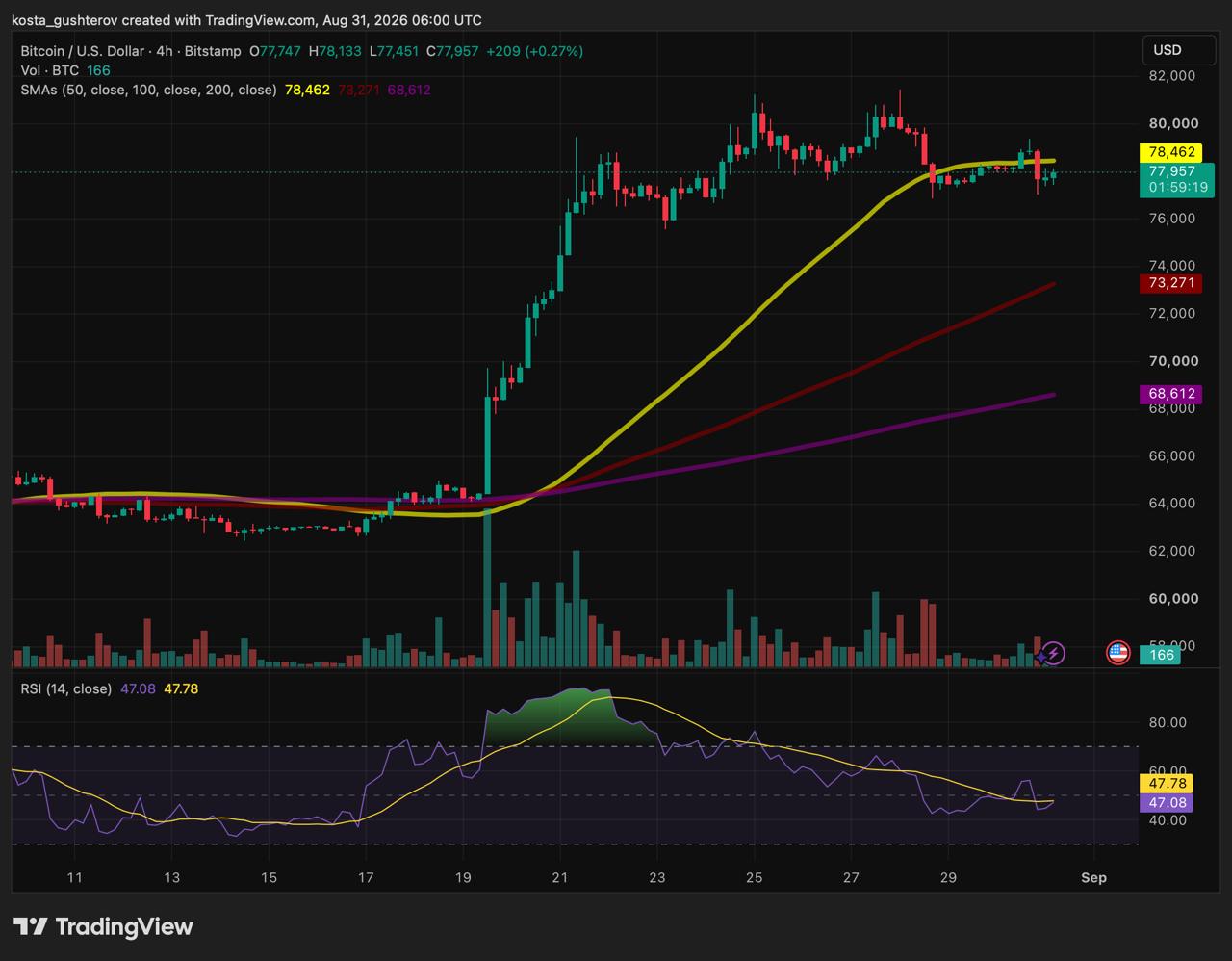
The 50-SMA reflects roughly eight days of trading and is now acting as resistance. A four-hour close above it would be the first step toward a recovery, but buyers would still need to keep price above the average on the following candles. A brief move through it would carry less weight.
BTC remained above the slower 100-SMA at $73,271 and 200-SMA at $68,600, although both sit too far below the current price to confirm near-term strength. Momentum is weaker: RSI stood at 47.08, below both its moving average at 47.78 and the neutral 50 mark. The slower trend remains positive; the near-term signal does not.
After six months of attacks, retaliation and interrupted ceasefires, traders have repeatedly seen alarming headlines without a lasting change in energy supply or global financial conditions. That experience may be reducing the impulse to sell immediately whenever fighting resumes.
Coindoo previously examined why the Iran-U.S. war did not derail Bitcoin. The latest response fits that pattern, although price action alone cannot prove that familiarity caused the muted reaction.
The confirmed details offer a more direct explanation. The U.S. targeted military launchers rather than oil-production or export facilities, while Iran’s reported retaliation caused no substantial damage to the American base.
The size of the oil move also matters. Brent traded above $126 in April when concerns about a prolonged shortage were more severe, according to Reuters. A return above $90 raises inflation risk, but it remains far below the stress level reached earlier in the conflict.
Holding steady for one session does not make Bitcoin a wartime safe haven. Its resilience remains conditional on the conflict avoiding a larger energy shock and on buyers preventing the technical structure from weakening further.
This is conditional resilience, not indifference. Current prices suggest traders are treating the Larak strike as a limited escalation; evidence of lasting damage to oil supply would force a different calculation.
Disclaimer: This article is for informational purposes only and does not constitute financial or investment advice. Cryptocurrency prices are volatile, and market data can change rapidly.
The post Bitcoin Stays Near $78,000 as U.S. Hits Iran, Oil Jumps appeared first on Coindoo.





