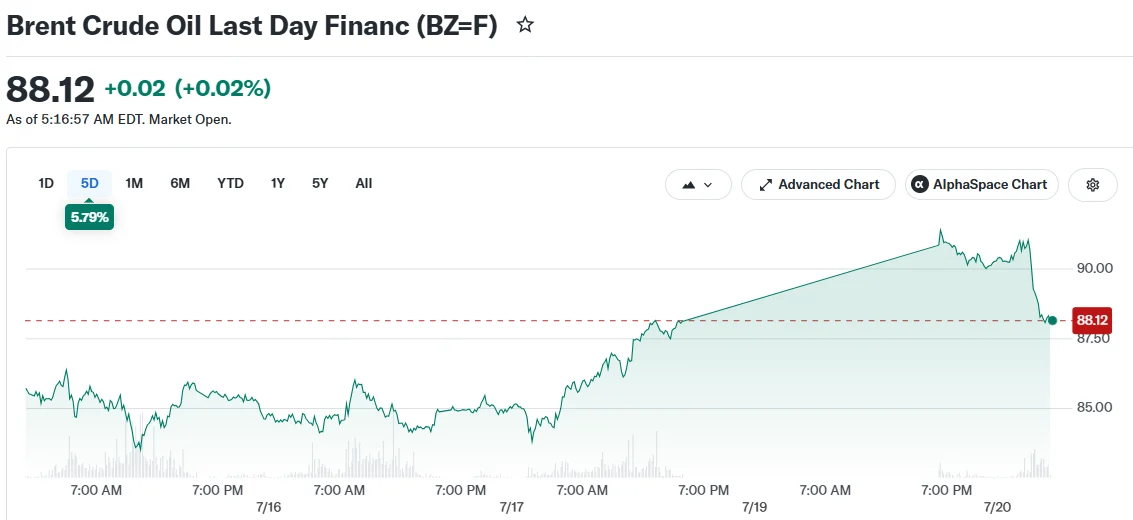
Crude benchmarks climbed to their strongest position in more than five weeks during Monday trading before moderating, as the intensifying military confrontation between Washington and Tehran continued to strangle petroleum flows through the vital Strait of Hormuz.
The international Brent benchmark touched an intraday peak of $90.75 per barrel—the highest mark in five weeks—before settling back toward $88.26 following comments from an Iranian foreign ministry representative suggesting diplomatic channels with the United States might be explored in alignment with national priorities.
The domestic U.S. benchmark West Texas Intermediate likewise retreated, declining 0.4% to settle at $82.18 per barrel after briefly crossing the $83 threshold earlier in the session.
The reduction in petroleum shipments navigating the strategic chokepoint has been dramatic. Only four commercial vessels successfully completed the passage on Sunday, a decline from eight ships the previous day, data from LSEG confirms.
Market strategists at ANZ reported that passage volumes have collapsed to single-digit levels, emphasizing that “the anticipated recovery in shipping has effectively stalled.”
Prior to the outbreak of hostilities in late February, approximately one-fifth of worldwide petroleum supplies transited through this critical maritime corridor.
The Islamic Revolutionary Guard Corps reported that two petroleum tankers sustained damage and were rendered immobile following explosions during their transit attempts. Iranian officials alleged the vessels had been persuaded by American military forces to utilize what Tehran characterized as a hazardous southern passage route.
Reuters indicated it was unable to immediately confirm those assertions.
American military forces have executed operations against Iranian targets for nine straight days. Iranian military units have retaliated with strikes targeting U.S. aircraft stationed at a Jordanian airfield, along with American military installations in Kuwait and Syria.
Bahrain additionally confirmed that warning sirens were activated Monday morning.
UBS market analyst Giovanni Staunovo observed that the oil market is “again tightening,” with continuous attacks on vessels attempting strait crossings leading to a reduction in tankers departing the Gulf region.
ANZ market strategists highlighted that although American production volumes have risen, these increases have not substantially altered the fundamental market equilibrium. Worldwide inventories continue their downward trajectory, maintaining pressure on both crude and refined products markets.
Brent recorded its most significant weekly advance since April during the previous week, surging 15.9%. West Texas Intermediate jumped 15.5% across the identical timeframe, marking its strongest weekly performance since early March.
The Brent benchmark had previously surged beyond $110 per barrel during the conflict’s early stages before tumbling toward $70 following a ceasefire agreement signed in June. That temporary peace arrangement has subsequently disintegrated.
Persian Gulf nations did increase crude oil and condensate shipments in early July to their most robust volumes since fighting commenced. Nevertheless, throughput via the Strait of Hormuz is once again decelerating as military operations intensify.
Tehran has additionally pressured Houthi forces to obstruct Red Sea shipping lanes should American forces target Iranian energy infrastructure, creating the potential for additional supply chain interruptions.
The post Crude Oil Surges Past $90 Amid U.S.-Iran Conflict Choking Hormuz Strait appeared first on Blockonomi.





