Key Takeaways
As reported by Reuters, strategist Alex Saunders pointed to stalled U.S. crypto legislation as the primary driver, and the move has already prompted speculation that a broader wave of institutional downgrades could follow if Washington fails to act before summer.
The bank is not abandoning its long-term bullish stance. A recessionary scenario puts Bitcoin at $58,000 and Ethereum at $1,198. The bull case goes to $165,000 and $4,488. But the base case – the number that moves markets in the short term – has taken a meaningful hit.
The CLARITY Act cleared the House but has stalled in the Senate over disagreements on stablecoin regulation and anti-money laundering provisions. Polymarket data cited in Citi’s note puts passage probability at roughly 60%. With the 2026 midterms approaching, that window is closing. A Democratic pickup in the Senate could effectively shelve the bill in its current form.
The consequences are already showing up in Citi’s numbers. Bitcoin ETF inflow projections were cut from $15 billion to $10 billion; Ethereum ETF estimates dropped to $2.5 billion. Bitcoin is trading below its 200-day moving average – a technical signal Citi says reduces urgency for new retail buyers. Without a regulatory catalyst, the path to six figures looks longer than it did six months ago.
Citi’s caution is not the consensus view. As reported by Fortune back in January, Goldman Sachs maintains a $200,000 BTC scenario, with focus on the tokenization supercycle – it projects real-world asset tokenization doubling to $80 billion in 2026, which it argues creates a structural floor for Ethereum. JPMorgan holds a $170,000 target built around gold parity, though it is watching $77,000 closely as a miner production cost threshold.
Standard Chartered followed Citi’s lead, cutting its ETH target from $7,500 to $4,000 while maintaining long-term conviction – it targets $40,000 for ETH by 2030. Bernstein remains the loudest bull, pointing to just 5% ETF outflows during Bitcoin’s slide to $90,000 as evidence of institutional resilience. Fundstrat’s Tom Lee still calls $250,000 for BTC as a cycle peak.
The emerging institutional floor sits between $58,000 and $65,000 for Bitcoin, anchored to the 200-week moving average. For Ethereum, $3,200 to $4,000 is seen as a resistance ceiling difficult to break without a clear demand catalyst. MicroStrategy continues accumulating regardless – nearly 18,000 BTC added recently, with a stated target of 1 million Bitcoin by year-end.
The FOMC meeting on March 17–18 adds another variable. Fewer rate cuts than the market has priced in would likely trigger a sell-off in risk assets across the board, crypto included.
In the UK, former Prime Minister Boris Johnson used a Daily Mail column to brand Bitcoin a “Ponzi scheme,” comparing it unfavourably to Pokémon cards. His argument rested on a personal anecdote: a retired friend who lost £20,000 after being lured by promises of doubled returns through Bitcoin and paying escalating fees for years with nothing to show for it.
The industry’s response was predictable but pointed. Michael Saylor noted that a Ponzi by definition requires a central operator and guaranteed returns – Bitcoin has neither. Pierre Rochard called the United Kingdom itself a “giant Ponzi scheme” financed by sovereign debt. Kwasi Kwarteng, Johnson’s own former Chancellor and now Executive Chairman of Bitcoin firm Stack, compared the asset’s trajectory to the early internet.
The political irony is hard to ignore. It was Johnson’s government – through Rishi Sunak – that first positioned the UK as a global crypto hub. Much of the FCA’s current regulatory framework originated under that same administration. Days before Johnson’s piece ran, Nigel Farage invested £215,000 into Kwarteng’s Stack, deepening a visible split within the UK’s right-leaning political sphere.
The mood across institutional crypto markets in early 2026 is best described as cautious but not capitulating. Citigroup’s downgrade reflects a specific frustration: prices cannot sustainably move higher on narrative alone when the regulatory architecture meant to support institutional scale remains stuck in a Senate committee. Until the CLARITY Act either passes or fails decisively, banks have little choice but to trim their assumptions.
The Boris Johnson episode, meanwhile, is a footnote – but a revealing one. Bitcoin has matured to the point where a former head of government attacking it makes headlines, and the sharpest rebuttals come from his own former cabinet colleagues. That, perhaps more than any price target, says something about where this market actually stands.
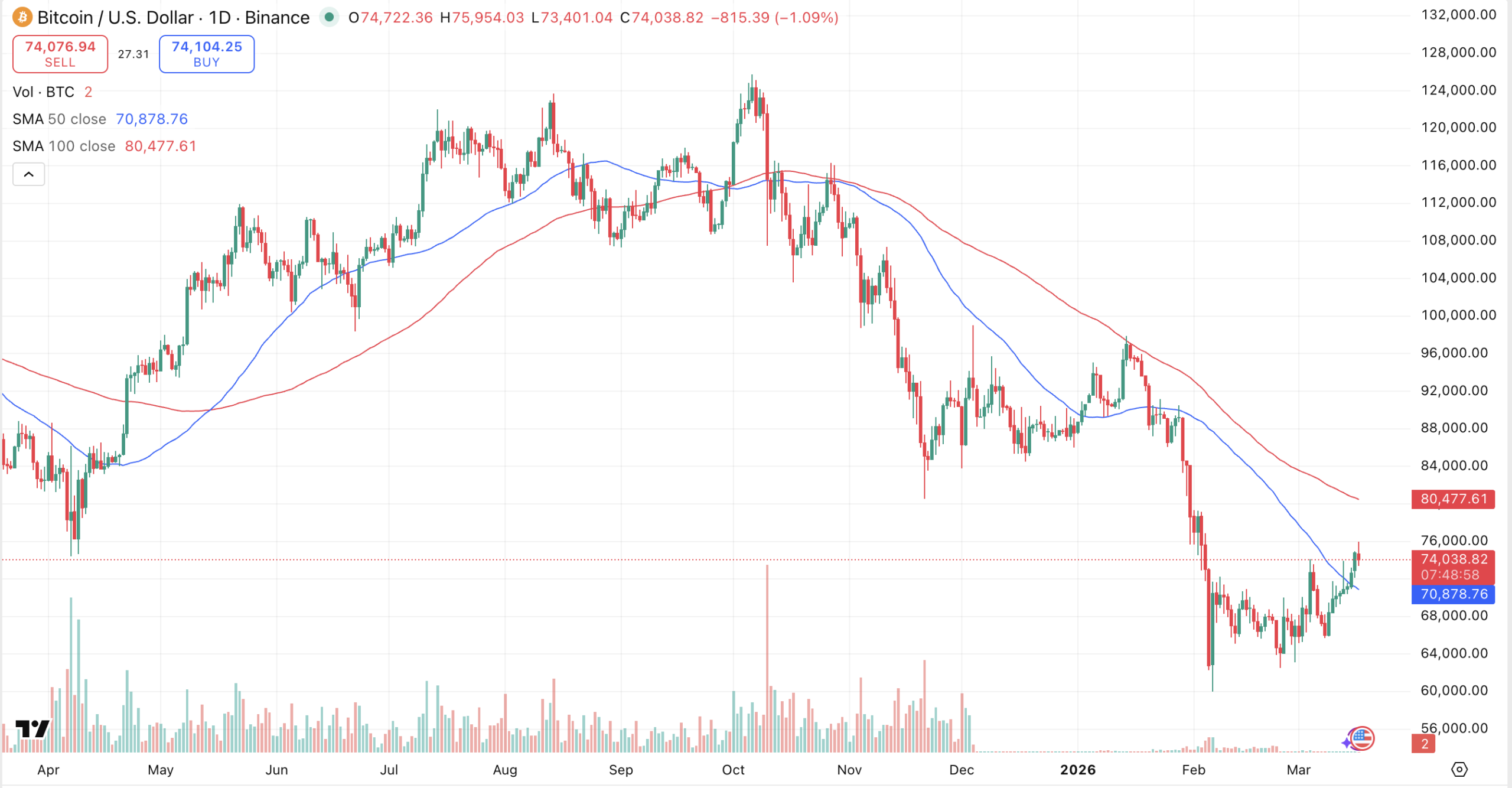
Bitcoin has currently found some relatively strong foothold above the $70,000 level after a significant market correction. At the time of writing BTC is trading near $74,000 with a market cap of around $1.48 trillion. Despite the recent surge, Bitcoin’s price is down more than 41% from its ATH, reached on October 6, 2025 (a little over $126,000.)
The information provided in this article is for educational purposes only and does not constitute financial, investment, or trading advice. Coindoo.com does not endorse or recommend any specific investment strategy or cryptocurrency. Always conduct your own research and consult with a licensed financial advisor before making any investment decisions.
The post Citigroup Cuts Bitcoin Target – Here’s Where Other Major Banks Stand appeared first on Coindoo.