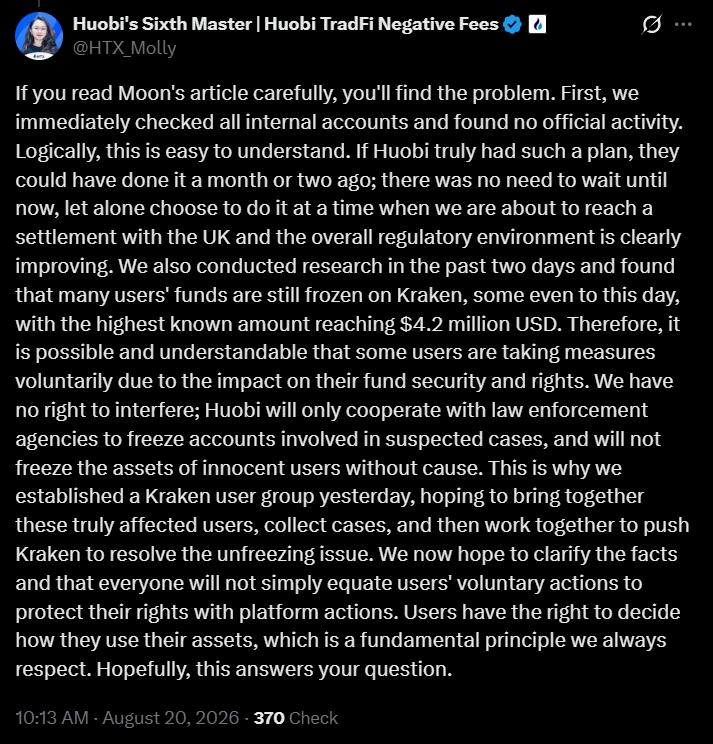
In posts published on August 20, HTX Molly said an internal review found no official HTX accounts involved in the transfers cited in earlier address-poisoning reports. She also suggested that some users may have acted independently after their Kraken funds were restricted.
That is a denial of direct platform involvement. It does not identify the wallets examined, disclose the transaction history or explain how HTX separated exchange-controlled addresses from wallets belonging to its users. A wallet used by an HTX customer is not necessarily a wallet controlled by HTX itself.
The post also referred to reports of Kraken users whose assets remained restricted. An image included in a later update appeared to show a Kraken Support notice saying that a deposit had exposure to Huobi Global SA and warning that transactions involving sanctioned entities can lead to account restrictions.
The screenshot cannot independently authenticate the email or establish Kraken’s position. But it illustrates why the parties can be addressing different parts of the same case. HTX’s review asks whether one of its official wallets sent the funds. A receiving exchange may instead review whether a customer’s deposit can be linked to a particular entity, address cluster or transaction route.
Neither position proves the other wrong. An HTX internal review could find no official-wallet activity while a Kraken review still flags a customer deposit for compliance checks. Public transaction data and Kraken’s explanation would be needed to establish whether that happened here.
Molly said HTX had identified users with funds still restricted at Kraken and referred to a highest known amount of about $4.2 million. The post did not publish the number of affected users, supporting account records or a list of balances.
For that reason, the figure should be read as HTX’s description of a reported individual case. It is not evidence that Kraken froze $4.2 million in aggregate, nor that the amount was connected to the alleged address-poisoning transfers.
Hours later, Molly wrote that several affected Kraken users had already had their accounts unfrozen. The post included a private-chat screenshot in which a user appeared to confirm that access had been restored.
好消息!
我们了解到,目前已经有几例受影响的kraken用户解冻了,这是一个很好的信号:一刀切冻结用户的资产,违背了“私人财产神圣不可侵犯”的基本原则。权利是争取来的,针对加密的新法,必须符合加密去中心化、全球化的特色。
欢迎加入Kraken合规难民群,
一起捍卫资产安全! https://t.co/cPzXfdjhzA pic.twitter.com/jLCTmwqwAg— 火币六爷|火币TradFi负费率 (@HTX_Molly) August 20, 2026
That is a meaningful change for the individual cases described by HTX, but it does not establish a platform-wide reversal. The post does not state how many accounts were released, how long they had been restricted, whether any assets remained unavailable or why Kraken allegedly lifted the restrictions.
One case involved roughly $4.2 millionHTX’s reported highest-known amount.The total value of all restricted funds.Several accounts were unfrozenHTX’s later post and a user-chat screenshot.A broader change to Kraken’s compliance approach.
| Claim | Evidence currently available | What it does not establish |
|---|---|---|
| HTX official accounts were not involved | HTX Molly’s account of an internal review. | A public audit of the alleged transaction path. |
| Kraken restricted users connected to HTX | HTX’s account of user cases and a screenshot presented as a support notice. | Kraken’s reason, scope or policy for the restrictions. |
Four pieces of evidence would clarify the case:
All we know for now is that the public record supports a limited conclusion: an HTX executive has denied official-account involvement and says some users have since regained access at Kraken. It does not yet show who controlled the disputed wallets, why each account was reviewed or whether the reported cases were connected.
This article is provided for informational purposes only and does not constitute financial, legal or compliance advice.
The post HTX Executive Denies Address-Poisoning Link in Kraken Dispute appeared first on Coindoo.





