LAPTOP opened at $0.05 on September 9 before briefly reaching $199.51, according to The Wall Street Journal. The token had fallen to approximately $1.30 by 4:15 p.m. ET, erasing more than 99% of the highest recorded price.
A September 10 CoinMarketCap snapshot subsequently showed LAPTOP near $0.7907, with a 97.87% decline over 24 hours. That displayed percentage was based on the platform’s reference price for the period, not the brief $199.51 peak.
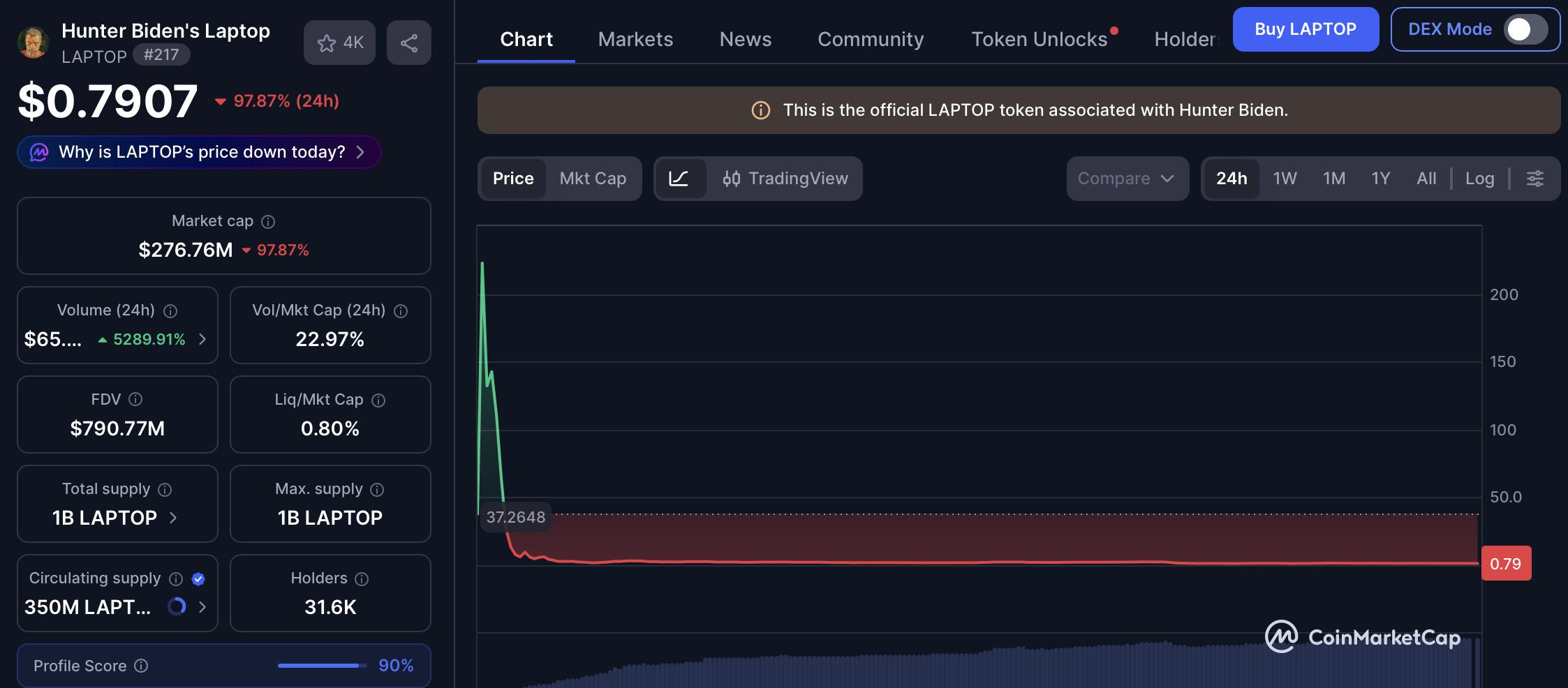
The snapshot put LAPTOP’s market capitalization near $276.8 million and its fully diluted valuation at approximately $790.8 million. The difference reflects an initial circulating supply of 350 million tokens against a maximum supply of one billion; neither figure represents the amount of money invested in the token.
The launch followed earlier disclosures covering LAPTOP’s Base deployment and planned distribution. After the price collapsed, Hunter Biden said X had suspended the foundation’s account and directed users to a statement published on Medium.
In its post-launch update, Phoenix Veritas Foundation said strong demand and automated traders overwhelmed the limited liquidity available from market makers. The team identified what it called front-running or sniper bots as a major source of the initial disruption.
LAPTOP began trading through a decentralized liquidity pool rather than against an established price on a large centralized exchange. An automated market maker sets the price from the ratio of assets held in that pool. When reserves are shallow, an early purchase can remove a large share of the available tokens and push the quoted price sharply higher.
Multiplying the brief $199.51 trade by LAPTOP’s one billion-token maximum supply produced an implied valuation close to $200 billion. Only a fraction of the supply traded at that level, so the calculation did not indicate that buyers had committed anything close to $200 billion.
The same mechanism accelerated the decline. As early buyers sold, the pool lacked enough paired assets to absorb those transactions without severe price slippage. The opening spike and the subsequent crash therefore reflected the depth of the market as well as demand for the token.
Launch sniping refers to automated programs buying immediately after a new pool becomes active. Front-running is a narrower practice involving advance visibility of pending transactions or an advantage in transaction ordering. The foundation has not published a transaction-level reconstruction showing how much of LAPTOP’s move came from either activity. For now, its account explains a possible mechanism without establishing how responsibility was divided among bots, market makers and the initial pool design.
The foundation said it would allocate four million LAPTOP, equal to 0.4% of the maximum supply, as incentives for the LAPTOP-USDC pool on Aerodrome beginning at 00:00 UTC on September 10.
The rewards could encourage liquidity providers to deposit LAPTOP and USDC, increasing the assets available for trades. A deeper pool would reduce the effect that an individual purchase or sale has on the token’s price.
The allocation consists of LAPTOP rewards rather than four million tokens being sold or paired directly with an equivalent amount of USDC. Its impact will depend on how much outside liquidity providers deposit, how concentrated that liquidity is and whether they keep their assets in the pool after rewards decline.
Two events within LAPTOP’s prediction allocation have resolved “yes,” according to the foundation, placing 10 million tokens on course to be burned during the project’s first week. The amount equals 1% of LAPTOP’s maximum supply.
Those tokens come from the prediction allocation, which is locked for 12 months before beginning a 24-month release schedule. The burn would therefore reduce supply that could have entered circulation in the future rather than remove 10 million tokens from the current trading pool.
The process follows the rules examined in an earlier breakdown of who determines LAPTOP’s token burns. Phoenix Veritas Foundation resolves the applicable events and instructs Coinbase Custody to transfer the corresponding tokens to a published burn address.
Completing the transfer would make the supply reduction visible onchain. It would not add USDC to the liquidity pool or create new buying demand, so the burn does not directly address the market-depth problem behind the launch volatility.
The foundation reiterated that LAPTOP had no presale and no allocations for investors, influencers or key opinion leaders. It said the 30% founder allocation is held through Coinbase Custody, with a six-month lock followed by 24 months of vesting.
Those restrictions reduce the risk of the founder allocation entering the market immediately. They do not resolve questions about the opening pool, including how much liquidity was available and how market-maker inventory was used during the first trades.
Previous disclosures identified loans of 20.5 million LAPTOP to G20 and GSR for market-making purposes. The distinction is important: the absence of a presale or influencer allocation does not mean that no tokens moved before public trading, because market makers required inventory to support the launch.
Another 80 million LAPTOP can be claimed by eligible subscribers to Hunter Biden’s “Where’s Hunter?” newsletter. Successful claims could expand the amount available to trade, while unclaimed tokens are scheduled to be burned after the 30-day claim period. Claim activity will therefore affect the circulating supply even if the maximum supply declines.
LAPTOP’s next test is whether the Aerodrome programme can establish a functioning market after the distorted opening. That requires enough sustained liquidity to process trades without extreme slippage, along with clear records of market-maker transfers, liquidity movements and the announced burn.
Temporary depth created by token rewards would be less convincing if liquidity providers leave once those incentives decline. A pool that remains liquid after the initial rewards would provide stronger evidence that LAPTOP has moved beyond the conditions that produced its launch-day price distortion.
This article is for informational purposes only and does not constitute financial advice.
The post LAPTOP Team Explains Price Drop, Cites Bots and Thin Liquidity appeared first on Coindoo.