RWA stands for real-world asset. It is something that exists outside the blockchain and has financial value, such as a US Treasury bill, company share, loan, property, commodity, or money market fund.
Tokenization creates a digital token that represents a legal or economic claim connected to that asset. The token can then be held or transferred through a blockchain wallet, subject to the issuer’s rules and regulatory restrictions.
The Treasury bill itself is not placed on the blockchain. It remains in the traditional financial system. The blockchain token acts as the digital ownership or distribution layer connecting the investor with the fund, custodian, and underlying asset.
Tokenization can make traditional financial products easier to hold, transfer, divide, and use inside digital markets.
The token does not automatically make the underlying investment safer, more liquid, or legally simpler. Its value still depends on the real asset, the company holding it, the investor’s legal rights, and the ability to redeem the token for cash or the underlying security.
An RWA tokenization platform is the infrastructure that connects the offchain asset with its onchain token.
Platforms such as Securitize, Ondo, Centrifuge, and Franklin Templeton’s Benji system all operate in the RWA market, but they do not provide the same service. Some issue regulated fund shares, some distribute tokenized exposure, and others build the infrastructure used by asset managers.
Real-world asset tokenization moved beyond isolated blockchain trials in 2026. RWA.xyz tracks 199 tokenization platforms as of July 17, 2026, with approximately $34.96 billion in distributed assets and $370 billion in represented assets.
Those figures describe two different markets. Distributed assets use blockchain as a delivery layer, allowing approved investors to receive and manage tokens through wallets or custodians. Represented assets use blockchain mainly for recordkeeping, reconciliation, or operational processing without necessarily allowing investors to transfer the assets onchain.
Combining the two figures into a single “tokenized asset market” total can therefore exaggerate the amount of capital that is actually available inside wallets, decentralized applications, or secondary markets.
BlackRock Chairman and CEO Larry Fink described the practical goal in his 2026 letter to investors as updating “the plumbing of the financial system.” Tokenization can reduce administrative friction, but it does not remove the legal, custodial, and credit structures supporting the asset.
A token’s ticker and blockchain address do not reveal what the holder legally owns.
The US Securities and Exchange Commission’s January 2026 statement separates tokenized securities into two broad categories:
Those structures can produce very different rights.
An issuer-sponsored fund token may represent an actual share recorded by the fund’s transfer agent. A custodial token may instead provide an indirect entitlement to an asset held by another company. A synthetic token can track the price of a stock or bond without giving its holder ownership of the underlying security.
The SEC states that changing the format or recordkeeping system does not change the application of federal securities law. A security remains a security when represented on a blockchain.
Evaluate these five pillars to understand your risk and rights:
A technically sophisticated token can still provide weak investor protection when its legal claim is unclear.
Tokenization does not normally place a Treasury bill, loan agreement, building, or company share directly inside a smart contract. It coordinates an onchain token with several offchain institutions and records.
The smart contract controls the digital representation. It does not independently prove that the custodian holds the claimed assets or that a court will recognize the token holder’s rights.
Blockchains cannot independently read a fund administrator’s books, bank balance, property appraisal, or loan-servicing records.
Oracle infrastructure can transmit information such as net asset value, prices, ownership data, and reserves into smart contracts. Accurate NAV data is required to calculate how many tokens should be issued during a subscription and how much an investor should receive during redemption.
Proof-of-reserve systems can also provide evidence that offchain collateral exists. They may be used as automated controls that stop new minting when reported reserves fall below a required level.
The oracle solves a data-delivery problem. It does not replace legal due diligence, audited financial statements, custody controls, or redemption terms.
Calling Securitize, Franklin Templeton, Ondo, Centrifuge, and J.P. Morgan “RWA platforms” can suggest they are interchangeable. They operate at different points in the tokenization process.
Some provide regulated issuance and transfer-agent services. Others distribute tokenized products, manage funds, connect assets with DeFi, or build institutional settlement infrastructure.
Securitize provides infrastructure for issuing, administering, and distributing tokenized securities. Its role can include investor onboarding, transfer-agent functions, compliance controls, token issuance, and regulated secondary-market services.
The platform became widely known through BlackRock’s BUIDL fund, which holds cash, US Treasury bills, and repurchase agreements while issuing blockchain-based fund shares to eligible investors.
A February 2026 integration made BUIDL available through UniswapX’s request-for-quote infrastructure. The integration permits 24/7 bilateral trading and atomic onchain settlement, but it is not an unrestricted liquidity pool. Participants must be pre-qualified and whitelisted through Securitize.
That distinction captures the current institutional model: blockchain settlement with regulated access controls.
The Franklin OnChain U.S. Government Money Fund, represented by BENJI, is a registered US government money market fund rather than a token merely tracking Treasury prices.
Its portfolio invests in government securities and repurchase agreements collateralized by government securities or cash. Franklin Templeton uses blockchain within the system that records and processes fund-share ownership.
According to the company’s April 2026 update, BENJI represented more than $650 million and offered peer-to-peer share transfers, daily onchain dividend distribution, and intraday yield calculations when tokens moved between approved investors.
That model gives the token a closer connection to an established regulated fund than many third-party RWA wrappers.
Ondo Finance focuses heavily on bringing traditional financial exposure into wallets and blockchain applications.
Its main product categories include:
As of July 2026, Ondo’s official dashboard reported approximately $2.16 billion in USDY, $405 million in OUSG, and more than $1 billion across Ondo Stocks. The stock platform listed more than 440 assets and approximately 80,100 holders.
Access is not universal. OUSG is designed for accredited investors and qualified purchasers, while USDY and Ondo Stocks are not offered to US persons.
The legal distinction is also important. Ondo’s product disclosures explain that a token providing economic exposure does not necessarily give the holder direct ownership of the underlying Treasury or public company share.
Centrifuge provides infrastructure that allows asset managers to launch compliant tokenized funds and connect them with blockchain-based investors and DeFi protocols.
Its ecosystem covers Treasury strategies, structured credit, private credit, and alternative assets. Products displayed through the Centrifuge application include the Janus Henderson Anemoy Treasury Fund and an AAA collateralized loan obligation strategy.
Centrifuge’s model is particularly relevant to private credit, where tokenization can automate subscriptions, distributions, investor permissions, reporting, and collateral use.
It cannot eliminate the underlying loan risk. Private-credit tokens still depend on borrower repayment, underwriting quality, servicing, recovery procedures, valuation methods, and the legal enforceability of loan documents.
J.P. Morgan illustrates a more institution-controlled model. Its products use public blockchain infrastructure without removing the firm’s traditional subscription, administration, and investor-eligibility systems.
In May 2026, J.P. Morgan Asset Management launched JLTXX on Ethereum with a $100 million initial investment. The registered government money market fund invests in Treasury securities and fully collateralized overnight repurchase agreements.
Investors subscribe through Morgan Money and receive token balances at blockchain addresses. The token exists on Ethereum, but the fund’s legal and operational structure still depends on J.P. Morgan Asset Management, its transfer records, qualified-investor controls, and service providers.
John Donohue, J.P. Morgan’s Head of Global Liquidity, described the objective as allowing investors to “modernize liquidity management without changing the fundamentals of what they own.”
The underlying asset determines most of the financial risk. The tokenization platform determines how the investor accesses, holds, transfers, and redeems that exposure.
Tokenized US Treasury products reached approximately $15.94 billion by July 16, 2026, making government debt one of the largest non-stablecoin RWA categories.
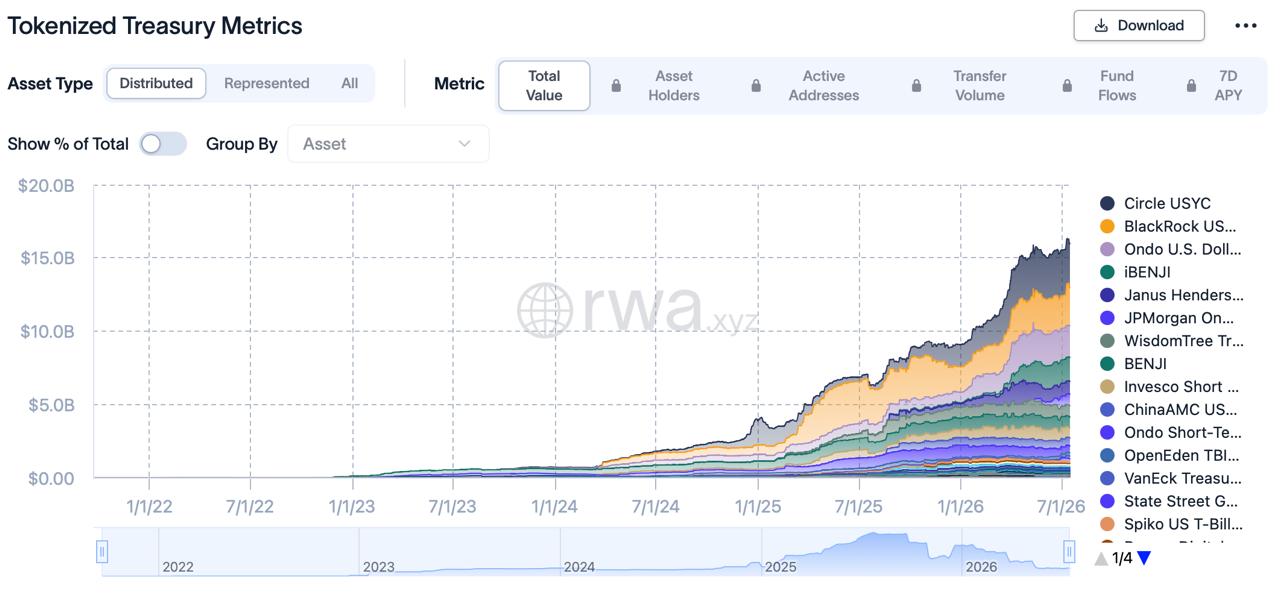
These products became popular because their yield comes from Treasury bills, government money market instruments, or repurchase agreements rather than newly issued incentive tokens.
In crypto terminology, this is often called “real yield.” It should not be confused with the economic definition of real yield, which adjusts returns for inflation.
The quoted yield is not guaranteed and normally changes with short-term interest rates. Platform fees, fund expenses, redemption delays, custodian risk, and smart-contract failures can also reduce the investor’s effective return.
RWA.xyz reported approximately $7.03 billion in distributed tokenized credit and $35.63 billion in represented credit as of July 2026.
Private-credit yields may exceed Treasury yields because investors accept additional default, duration, liquidity, and servicing risk. The higher return is compensation for those risks, not a free benefit created by blockchain.
Before committing capital, run every opportunity through this diagnostic framework:
Credit Health & Structure
Operational & Liquidity Risks
A 24/7 token interface cannot guarantee a 24/7 buyer for an illiquid loan.
Tokenized equities can provide extended trading hours, fractional access, faster settlement, and compatibility with blockchain wallets.
The investor must determine whether the product represents:
These structures affect voting, dividends, tax reporting, corporate actions, insolvency treatment, and the right to convert the token into a conventional security.
Trading a token when the primary stock exchange is closed also introduces stale-price and liquidity risks. Twenty-four-hour availability does not guarantee that the execution price accurately reflects the market value the stock will have when its primary exchange reopens.
Real estate tokenization can divide ownership into smaller units and automate rental distributions. It does not remove property law, maintenance costs, vacancies, local taxes, insurance, or the time needed to sell a building.
A token may represent equity in a company that owns the property rather than direct title to the property itself. Investors should verify the corporate structure, debt seniority, appraisal policy, rental assumptions, property manager, and procedure for selling the underlying asset.
Tokenizing an illiquid building creates smaller digital claims. It does not automatically create a liquid market for them.
A useful platform review should answer the following questions before comparing advertised yields.
Read the offering documents, not only the product page. Identify whether the token is a fund share, debt obligation, beneficial interest, security entitlement, receipt, derivative, or synthetic exposure.
The platform, asset manager, issuer, transfer agent, custodian, and broker may be separate companies. Each creates a different operational or counterparty dependency.
Check:
A token may trade continuously while direct redemptions remain limited to banking or market hours.
“Available onchain” does not mean available to everyone. Products may be limited by nationality, residence, accreditation, qualified-purchaser status, wallet screening, sanctions rules, or minimum investment.
Never attempt to bypass geographic or investor-eligibility restrictions with a VPN or an unidentified wallet. Doing so can breach the product terms and complicate redemption.
A platform may advertise 24/7 transfers even when only a small group of approved market makers can trade the token.
Total value locked measures the size of the product. It does not measure how easily an investor can exit.
Before investing, verify if the asset provides true digital freedom by checking these five functional capabilities:
Restrictions may be embedded in the smart contract. A wallet can hold the token while remaining unable to send it to an unapproved address.
Management fees are often just the beginning. Investors should account for these additional layers:
Compare the expected net return after all costs rather than the displayed gross yield.
Read the documents governing smart-contract upgrades, paused transfers, oracle failures, lost wallet access, chain outages, custodian insolvency, and legal disputes.
A credible platform should explain which record is authoritative when the blockchain and the transfer agent’s records disagree.
The 2026 regulatory shift is not that tokenized assets have escaped traditional financial rules. Regulators are increasingly explaining how those rules apply to blockchain-based records.
The SEC’s tokenized-securities statement confirms that the economic and legal substance matters more than the token’s format. Issuer-sponsored, custodial, and synthetic models can have different obligations and investor rights.
In March, the Federal Reserve, FDIC, and OCC clarified the bank capital treatment of eligible tokenized securities. A qualifying tokenized security generally receives the same treatment as its conventional version, regardless of whether it uses a permissioned or permissionless blockchain.
That technology-neutral approach may make it easier for regulated financial institutions to hold and process eligible tokenized securities. It does not approve every RWA token or eliminate platform-level risk.
Broader crypto market-structure proposals such as the CLARITY Act should not be treated as blanket authorization for tokenized stocks, funds, or private-credit products. Registration, exemptions, custody, transfer-agent responsibilities, investor rights, and trading-venue rules remain product-specific.
In the European Union, the DLT Pilot Regime provides a controlled framework for trading and settling financial instruments through distributed-ledger market infrastructure. MiCA mainly covers crypto-assets not already regulated as financial instruments, so it should not be used as the sole legal framework for tokenized securities.
The strongest evidence that tokenization has moved beyond experimentation came from DTCC rather than a DeFi startup.
On July 15, DTCC converted DTC-held securities into tokens and processed them through live production trades. More than 30 traditional and digital financial firms participated across use cases involving equities, exchange-traded funds, Treasury securities, collateral transfers, trading, and repo transactions.
The assets remained connected to securities held at DTC. Participants could convert positions between traditional and tokenized formats, creating digital twins with the ownership rights and investor protections attached to the conventional assets.
DTCC plans to launch its Tokenization Service commercially in October 2026.
DTCC CEO Frank La Salla said the firm had applied the “same institutional rigor” to tokenization as it does to traditional assets. That approach is materially different from issuing an unregulated wrapper around a security held by an unrelated third party.
The DTCC launch could improve interoperability between existing market infrastructure and blockchain networks. It does not mean every retail investor will immediately be able to move US stocks into a self-custodied wallet or trade them through DeFi.
Its significance is operational: one of the central institutions in US securities settlement is preparing tokenization as production infrastructure rather than a separate experimental market.
There is no single best RWA tokenization platform because the platforms solve different problems.
The platform should be evaluated after the investor has chosen the asset, risk level, jurisdiction, and required degree of liquidity.
A Treasury-backed token with predictable redemption may be appropriate for short-term liquidity management. A private-credit token can offer a higher return but may remain locked during stress. A tokenized stock may provide extended access while delivering fewer shareholder rights than the conventional share.
The useful question is not simply whether an asset is onchain. It is whether the token improves access, settlement, transparency, collateral use, or ownership without creating counterparty and liquidity risks that outweigh those benefits.
The information provided in this article is for educational purposes only and does not constitute financial, legal, tax, investment, or trading advice. Eligibility, investor rights, taxation, and regulatory treatment vary by product and jurisdiction.
The post RWA Tokenization Platforms: How to Choose in 2026 appeared first on Coindoo.





