Key Takeaways:
The Fermi hard fork has officially activated on BNB Smart Chain, marking one of the network’s most meaningful performance upgrades to date. The change pushes the chain closer to the limits of global block propagation while keeping stability front and center.
Read More: opBNB Mainnet Hardfork Slashes Block Time to 250ms, Doubling Speed Across BNB Chain
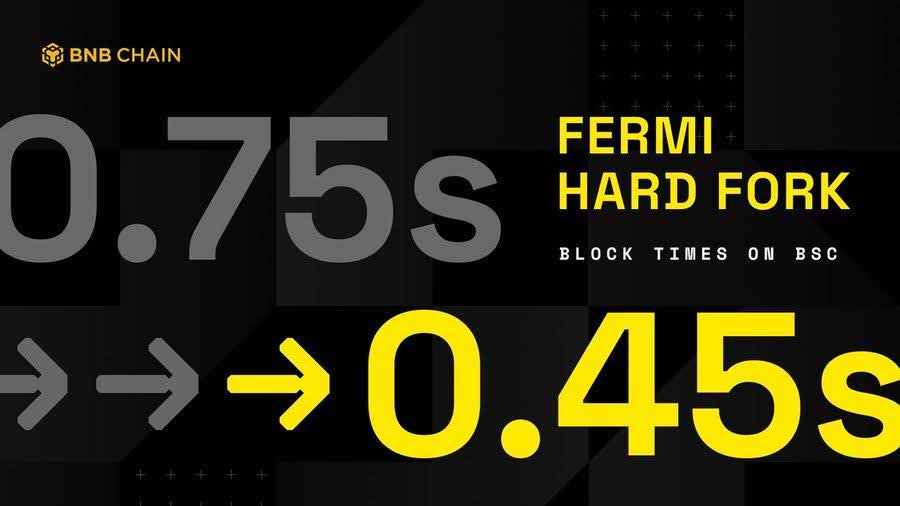
The Fermi hard fork was triggered on block 75,140,593 and was the final step of a series of phases to reduce the block time on BNB Smart Chain. The upgrade will allow reducing the average block times by approximately 0.75 seconds to approximately 0.45 seconds and thus make the network much more responsive under load.
This is not an isolated tweak. Fermi is an extension of previous upgrades such as Lorentz, Pascal, Maxwell and so on, whose main emphasis was to enhance the execution speed without compromising the assumptions that developers and users were basing on.
In the case of BNB Chain, the vision is straightforward: to achieve faster everyday onchain interactions with a predictable network as the activity increases.
The benefits of shorter block times are practical and immediate:
These profits are most important when the chain is operational rather than in the state of idleness.

Fermi is being deployed with a BSC v1.6.4 client and a package of protocol enhancements that are to be used together.
The essential BEPs that were turned on by Fermi are:
Although block time savings is the headline, the subsidiary changes are what can be discussed as making the upgrade safe to operate in production.
Incident snapshots, such as incremental snapshots, seek to make it cost-efficient to node operators over the long term. Over time, this should make running infrastructure more efficient, even as the chain grows.
Read More: XRP Outpaces BNB to Be the Third Largest Cryptocurrency in the World
All BSC mainnet nodes were required to upgrade to v1.6.4 ahead of activation. On first startup after the upgrade, nodes trigger snapshot regeneration and log indexing.
Operators should expect:
On reference hardware, snapshot regeneration took roughly five hours, making planning and monitoring essential. No contract changes are required for compatibility. However, faster block times can affect tooling and assumptions.
The post BNB Chain’s Fermi Hard Fork Goes Live, Slashing Block Times to 0.45s as Onchain Load Surges appeared first on CryptoNinjas.





