Key Takeaways:
The sharp increase reflects growing institutional participation, expanded product offerings and rising demand for blockchain-based settlement rails that promise 24/7 accessibility and improved efficiency.
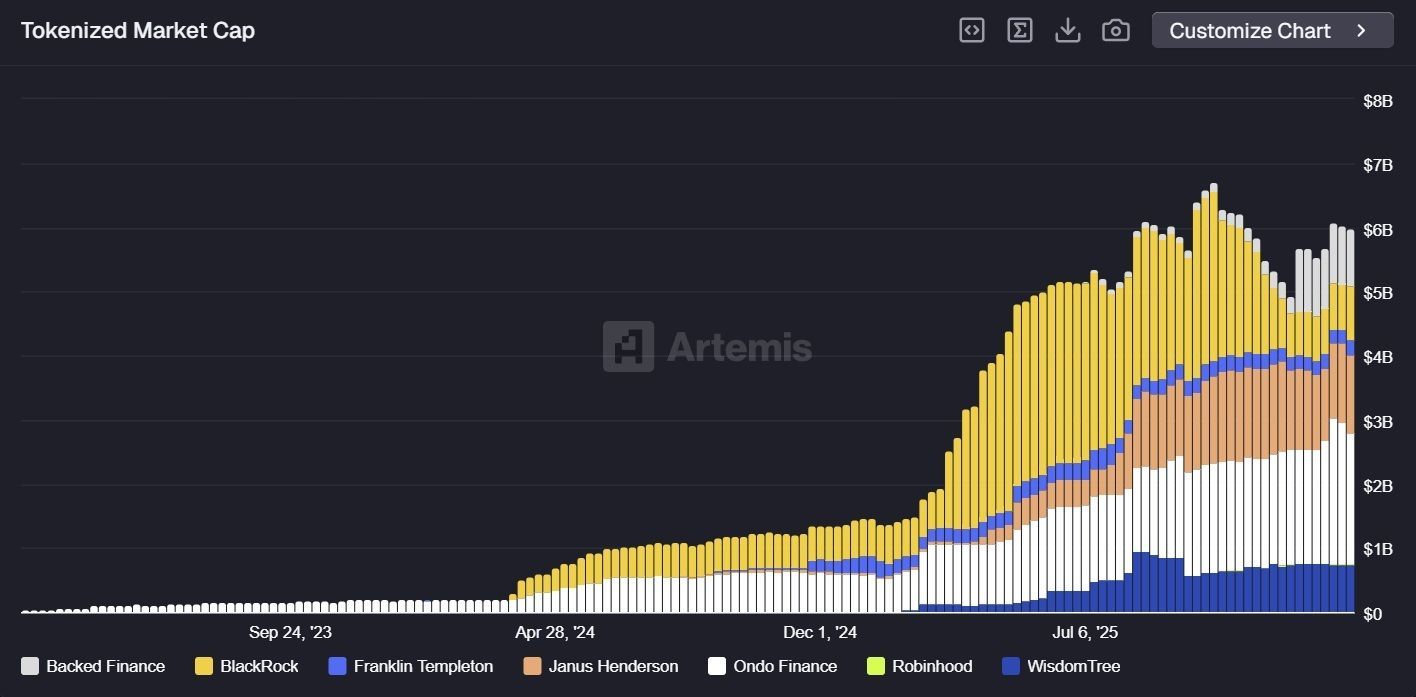
The move from $1 billion to $6 billion in just over a year represents one of the fastest expansions within digital asset infrastructure segments.
Tokenized assets typically include blockchain-based representations of real-world instruments such as Treasury bills, private credit, funds, and other yield-generating products. The appeal lies in programmable settlement, fractional ownership, and around-the-clock liquidity.
Institutional players including asset managers and fintech firms have accelerated issuance, contributing to the steep growth curve.
A notable catalyst for further adoption could arrive in 2026, when the New York Stock Exchange plans to launch a 24/7 blockchain-based tokenized exchange for stocks and ETFs.
Such a development would represent a significant departure from traditional market hours and could normalize continuous trading models across asset classes. Market participants see round-the-clock access as a potential bridge between crypto-native infrastructure and conventional capital markets.
If implemented successfully, it could dramatically increase both issuance and secondary market activity for tokenized instruments.
Ethereum continues to serve as the primary network hosting the majority of tokenized real-world assets. Its established infrastructure, institutional tooling, and liquidity depth have positioned it as the default settlement layer for many issuers.
However, other major networks are expanding their share, particularly as scalability improvements and compliance-friendly frameworks mature.
Competition among blockchains may intensify as tokenization moves from pilot programs to scaled deployment.
Industry analysts project that tokenized real-world assets could grow to $30 trillion by 2030, framing the trend as one of the largest infrastructure shifts in modern financial history.
Such forecasts assume sustained institutional participation, regulatory clarity, and technological reliability. While projections remain ambitious, early growth metrics suggest momentum is building.
If the trajectory continues, tokenization could reshape capital formation, asset distribution and settlement mechanics across global markets.
For now, the climb to $6 billion marks an important milestone – one that signals tokenization is moving from experimentation toward structural adoption within traditional finance.
The information provided in this article is for educational purposes only and does not constitute financial, investment, or trading advice. Coindoo.com does not endorse or recommend any specific investment strategy or cryptocurrency. Always conduct your own research and consult with a licensed financial advisor before making any investment decisions.
The post Tokenized Asset Market Cap Climbs to $6 Billion as On-Chain Finance Gains Momentum appeared first on Coindoo.