USDT first launched on Bitcoin in 2014 through the Omni Layer, back when Bitcoin was effectively the only chain available. When Bitcoin’s network congested in 2017 and fees spiked, USDT migrated to faster, cheaper networks, and Tron eventually became the dominant rail for stablecoin transfers, a position it still holds across emerging markets. Tether now aims to reverse that history. According to an exclusive interview with Bitcoin Magazine, the company is issuing USDT natively on Bitcoin through RGB protocol version v0.11.1, which recently reached mainnet.
The commercial rollout is led by UTEXO, a Bitcoin-native settlement layer that raised $7.5 million in a seed round co-led by Tether in March. UTEXO co-founder Viktor Ihnatiuk framed the launch as the end of a long separation, telling Bitcoin Magazine the divorce between the two most important digital assets is finally over. Before that Tether CEO Paolo Ardoino has said Bitcoin was always central to USDT’s long-term vision, but the infrastructure to make it work did not previously exist.
The technology that makes this possible is client-side validation, the core innovation in RGB. On networks like Ethereum or Tron, every transaction is broadcast to and verified by the entire network. RGB takes a different approach: the transaction details, amounts, sender, receiver, and asset IDs, stay off-chain and move privately between the two parties. The receiving wallet independently verifies the token’s history rather than relying on global validators.
To prevent double-spending, RGB anchors each transfer to Bitcoin’s UTXO model using single-use seals. Moving USDT requires spending a specific Bitcoin output, and when that happens, only a small blinded cryptographic commitment is stamped onto the Bitcoin blockchain. To any outside observer, it looks like an ordinary Bitcoin transaction, while the actual USDT movement remains confidential. Combined with Lightning Network routing, this enables settlements that leave minimal trace on the public ledger.
The practical pitch is cost and confidentiality. Transfers routed through Lightning target fractions of a cent, compared with the roughly $1 to $3 that TRC-20 USDT transfers cost on Tron, which fluctuate with network energy and bandwidth demand. UTEXO co-founder Ihnatiuk has said the model could allow wallets to offer users free USDT transactions for the first time.
On privacy, RGB standardizes a fresh address for every transaction, directly addressing the address reuse common on account-based chains like Tron, Ethereum, and Solana, which exposes user activity to public analysis. Because most transaction data never touches the public chain, counterparties and payment flows stay hidden in a way transparent ledgers cannot match.
The stakes are defined by USDT’s size. Tether now carries a market capitalization of roughly $184 billion, according to DefiLlama, making USDT the largest stablecoin in existence and the third-largest cryptocurrency overall, behind only Bitcoin and Ethereum.
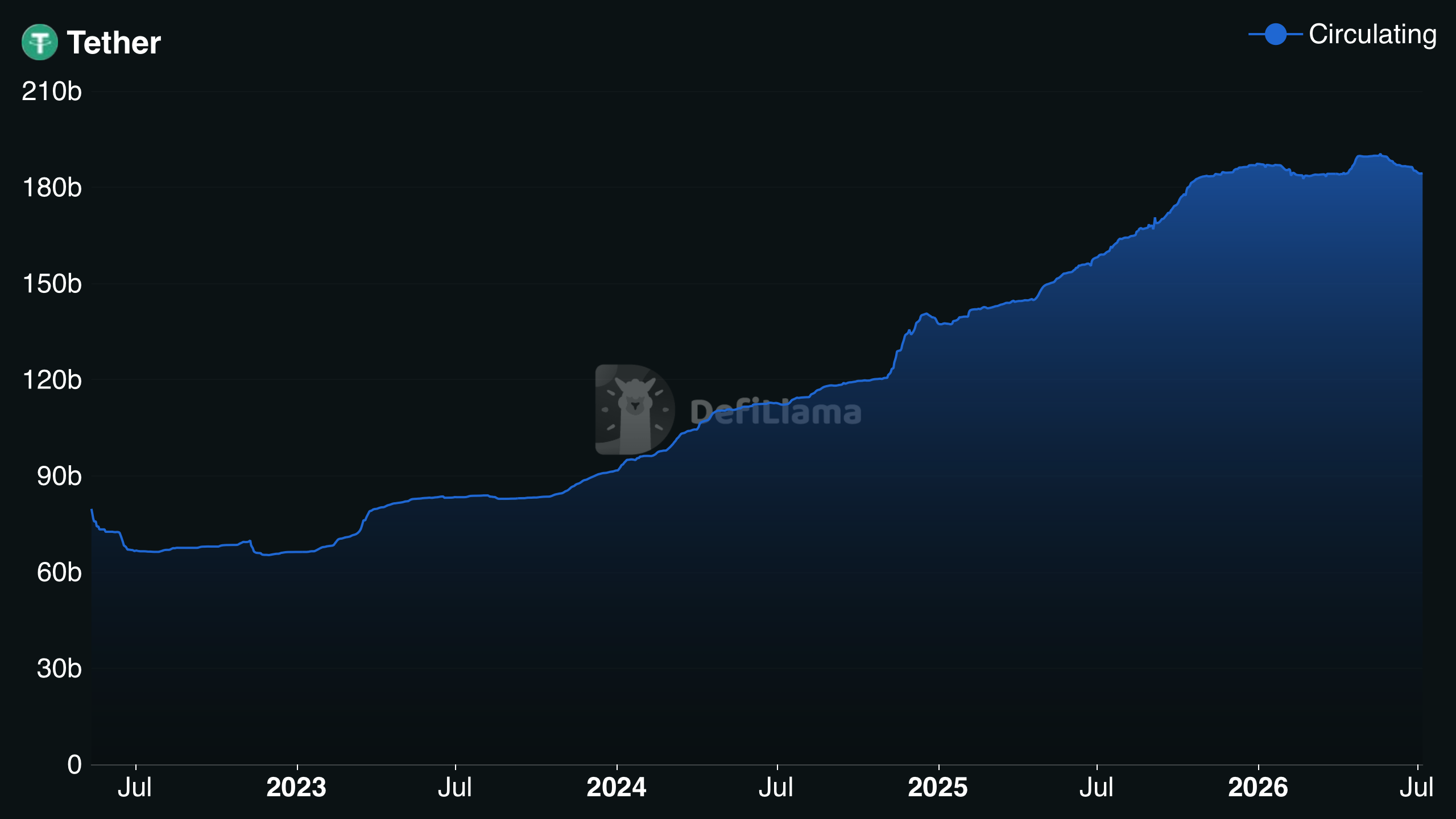
That scale was built on the model Tether pioneered in 2014: a token pegged 1-to-1 to the US dollar that lets traders, merchants, and funds move in and out of volatile positions without touching the banking system, a use case that made USDT the default settlement dollar of crypto and drove its supply from under $70 billion in 2023 to its current level. Importantly, Tether is not relocating USDT to Bitcoin, it is adding Bitcoin as another native option while continuing to operate fully across all its existing networks. The bulk of supply currently lives on Tron, which holds roughly $87.6 billion of circulating USDT.
The launch is expected within weeks, potentially before month-end, following the mainnet release of RGB v0.11.1. UTEXO serves as issuer and distributor and has built the supporting infrastructure, including APIs, SDKs, UI components, and a live mint bridge at mint.utexo.com that moves USDT across chains with what the company calls deterministic low fees. Early support is expected through compatible RGB and Lightning-enabled wallets that handle native Bitcoin addresses, with subsequent integration planned into the Tether Wallet ecosystem and major exchanges.
The strategic stakes are larger than a technical launch. Bitcoin-native USDT is Tether’s attempt to reclaim stablecoin flow onto the network it considers the most secure settlement layer. Whether it succeeds depends less on the cryptography, which is sound, than on adoption: UTEXO’s go-to-market deliberately targets existing USDT flows through payment providers, exchanges, and wallets rather than trying to bootstrap new demand.
Challenges remain, particularly regarding the Lightning Network’s capacity for liquidity routing at scale, as the movement of substantial stablecoin volume via this method has yet to be proven. Nevertheless, the strategic potential is high: it could transition Bitcoin into an active dollar-settlement rail and grant Tether greater independence from the networks it does not control.
This article is for informational purposes only and does not constitute financial or investment advice. Cryptocurrency markets are highly volatile. Always conduct your own research before making investment decisions.
The post USDT Returns to Bitcoin, 12 Years After Its Debut appeared first on Coindoo.





