Key Takeaways:
Ethereum is set out for the largest protocol upgrade in its history since The Merge. Ethereum co-founder Vitalik Buterin announced an update to the chain’s roadmap, which takes the form of numerous coordinated improvements dubbed Lean Ethereum and that will make the network more efficient and scalable in the next few years.

Buterin described Lean Ethereum as the network’s third major evolution rather than a single hard fork. The roadmap not only changes many existing fundamental parts of Ethereum, but reorganizes it without severely harming decentralized applications.
Two weeks ago, Ethereum researchers met in Berlin to continue charting the protocol’s long-term trajectory, following along discussions with client teams in Svalbard in April.
The updated strawmap is at https://t.co/HZEerH1xxI, and I attached a picture of it to this post.
My… pic.twitter.com/KPGayHSySf
— vitalik.eth (@VitalikButerin) July 4, 2026
One crucial change is the transition of the direct transaction re-execution proofs to recursive STARK proofs to enable faster block verification. Ethereum’s development team also intends to implement a new consensus model that either renders the transactions confirmed within one round or two rounds, which will make nodes quicker to turn confirmed transactions into blocks and enhance security.
Other planned upgrades are multidimensional gas pricing, client architecture improvements, and further protocol simplification for easier maintenance as Ethereum scales.
Read More: Vitalik Reveals Ethereum Foundation Overhaul as ETH Secures $250B and Cuts Influence
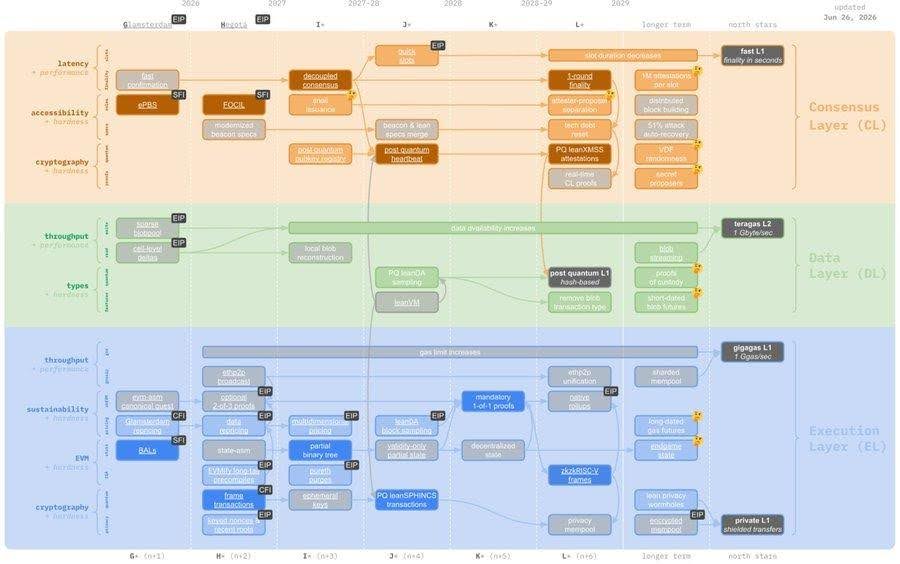

A major shift in the Roadmap is the rise in prioritizing post-quantum security. Buterin said Ethereum will gradually replace cryptographic components that could become vulnerable to future quantum computers, with quantum-safe blob designs already under active development.
Privacy is also becoming a core protocol objective instead of an optional feature. Going forward, privacy will be addressed over layers in the Ethereum system, from the mempool to the state design, to the processing of transactions.
The roadmap also makes formal verification more common, enabling developers to mathematically prove and validate the protocol’s parts before implementation for increased reliability and lower security risks.
The most powerful one might be the updated state design in Ethereum.
Ethereum will support more state types besides the dynamic type that are scalable for other assets like ERC-20 tokens, NFTs, and numerous DeFi consumers. Pre-existing apps will not need to migrate, but developers can choose to use the new storage formats and gain efficiencies from their use.
Buterin says that apps on these new state models would slash transaction costs by over 10x. By 2030, Ethereum could have up to 2 TB of traditional state and 100TB of new scalable state for increased throughput.
Read More: Vitalik Buterin Redefines Crypto Security, Says “Perfect Security” Is Impossible
The post Vitalik’s Lean Ethereum Plan Targets 10x Lower Fees, Quantum Safety, and Faster Finality appeared first on CryptoNinjas.





