Ethereum’s Lean Ethereum roadmap is a broad vision spanning multiple years and touching almost every layer of the protocol, from consensus and cryptography to data availability and node economics. The core ambition is to make Ethereum radically simpler to run and verify, so that ordinary users can participate as full validators without specialized hardware, while pushing throughput high enough to serve global-scale demand. But its credibility rests on whether the individual pieces are actually buildable.
One of Vitalik Buterin’s concrete proposals, the “Extremely Lean Chain,” offers a look at how the abstract goals turn into real engineering, and it captures the whole philosophy in miniature: do far more with far less permanent data. The design leans on zero-knowledge proofs and short data-retention windows so that validators keep the network secure without storing its entire history, a shift that would redefine what it means to run an Ethereum node.
The proposal targets the consensus layer, and specifically the amount of data Ethereum has to store about every validator. Today, the Beacon Chain keeps a full profile for each one: a 48-byte public key, 32-byte withdrawal credentials, a 1-byte effective balance, a 1-bit slashing flag, 32 bytes of epoch data across eight fields, and an 8-byte active balance. Multiply that by hundreds of thousands of validators, all of it held permanently on-chain, and it becomes one of the ceilings on how many validators Ethereum can realistically support.
Buterin’s design attacks that directly. Under the proposal, each validator’s stored state shrinks to just two fields: a 1-byte effective balance and a 5-byte public key index. Everything else that used to sit permanently on-chain gets verified through cryptographic proofs instead of being stored. That’s the core idea behind “lean”, replacing stored data with math.
The public key is a good example of how this actually works. Today, every validator’s full 48-byte key lives in Ethereum’s permanent consensus state. Under Buterin’s proposal, the key stays in the deposit tree, where it’s already recorded when a validator first joins, so there’s no need to store it a second time on-chain.
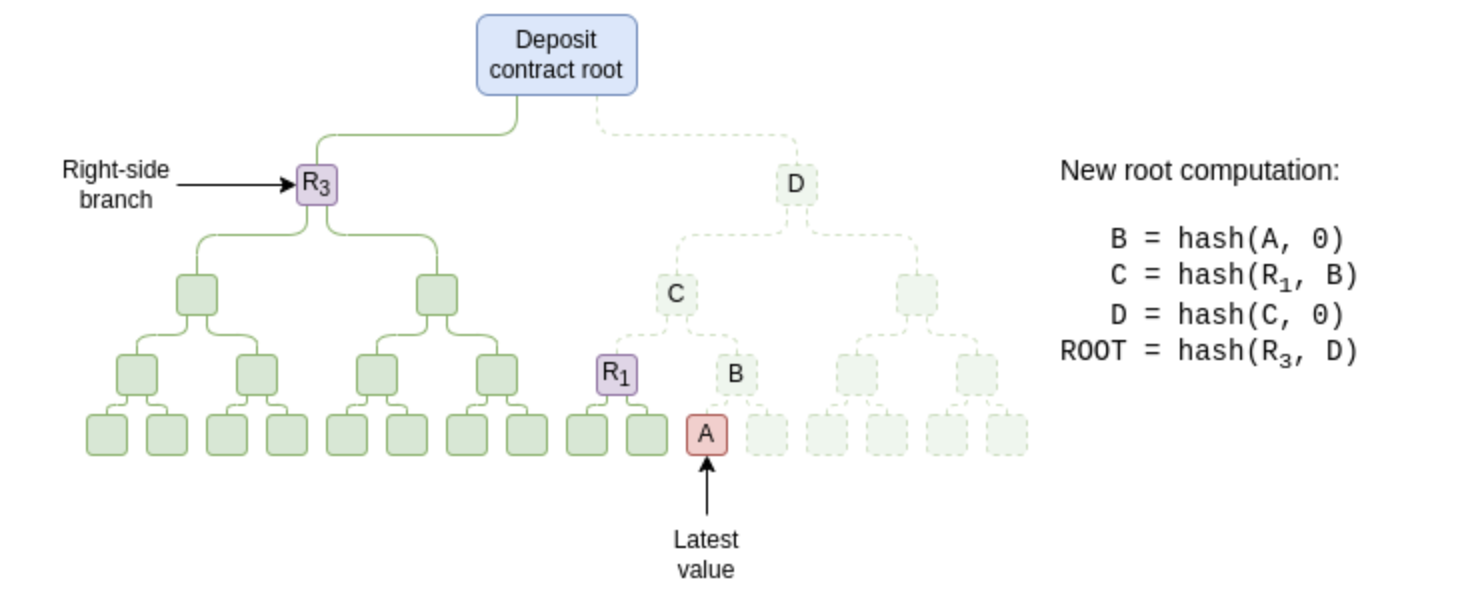
Instead, Ethereum keeps only a 5-byte index pointing to the key’s location in that tree. Because the deposit contract only has to maintain the tree’s right-side branch to append new deposits, validators can retrieve and prove their public key whenever it’s needed, without every node holding a permanent copy. Paired with STARK-based aggregation, this alone strips a substantial chunk of data out of the consensus layer.
The same trick extends to withdrawal credentials. Because they sit right next to the validator’s public key inside the deposit tree, Ethereum no longer needs to keep them in Beacon Chain state either, they’re already recorded where the key lives. That removes yet another field from permanent storage, compounding the savings rather than adding a separate system to manage.
The way it works is where the design gets interesting. Rather than the network continuously tracking every validator’s balance, each validator would generate a daily zero-knowledge STARK proof, a compact cryptographic statement showing how it participated over the previous period and what its new balance should be. The network simply verifies that proof and updates the validator’s effective balance for the following day.
The shift is bigger than it sounds, because it moves reward and penalty math off the Beacon Chain’s real-time processing entirely. Today, the network calculates those adjustments as part of its live state transition; under the proposal, each validator instead generates a daily ZK-STARK proof, using Merkle branches and attestation bitfields, that shows how many attestations it actually completed and derives its updated balance. That proof becomes the validator’s balance for the next day. There’s also a practical timing detail baked in to prevent congestion: each 24-hour period’s balances are calculated using only blocks from up to 12 hours earlier. That gives validators a half-day window to submit their proofs and spreads proof publication evenly across the network, rather than having everyone rush to prove at the same moment.
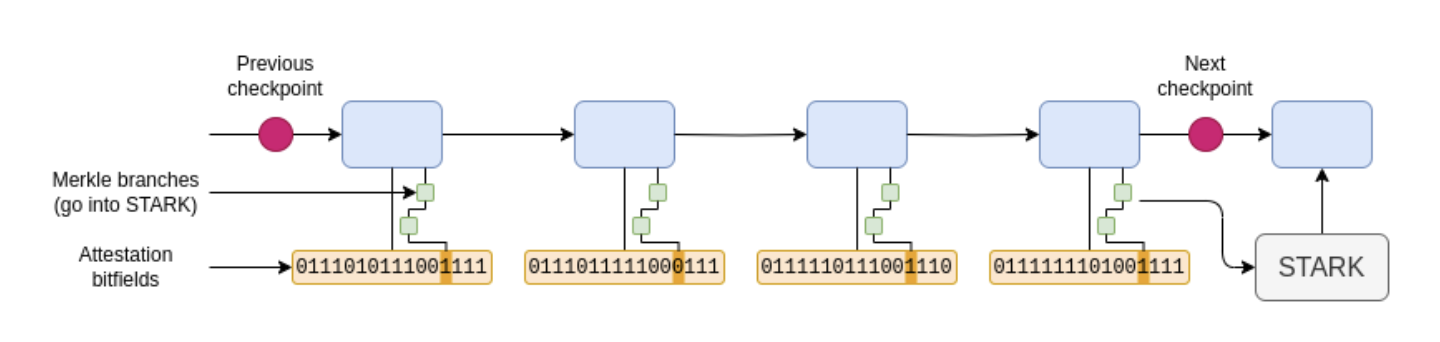
The elegant part is what happens when a validator doesn’t submit one. It isn’t slashed or removed from the network; it just can’t keep attesting until it provides the required proof. Honesty is enforced by the system’s design rather than by Ethereum having to permanently monitor everyone’s data, the responsibility shifts to the validator to prove it’s acting correctly, instead of the network storing everything needed to check.
The payoff shows up in how rarely the chain has to write anything at all. Today, Ethereum updates validator balances constantly. Under the proposal, those writes collapse to just two kinds: one when a slashing happens, and one per validator per day when its proof lands. And because a validator can always submit its proof late, catching up whenever it’s ready without being penalized, the “can’t attest until you prove” rule stays an accountability mechanism rather than a punishment. The result is a consensus layer that does dramatically less continuous work.
All of this is in service of scale. The proposal is explicitly built to support far more validators than Ethereum runs today, potentially millions, without the storage burden exploding to match. Assuming 16-second epochs, each validator would generate proofs covering roughly 5,400 Merkle branches per day, a workload Buterin says can be produced in about an hour even on relatively weak hardware.
The rest of the numbers Buterin cites are meant to show this is computationally realistic, not just theoretical. At one million validators, the network would need roughly a 128 KB bitfield to track participation and about a 1 MB tree to hold effective balances, both modest by modern standards. He notes that laptops can already prove more than 500,000 hashes per second, well within range of the daily workload each validator faces.
Buterin is also upfront about the catch. A network with a million validators would generate more than 100 STARK proofs per slot, which means the proofs themselves would need to be aggregated before being submitted on-chain. That aggregation is an engineering challenge the design still has to solve, not one it has already cleared, a reminder that this is a proposal under discussion, not a finished system.
If we want to make the Lean Ethereum consensus chain aggressively more “lean”, and add strong validator privacy (ZK-unlink deposit from staking activity from withdrawal, and re-anonymize stakers every day), here is a path:https://t.co/Gdee7tE53R
— vitalik.eth (@VitalikButerin) July 6, 2026
The structure also delivers on one of Lean Ethereum’s stated priorities, privacy, almost as a side effect. Instead of carrying a permanent, trackable identity, each validator would generate a new public key every day, using ZK-STARKs to prove ownership without revealing the link between its past and current identities.
In practice, that means a validator effectively gets a brand-new identity every single day, and only the validator itself knows the daily keys belong to the same operator. It also means Ethereum stops maintaining a permanent validator registry altogether: instead of a long-term index tracking every participant over time, validators simply appear new each day, with no lasting on-chain thread linking them together. That’s a substantial architectural change, not just a privacy tweak.
The privacy extends to withdrawals, too. Today, a deposit publicly reveals its withdrawal credentials. Under the proposal, a deposit would instead store only a hash commitment, keeping the withdrawal address hidden until the moment ETH is actually withdrawn. And Buterin notes the design nearly delivers Single Secret Leader Election (SSLE) for free, a feature that hides which validator will propose a block until it actually produces one, improving censorship resistance and protection against targeted attacks.
According to Buterin, this gives validators strong anonymity while still letting Ethereum verify balances and enforce slashing events. That’s the meaningful shift: privacy stops being an optional feature layered on top and becomes a native property of how consensus itself works, which is exactly the design principle the broader roadmap is trying to establish.
On its own, a validator-accounting redesign sounds narrow. But it’s a useful window into what “leaner” actually means in practice, and it’s not vague talk of efficiency. It’s specific choices: replacing permanent stored data with on-demand proofs, enforcing honest behavior through cryptography instead of constant monitoring, and folding privacy into the base layer rather than bolting it on.
The payoff for the network, if it works, is meaningful. Supporting far more validators without a matching explosion in state directly serves decentralization, more independent participants can run nodes because the data burden on each one stays manageable. Lighter state also means faster syncing and lower hardware requirements, which lowers the barrier to running a validator and reduces the drift toward a handful of well-resourced operators. The privacy gains address a real, under-discussed vulnerability too: today’s permanent validator identities can be mapped and targeted, and daily re-anonymization plus hidden block proposers (through the near-free SSLE) make censorship and targeted attacks materially harder. Taken together, these are improvements to the parts of Ethereum that matter most for its long-term health, not just its raw throughput.
The risks are just as real, and worth stating. The whole design leans heavily on zero-knowledge proving being fast, cheap, and reliable at massive scale, and the aggregation problem Buterin flags, more than 100 proofs per slot at a million validators, is not yet solved. If proof generation or aggregation proves too slow or too costly in practice, the elegance on paper doesn’t translate. There’s also added complexity: shifting from stored data to daily proofs introduces new moving parts, new places for bugs, and new dependencies on cryptography that has to be flawless, since a flaw in a proof system is far harder to spot than a wrong number in a database. And the daily-proof model changes validator responsibilities, an operator whose proving setup fails simply stops attesting until it recovers, which is safer than being slashed but shifts more operational burden onto validators themselves.
Like the rest of Lean Ethereum, none of this is live, and the proposal will evolve through debate, auditing, and testing before anything reaches the network, if it does at all. That caution is the appropriate response to a change this deep: the upside is a more scalable, more private, more decentralized consensus layer, but the path there runs through hard cryptographic engineering that has to be proven safe before it can be trusted with billions in staked value. What the proposal shows, at minimum, is that the roadmap’s ambitions rest on real, detailed engineering rather than slogans, which is the strongest thing any early-stage proposal can offer.
The post Inside One of the Boldest Ideas in Ethereum’s Lean Roadmap appeared first on Coindoo.





