15.5 million LIT tokens are about to disappear from circulation forever. If you're holding or staking LIT, this shift in how rewards get funded could directly affect your yield going forward. Here's what most reports aren't telling you about the timing — and why the stakings number matters more than the burn.
The Ethereum ZK-rollup perpetuals exchange has confirmed a major Lighter Tokenomics Update. The Lighter protocol will permanently burn approximately 15.5 million $LIT that were previously bought back using exchange revenue.
That figure represents roughly 6.3% of Lighter Token's circulating supply. According to the announcement, these tokens were accumulated programmatically since the token generation event, funded entirely by exchange fees.
The first burn is scheduled to happen in the weeks following the end of Q2 2026, with tokens withdrawn from the exchange and sent to a burn address on the Ethereum mainnet.
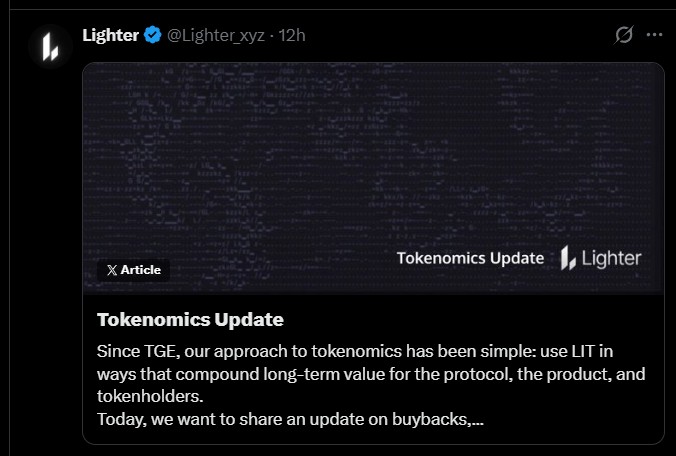
Source: Official Post
This isn't just a supply-reduction headline. Lighter is also changing how it funds locking rewards — a shift that touches every holder currently staking on the platform.
Until now, locking yield was bootstrapped using Lighter Token pre-TGE revenue, which let the protocol send exchange fees toward buybacks instead. Roughly 3.72 million LIT has already gone to stakers under that model.
Going forward, stakings rewards will instead be funded from the ecosystem token reserve rather than early revenue. That's a structural change in where yield actually comes from.
Burning mount: ~15.5 million LIT(6.3% of circulating supply)
First window: Weeks after Q2 2026 ends
Burn mechanism: Tokens sent to a address on the Ethereum mainnet;
Lighter notes it may burn undistributed LIT rather than the exact repurchased tokens, which it says is economically equivalent
New stakes yield target: 6% annualized
Current staked supply: ~125 million token
Estimated annual staking distribution: ~7.5 million $LIT, drawn from a remaining pool of 250 million ecosystem tokens
Lighter has also confirmed an End of Q2 2026 investor call on July 2 at 10:30 AM ET, led by founder Vlad Novakovski, covering metrics, product updates, and a live Q&A.
Lighter says future treasury decisions will balance four goals: rewarding long-term stakers, continuing disciplined burns, preserving tokens for future partnerships and points seasons, and stewarding funds for long-term tokenholder value.
That framing suggests burns and staking rewards won't be the only use of ecosystem tokens going forward — some supply is deliberately being held back for growth initiatives rather than distributed immediately.
The protocol has confirmed an End of Q2 2026 investor call on July 2 at 10:30 AM ET, led by founder Vlad Novakovski. The session covers protocol metrics, product updates, and a live Q&A, with an anonymous question form open beforehand. Given the timing, this call could add detail on exactly how the new burn and staking framework plays out in practice.
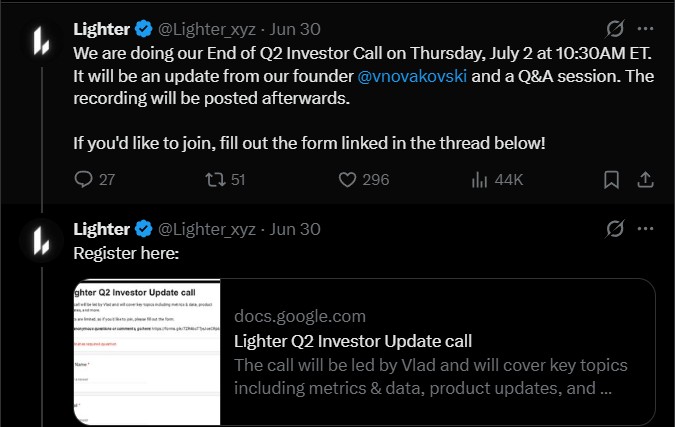
Source: Official X
The 6% staking yield target is explicitly described as subject to change at the team's discretion based on market conditions and protocol performance — so this number isn't locked in stone.
Watch the actual burn transaction once it executes on Ethereum mainnet in the weeks after Q2 close, since the "undistributed LIT" clause means the exact tokens burned may not match the original buyback batch.
The July 2 investor call could also reveal further details on how balances future burns against ecosystem growth spending — a topic directly tied to reported TVL levels near $511 million.
Lighter tokenomics changes overhaul locks in a real supply cut while shifting staking incentives onto the ecosystem reserve instead of trading revenue. The coming weeks — starting with the July 2 investor call and the first scheduled burns — will show whether this new structure holds up as staking scale grows.
Disclaimer: This article is for informational purposes only and does not constitute financial, investment, or trading advice. Cryptocurrency markets are volatile and carry risk. Always do your own research before making investment decisions.





