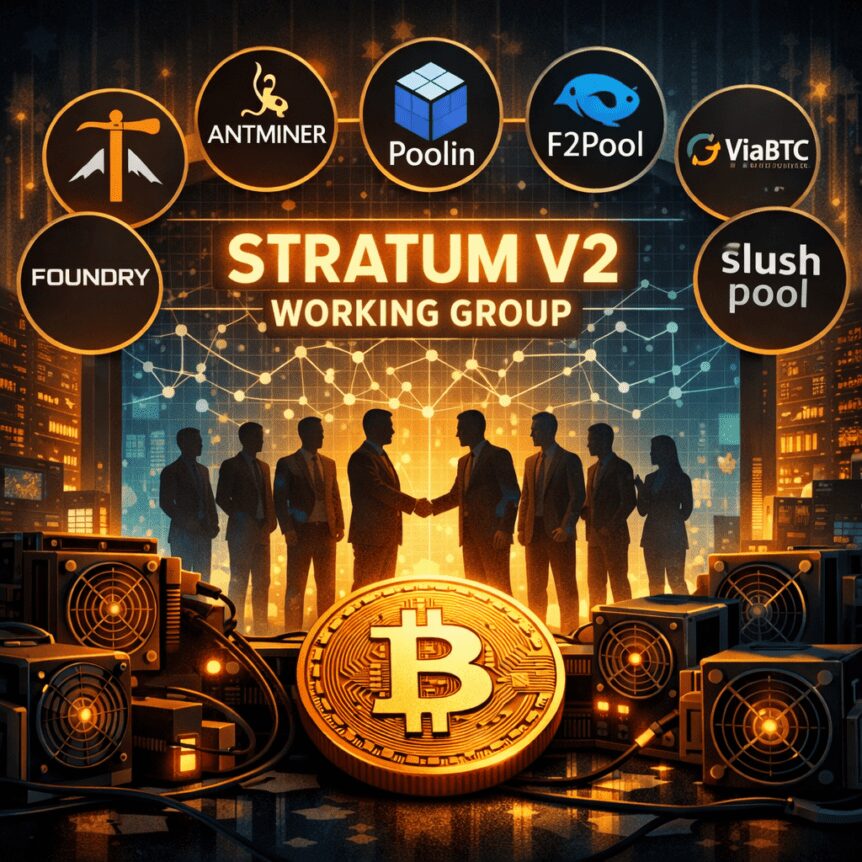
<pSeven major Bitcoin mining pools have joined the Stratum V2 working group to co-develop an industry-wide, open standard protocol that governs how pool operators communicate with individual miners within pools. The move marks a sustained push toward interoperable tooling in a sector that has long wrestled with fragmentation and centralized control.
<pThe participating pools are AntPool, Block Inc, F2Pool, Foundry, MARA Foundation, SpiderPool, and DMND. The group’s公开 announcement describes Stratum V2 as a collaboration aimed at standardizing mining-pool communication to speed up block discovery and improve overall efficiency. “Bitcoin mining is competitive and fragmented by design. It is a race for efficiency where a millisecond can determine whether a miner wins a block or loses to a competitor,” the Stratum V2 message notes.
“Bitcoin mining is competitive and fragmented by design. It is a race for efficiency where a millisecond can determine whether a miner wins a block or loses to a competitor.”
Foundry and AntPool are the two largest Bitcoin mining pools by hashrate, the total computing power deployed to secure the network. Hashrate Index data show Foundry controlling nearly 30% of the global mining pool hashrate, with AntPool accounting for about 17.7%.
Developing an open standard for mining pools that is not controlled by any single operator represents a deliberate move toward decentralization in an industry that has grown increasingly centralized in practice. By enabling more flexible block template selection and reducing reliance on any one pool’s internal systems, the Stratum V2 initiative seeks to lower barriers to entry for smaller operators and solo miners alike.
In a related note, Cointelegraph coverage has highlighted ongoing efforts to unify Bitcoin infrastructure through open-source tooling. For example, Tether recently launched an open-source mining framework intended to complement open standards in the space. These kinds of collaborations underscore a broader industry push toward interoperability that could reshape how mining capacity is aggregated and allocated across the network.
The Stratum V2 effort arrives at a time when the mining sector is re-evaluating how information about block templates, work distribution, and payout mechanics should flow between pools and miners. The Stratum V2 blog post frames the standard as a neutral, shared baseline that prevents any single operator from holding undue sway over the mining workflow. By enabling more miners to participate in block assembly and by standardizing communication layers, the protocol could improve resilience and resilience against outages or targeted disruptions in any single pool’s infrastructure.
This is not just a technical nicety. The degree to which mining remains decentralized is a live concern among observers. When a handful of pools control a sizable portion of the network’s hashrate, the incentives around protocol design, block templates, and timing can become concentrated. An industry-wide standard that is collectively owned could help tilt the balance back toward broader participation while preserving pool-level incentives for efficiency and reliability.
Beyond the Stratum V2 development, the broader crypto media ecosystem has been tracking parallel efforts to standardize and modernize Bitcoin infrastructure. The open-source mining framework advocated by Tether, as noted by Cointelegraph, aligns with a growing thesis that interoperability will be a key driver of adoption and resilience in the Bitcoin mining space.
Looking at the macro side of the mining equation, the network’s difficulty—the measure of how hard it is to mine a new block—is expected to rise at the next adjustment. CoinWarz projects the adjustment to occur around May 15, 2026, with the difficulty increasing from about 132.47 trillion to 135.64 trillion. While the exact timing can shift, the direction matters: a higher difficulty amplifies the cost per mined block unless efficiency improves.
At the same time, miners face mounting energy costs as the economics of securing the network tighten. The combination of higher difficulty and rising energy expenses compounds the pressure on a sector that, according to CoinShares, already has around 20% of operators unprofitable in the current market environment. Profitability is tightly tied to the price of electricity, which continues to be a critical input for miners globally.
Another signal of the tightrope miners walk is hashprice—the revenue per unit of mining power before expenses. CoinShares reports hashprice levels in a narrow band, roughly between $36 and $38 per petahash per day, which for some operators is near or at the breakeven point given their costs and efficiency profiles.
These dynamics frame the Stratum V2 adoption as a potentially important tailwind for miners seeking to regain material efficiency. By enabling faster, more reliable block templates and reducing coordination overheads between pools and miners, the open standard could help some operators squeeze out small but meaningful gains in throughput and stability even in a market where margins remain under pressure.
As readers watch these developments, investors and builders may consider how broader adoption of Stratum V2 could affect pool competition, miner profitability, and the resilience of the network during periods of stress. And while the path forward is still unfolding, the convergence around open standards is likely to influence both the competitive landscape and the regulatory conversations shaping how mining operations scale in the years ahead.
For readers interested in related industry threads, Cointelegraph’s coverage of mining sector dynamics, including Squeeze scenarios and the push for more open tooling, remains a useful companion resource. And as the sector contends with post-quantum considerations, industry voices continue to explore timelines for upgrading Bitcoin’s security layers—an arc that could shape debates on long-term protocol robustness as the mining ecosystem evolves.
Watch closely how many more pools embrace Stratum V2 and whether new open-standard implementations gain traction. The outcome could influence not only operational efficiency but also the degree to which the mining landscape remains distributed in practice, even as capital and technology concentrate around efficiency leaders.
Related: Tether launches open-source mining framework to unify Bitcoin infrastructure — Cointelegraph Tether launches open-source mining framework to unify Bitcoin infrastructure
Published context: CoinWarz data on difficulty, CoinShares mining insights, and Hashrate Index pool shares CoinWarz · CoinShares · Hashrate Index
Post-quantum reference: Bitcoin may take 7 years to upgrade to post-quantum — BIP-360 co-author Cointelegraph Magazine
This article was originally published as Seven Major Bitcoin Mining Pools Back Stratum V2, Form Working Group on Crypto Breaking News – your trusted source for crypto news, Bitcoin news, and blockchain updates.





