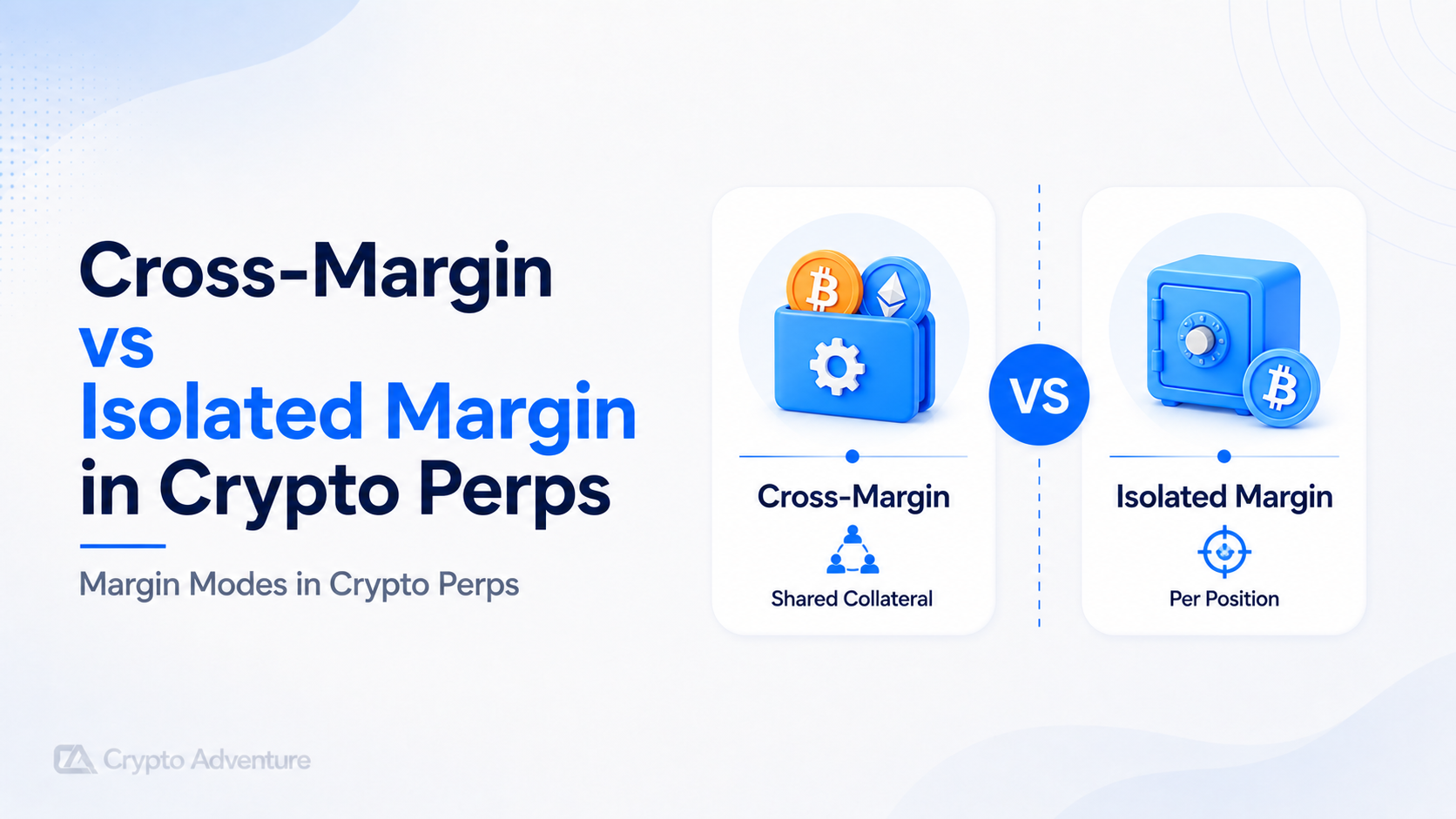
Margin mode decides how collateral supports a perpetual futures position. The trade direction may get most of the attention, but the margin mode often decides how much damage a wrong trade can do. In crypto perps, the two core choices are cross-margin and isolated margin.
Cross-margin shares available collateral across positions. If one position moves against the trader, other available account equity can help keep it alive. Isolated margin locks a defined amount of collateral to one position. If that position fails, the damage is contained to the isolated allocation unless the platform has special account-wide rules.
This choice matters because perpetual futures are leveraged instruments. A 5% move against a spot holder is uncomfortable. A 5% move against a leveraged perp trader can trigger liquidation if margin is too thin. Cross and isolated margin change the shape of that risk.
Cross-margin treats the account as a shared collateral pool. A profitable position can support a losing one, and unused collateral can reduce liquidation pressure across the account. This is why active traders often prefer cross-margin for portfolios with multiple related positions.
For example, a trader may hold a long BTC position, a short ETH position, and some unused collateral. If BTC dips temporarily while ETH also moves in a favorable direction, the account’s overall equity may still remain healthy. Cross-margin allows the risk engine to look at the account more holistically.
Hyperliquid margining uses margin rules where cross-margin positions draw from account collateral, while isolated margin allocates collateral to specific positions. In cross-margin, changing the leverage setting does not itself move the liquidation price in the same way because leverage mainly changes the amount of collateral initially used or available. The account equity and maintenance requirements matter more than the displayed leverage number.
The advantage is capital efficiency. The weakness is contagion. One bad position can consume collateral that the trader thought was backing the entire account. In a violent move, cross-margin can liquidate more of the account than the trader expected.
Isolated margin separates collateral for one position. The trader chooses how much margin to allocate, and that position has its own liquidation logic based on the assigned collateral. If the position moves against the trader, only that isolated collateral is at direct risk under normal conditions.
This makes isolated margin useful for higher-risk trades, experiments, long-tail markets, or positions that should not threaten the rest of the account. A trader may want to take a short-term high-conviction trade without letting it drain collateral from safer positions.
The downside is that isolated margin gives the position less flexibility. If the market wicks against the trade and the isolated allocation is too small, liquidation can happen even if the user has unused collateral elsewhere. The trader must actively add margin or reduce position size to avoid liquidation.
dYdX isolated markets use segregated collateral and market-specific risk properties. That structure helps protocols support more markets because risk can be contained rather than shared across every position in the same way.
Cross-margin protects the position by using more of the account. Isolated margin protects the account by limiting the position.
That is the cleanest way to remember the difference. Cross-margin can help a trade survive temporary volatility, but it can put more total collateral at risk. Isolated margin can stop one trade from damaging the whole account, but it can liquidate faster if the isolated allocation is too small.
| Margin Mode | Best For | Main Advantage | Main Risk |
|---|---|---|---|
| Cross-Margin | Portfolio trading, hedging, correlated positions | Better capital efficiency and more liquidation buffer | One bad trade can drain shared collateral |
| Isolated Margin | Single trades, speculative setups, risk containment | Damage is limited to allocated margin | Position can liquidate faster without extra margin |
Neither mode is universally better. The right choice depends on position size, leverage, asset volatility, correlation, funding cost, and how actively the trader manages risk.
Cross-margin can make liquidation feel farther away because more collateral supports the account. This can be helpful for lower-leverage strategies, hedged books, basis trades, and multi-position portfolios. A trader who understands the full account risk may prefer cross-margin because it avoids unnecessary liquidations caused by isolated collateral shortages.
The problem appears when traders mistake cross-margin for safety. It is not safety. It is shared exposure. If one position becomes large enough, it can pull the entire account toward liquidation. If several correlated positions move against the trader at the same time, cross-margin can accelerate account-wide damage.
This risk is especially important in crypto because correlations often rise during stress. BTC, ETH, altcoins, and perp markets may all move together when liquidity dries up. Cross-margin that looked efficient during calm markets can become dangerous when every position moves in the same direction.
Isolated margin creates a clearer loss boundary. The trader knows how much collateral is assigned to the position. That makes it easier to size a trade and avoid accidentally using the entire account as a backstop.
The trade-off is a narrower liquidation buffer. If the isolated margin is small, liquidation can happen quickly. Adding more isolated margin can move liquidation farther away, but that also increases the amount at risk in that position.
Isolated margin works best when the trader treats it as a position-sizing tool, not a leverage toy. A small allocation with very high leverage is still dangerous. The position may be contained, but the odds of losing that allocation can be high.
Funding affects both margin modes. If a trader pays funding, account equity or position margin can decline over time depending on the platform’s mechanics. A position can move sideways and still become more vulnerable because funding quietly reduces the available cushion.
This is why funding rates matter as much as entry price for leveraged trades. In cross-margin, funding can reduce shared account equity. In isolated margin, funding treatment depends on platform implementation, but the cost still affects the trade’s real return.
Fees and slippage also matter. Opening and closing costs reduce equity. A liquidation penalty can make losses worse. During volatility, a trader may exit at a worse price than expected, especially in thinner markets. Margin mode does not remove these costs. It only decides how collateral is allocated around them.
Cross-margin is better for experienced traders who understand portfolio-level risk. It can work well for hedging, market-neutral strategies, basis trades, or multi-position books where positions offset one another. It is also useful when the trader wants to reduce the chance of liquidation caused by temporary volatility in one position.
Isolated margin is better for users who want clearer containment. It is useful for directional trades, volatile altcoins, event-driven setups, and experiments where the trader wants a defined maximum collateral allocation. It can also be safer for beginners because one mistake is less likely to consume the whole account.
The key is honest risk sizing. A beginner using isolated margin with extreme leverage is not safer than an experienced trader using cross-margin conservatively. The risk comes from position size, leverage, volatility, funding, and liquidity together.
The most common cross-margin mistake is assuming unused account collateral is separate from a bad trade. In cross-margin, that collateral can support the position and be consumed if the trade continues moving against the account.
The most common isolated-margin mistake is allocating too little margin and using too much leverage. The trader may feel protected because the loss is capped, but repeated liquidations can still destroy capital.
Another mistake is ignoring correlation. A trader may think several positions diversify risk, but if they are all long crypto beta, cross-margin simply combines the same directional bet into one larger account-level exposure.
A final mistake is focusing only on liquidation price. Liquidation price is important, but it is not the whole trade. Funding, fees, price impact, oracle movement, and changing volatility all shape real risk. Anyone comparing spot and perps should treat margin mode as part of the product choice.
Cross-margin and isolated margin solve different problems. Cross-margin gives positions more room by sharing account collateral, making it useful for experienced traders, hedged books, and capital-efficient portfolio management. Isolated margin limits damage to a specific allocation, making it useful for contained risk, volatile trades, and users who do not want one position to threaten the full account.
Neither mode makes leverage safe. Cross-margin can drain more collateral than expected. Isolated margin can liquidate faster than expected. Both require careful position sizing, funding awareness, liquidity checks, and a clear understanding of how the platform calculates maintenance margin.
The best choice depends on the trader’s goal. Cross-margin protects positions by using the account. Isolated margin protects the account by limiting the position. Understanding that difference is one of the most important steps before trading crypto perps with leverage.
The post Cross-Margin Vs Isolated Margin In Crypto Perps appeared first on Crypto Adventure.





