The architecture of the Bitcoin blockchain is a masterwork of computer science, relying on ingenious, often invisible, components to sustain its verifiable integrity and efficiency at a planetary scale. For key stakeholders within the Bitcoin and broader blockchain ecosystem — from core developers and mining operators to protocol researchers and fund managers — understanding the Merkle Tree isn’t optional; it’s fundamental to evaluating the network’s resilience, scalability roadmap, and operational costs. This data structure is the silent engine that enables a multi-gigabyte ledger of transactions to be summarized in a 32-byte string, fundamentally allowing for lightweight clients and efficient block pruning.
A Merkle Tree is an elegant, tree-like data structure that uses cryptographic hashes to consolidate an unlimited number of data inputs (transactions) into a single output: the Merkle Root. This root serves as a definitive, computationally verifiable summary of all the data beneath it.
The cryptographic commitment is total: changing a single bit in any of the millions of historical transactions would cascade upwards, resulting in an entirely different Merkle Root. Since the Merkle Root is included in the block header and subsequently hashed into the next block’s header, any tampering would break the entire chain, instantly exposing the fraud.
Here’s a visual representation of how a Merkle Tree condenses multiple transactions into a single Merkle Root:
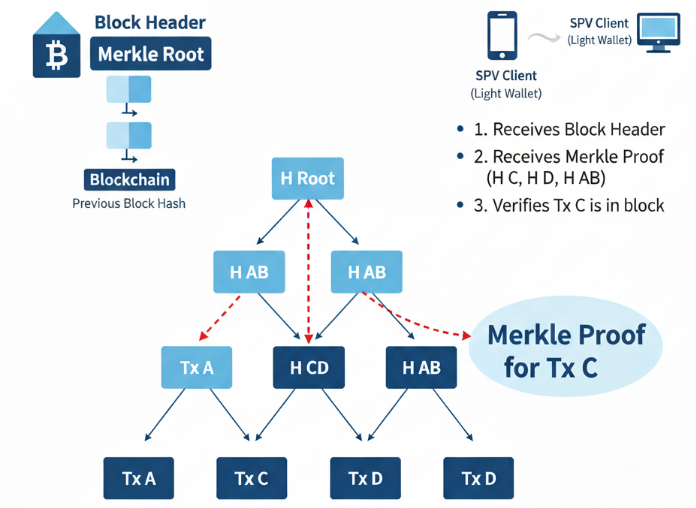
The Merkle Tree is more than a verification tool; it’s a critical enabler of Bitcoin’s operational model, facilitating resource optimization for various network participants.
For the ecosystem to scale, not every participant can run a full node. Full nodes must download and validate every transaction since 2009 — a massive resource commitment. This is where Merkle Trees unlock Simple Payment Verification (SPV), a concept vital for lightweight clients (wallets).
The Mechanism: An SPV client only downloads the block headers (which are tiny, roughly 80 bytes each) and the chain of proof-of-work. To verify a transaction, the client only needs two items from a full node:
The Benefit: The number of hashes in a Merkle Proof grows logarithmically with the number of transactions (log2(N)). For a block with 4,096 transactions, a client only needs 12 hashes to prove that their transaction was included cryptographically. This reduces the verification load from megabytes of transaction data to a few kilobytes of proof data, making instant, on-the-go verification secure and feasible for mobile and low-power devices. This structural efficiency is key to mass adoption.
Beyond Bitcoin, the Merkle Tree is a cryptographic staple for verifiable data structures. Projects that involve Proof-of-Reserves (PoR) utilize Merkle Trees to enable an auditor or individual user to verify that their funds are included in a total reserve pool without revealing the balance or identity of other users. By providing a personalized Merkle Proof, an exchange can cryptographically prove solvency while preserving user privacy — a crucial feature for financial transparency in the blockchain sector.
For full node operators, the most direct and strategic benefit of the Merkle Tree architecture is its ability to enable disk space reclamation — a process critical for maintaining network health and achieving low operational expenditures.
The blockchain is constantly growing, and an actual full node must download and validate every piece of data. This perpetual growth poses a threat to decentralization. If the hardware requirements to run a full node become too high, only a few well-resourced entities will be able to do so, thereby concentrating power.
The Merkle Tree offers a definitive solution through pruning (also referred to as block-chain archiving), a feature designed to curb storage demands without sacrificing security:
By allowing nodes to maintain the cryptographic proof of inclusion (the Merkle Root) while discarding the heavy, historical data, Merkle Trees ensure that running a validating node remains accessible, significantly improving the network’s long-term decentralization and resilience. This architectural feature directly mitigates the greatest scaling challenge for all full-copy distributed ledgers: the spiraling cost of storage.
Merkle Trees: The Engine of Bitcoin’s Scalability and Integrity was originally published in Coinmonks on Medium, where people are continuing the conversation by highlighting and responding to this story.