Meteor Wallet and NEAR Protocol are both built for accessibility without sacrificing power, helping bridge the gap between simplicity and deep functionality for crypto users.
Most crypto wallets ask you to choose between simplicity and depth, pick the clean interface that hides the power, or the powerful dashboard that overwhelms anyone new to Web3. Meteor Wallet has spent the past few years trying to prove that trade-off doesn't have to exist, and after digging through its current feature set, its staking mechanics, and its still-pending Mastercard plans, I think it's one of the more genuinely useful wallets built specifically for the NEAR Protocol ecosystem, even if a few rough edges are worth knowing about before you commit real funds to it.
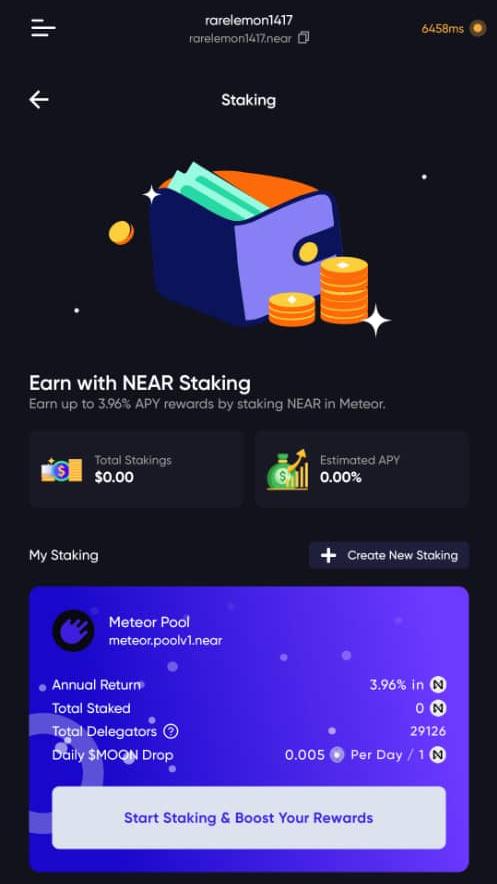
Meteor Wallet is a non-custodial wallet built specifically for NEAR Protocol, meaning you hold your own private keys and seed phrase rather than trusting a third party with custody of your funds. It's available as a web app, a browser extension, and native mobile apps for iOS and Android, and it was founded by a team with a track record inside the NEAR ecosystem, having previously built Near Tinker Union and Enleap Near.
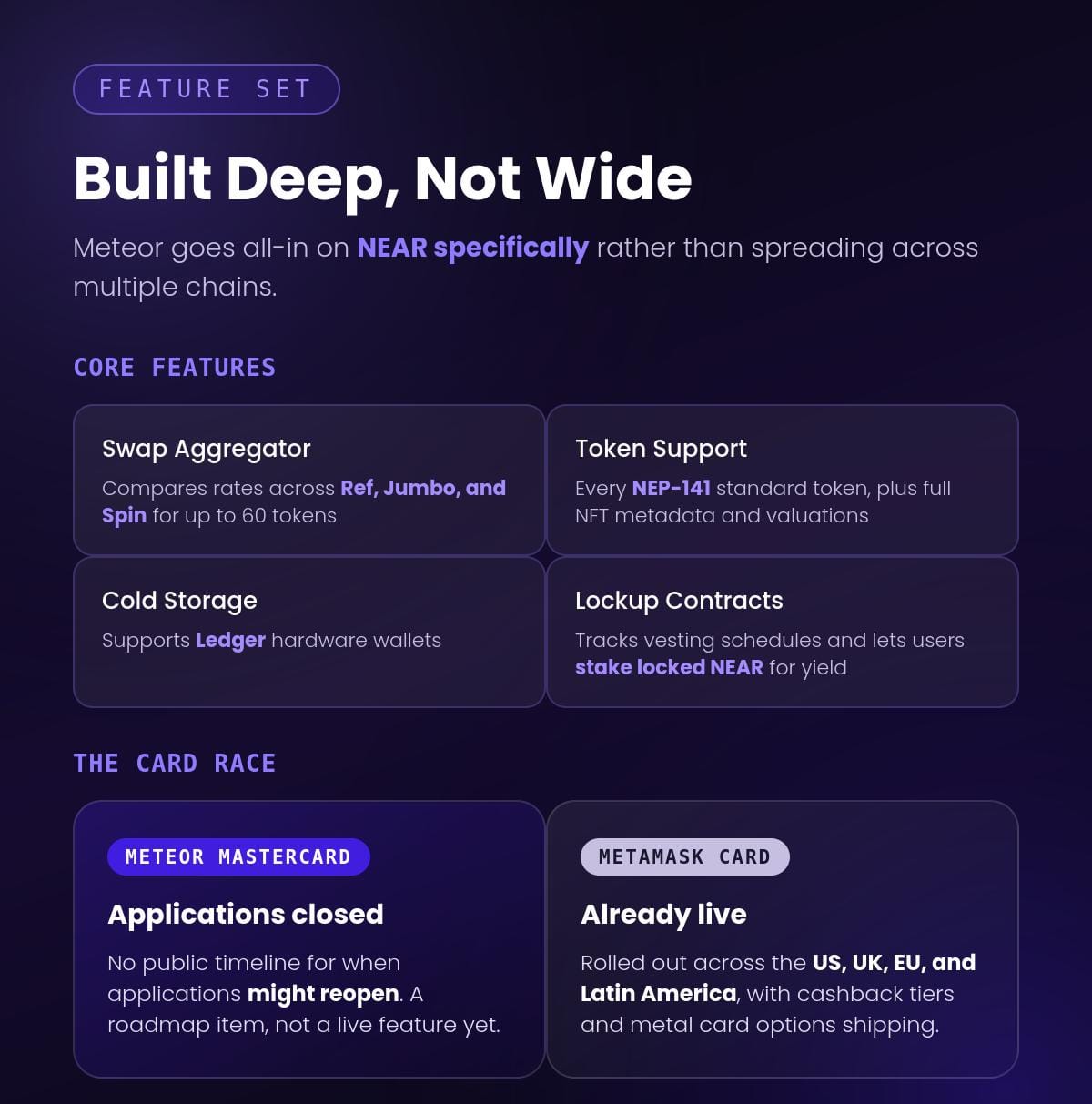
The wallet supports every token following NEAR's NEP-141 standard, gives NFT holders full metadata and asset valuations rather than a bare list of collectibles, and includes a built-in swap aggregator, something Meteor markets as the first of its kind on NEAR. That aggregator compares rates across liquidity providers like Ref, Jumbo, and Spin, letting users swap up to 60 tokens, including major stablecoins, while minimizing slippage and fees. On the security side, Meteor encrypts sensitive data, supports Ledger hardware wallets for cold storage, and says it doesn't log or retain personal information beyond what's publicly visible on-chain.
Staking is arguably where Meteor puts the most effort, and it offers two distinct paths depending on how much flexibility you want with your tokens. Standard Staking lets users delegate NEAR to any of more than 90 validators and pools directly from the wallet, with rewards currently advertised at up to 4% APY and lock periods of 7, 30, or 90 days depending on the option chosen. Liquid Staking, run through a partnership with Meta Pool, issues a receipt token called stNEAR in exchange for staked NEAR, a token that stays transferable and usable elsewhere in DeFi while your underlying stake keeps earning.
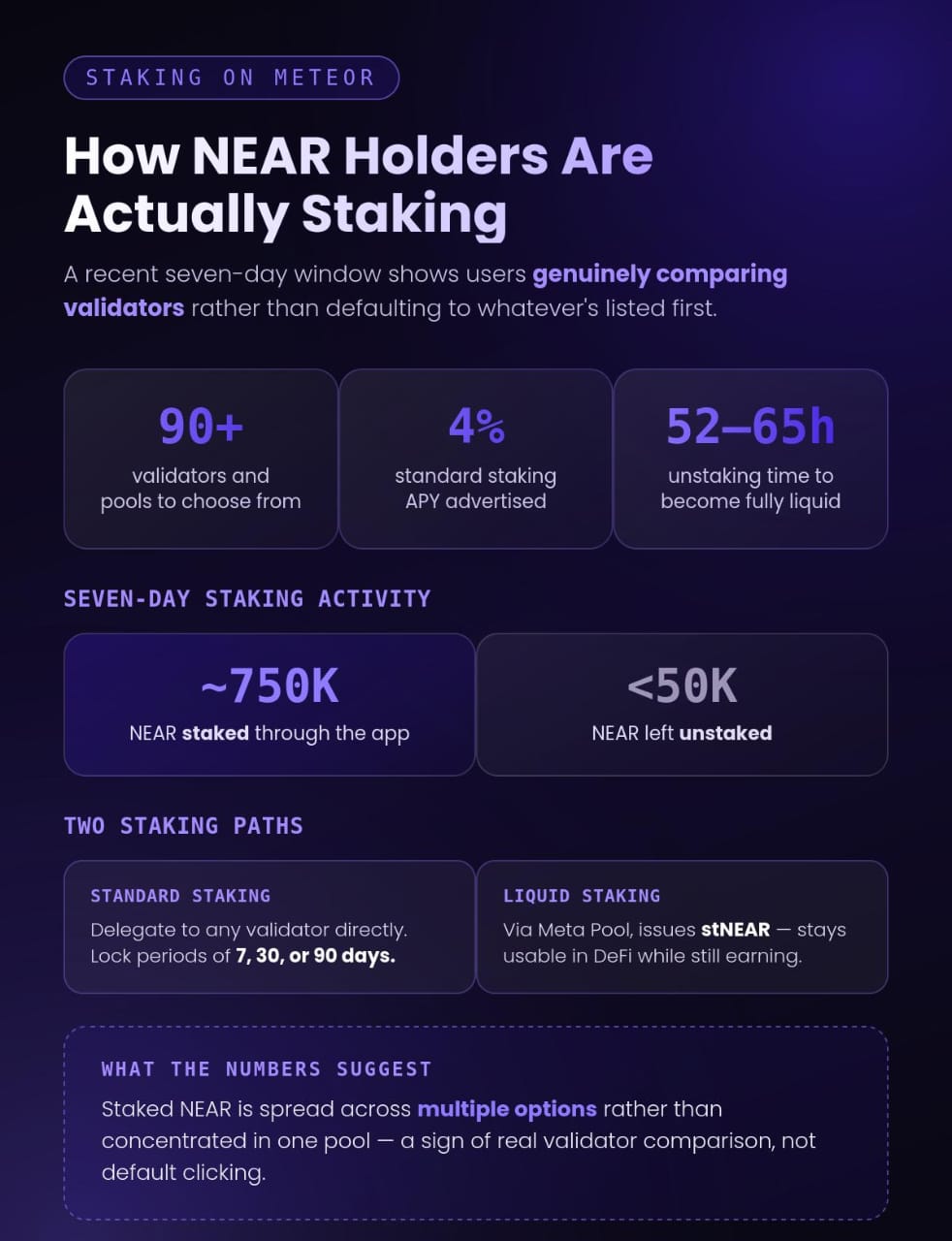
The appeal of the standard route is straightforward: you're not locked out of the broader NEAR economy just because your NEAR is staked. In practice, staking through the app takes a few clicks, enter the amount, choose a validator from a searchable list with visible fee percentages and estimated returns, and confirm. Unstaking typically takes around 52 to 65 hours to clear before funds become fully liquid again, which is standard for NEAR's proof-of-stake unbonding period rather than something specific to Meteor.
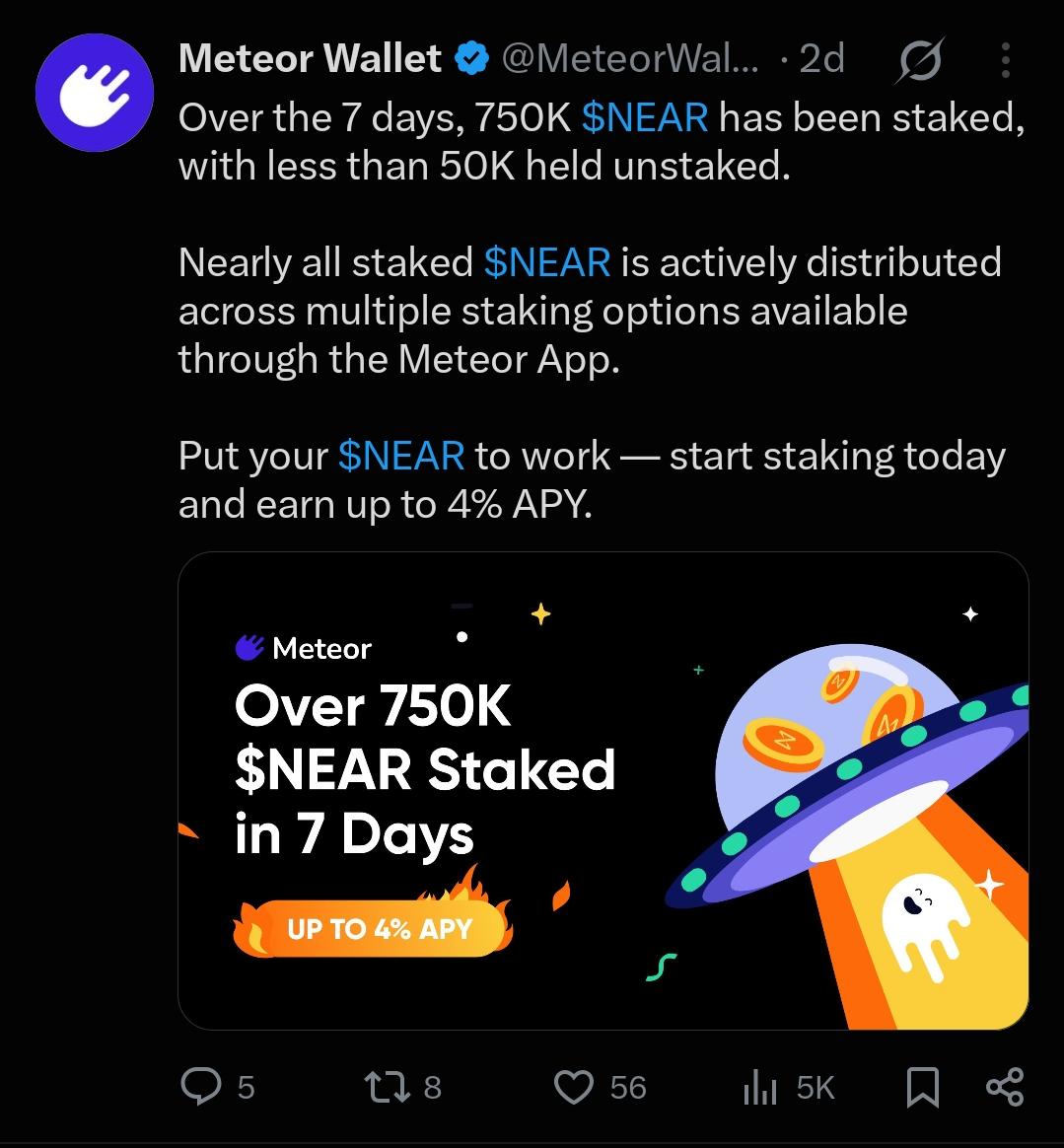
The scale of activity backs up how seriously users are treating this feature. Over a recent seven-day stretch, roughly 750,000 NEAR was staked through the app, with less than 50,000 NEAR sitting unstaked in comparison. Nearly all of that staked NEAR ended up spread across the multiple staking options Meteor offers rather than concentrated in a single pool, suggesting users are genuinely comparing validators rather than defaulting to whatever's listed first.
One of Meteor's more recent additions tackles a problem that's quietly frustrated long-term NEAR holders for years: lockup contracts. NEAR tokens distributed through investor allocations, team vesting schedules, or grants are frequently locked and released gradually over time, and tracking exactly what's vested, what's still locked, and when the next unlock hits has traditionally required digging through block explorers or third-party dashboards.
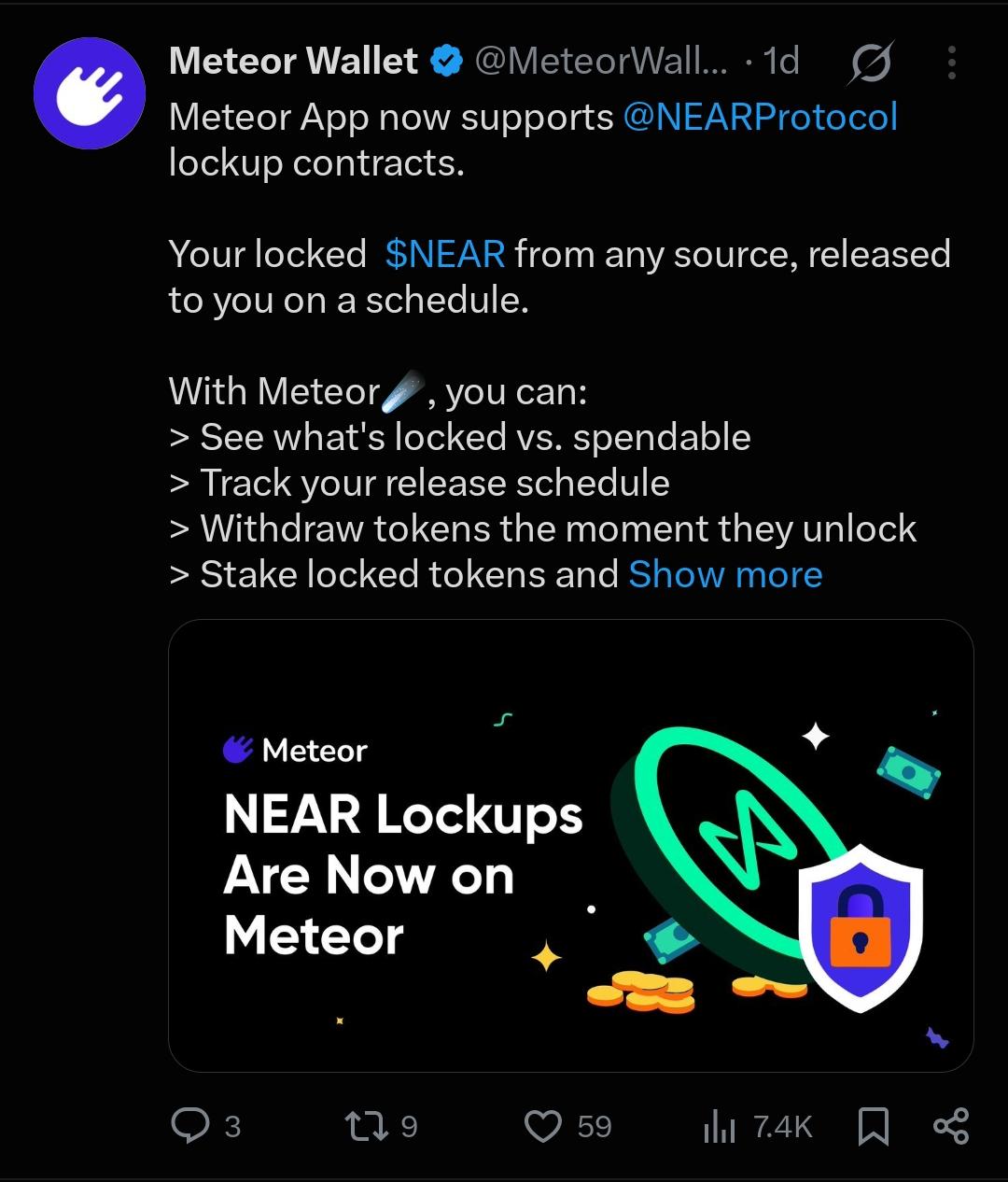
Meteor now supports NEAR Protocol lockup contracts natively inside the app, regardless of where those locked tokens originated. Within the wallet, users can see a clear breakdown of what's locked versus what's already spendable, track the exact release schedule tied to their contract, and withdraw tokens the instant they unlock rather than needing to check back manually. Perhaps the most useful piece of this update is that locked tokens aren't dead weight while they wait to vest, Meteor lets users stake locked NEAR and collect the resulting rewards as spendable tokens immediately, without needing to wait for the underlying principal to fully unlock.
For anyone sitting on a multi-year vesting schedule, that's a meaningful upgrade. It turns a previously idle asset into something that's at least generating usable yield in the meantime, rather than just ticking down a countdown clock.
Meteor has also been building toward its own crypto-linked Mastercard, following a pattern set by competitors like MetaMask, which rolled out its own self-custodial Mastercard-backed card broadly across the US and dozens of other countries earlier this year. The general appeal of these cards is consistent across the category: funds stay in self-custody inside the wallet until the moment of a purchase, at which point crypto converts to fiat and settles through Mastercard's existing merchant network, letting holders spend crypto essentially anywhere a normal debit card works.
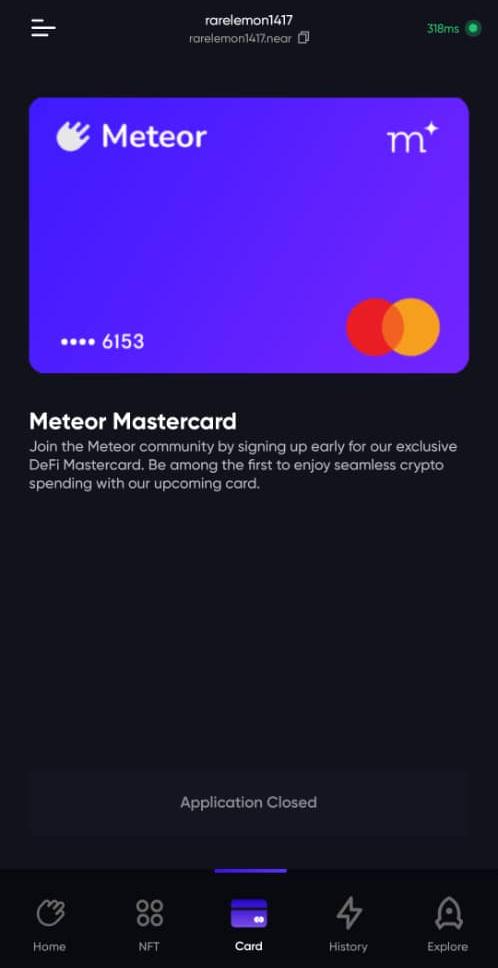
As it stands right now, though, applications for the Meteor Mastercard are closed. That puts it a step behind where some competitors already are, MetaMask's card, for comparison, is live across the US, UK, EU, and several countries in Latin America, with cashback tiers and physical metal card options already shipping. Meteor hasn't published a public timeline for when applications might reopen, which is worth factoring in if a spending card is the specific feature drawing you to the wallet. It's a strong signal of where Meteor wants to go, but not yet a reason to switch wallets on its own.
I don't think a fair review can skip the friction points, and Meteor has a few worth flagging. User reviews on the Google Play Store have specifically praised the interface and gamified onboarding, but have also flagged unwanted NFT airdrops that clutter the wallet with no easy way to remove or burn them, a nuisance more than a security risk, but an annoying one. Some longtime users have also pushed back on fee changes introduced without much warning, a complaint that's shown up across NEAR wallets generally as the ecosystem has matured and free-to-use models have had to adjust to sustain development.
There's also the matter of platform maturity relative to wallets tied to larger ecosystems. Meteor is excellent at what it does within NEAR specifically, but it doesn't offer the multi-chain breadth of something like MetaMask or Trust Wallet, so anyone managing assets across several blockchains will likely still need a second wallet alongside it. That's less a flaw than a scope decision, Meteor has clearly chosen to go deep on NEAR rather than wide across chains, but it's worth knowing going in.
For anyone already committed to the NEAR ecosystem, Meteor Wallet is hard to argue against. The staking options are genuinely flexible, the lockup contract support solves a real and previously annoying problem, and the swap aggregation adds a layer of convenience most competing NEAR wallets don't match. The 750,000 NEAR staked over the last week alone suggests the user base already trusts it enough to put meaningful sums to work through the app rather than treating it as just a storage tool.
The Mastercard is the one piece still worth watching rather than counting on, it's a strong roadmap item, not a live feature, and applications being closed means there's no clear entry point yet for anyone hoping to spend NEAR directly at checkout. Until that changes, Meteor's real strength remains what it already does well: making staking, swaps, and vesting management on NEAR simpler than digging through raw contract data ever was.
Disclosure: This is not trading or investment advice. Always do your research before buying any cryptocurrency or investing in any services.
Follow us on Twitter @themerklehash to stay updated with the latest Crypto, NFT, AI, Cybersecurity, and Metaverse news!





