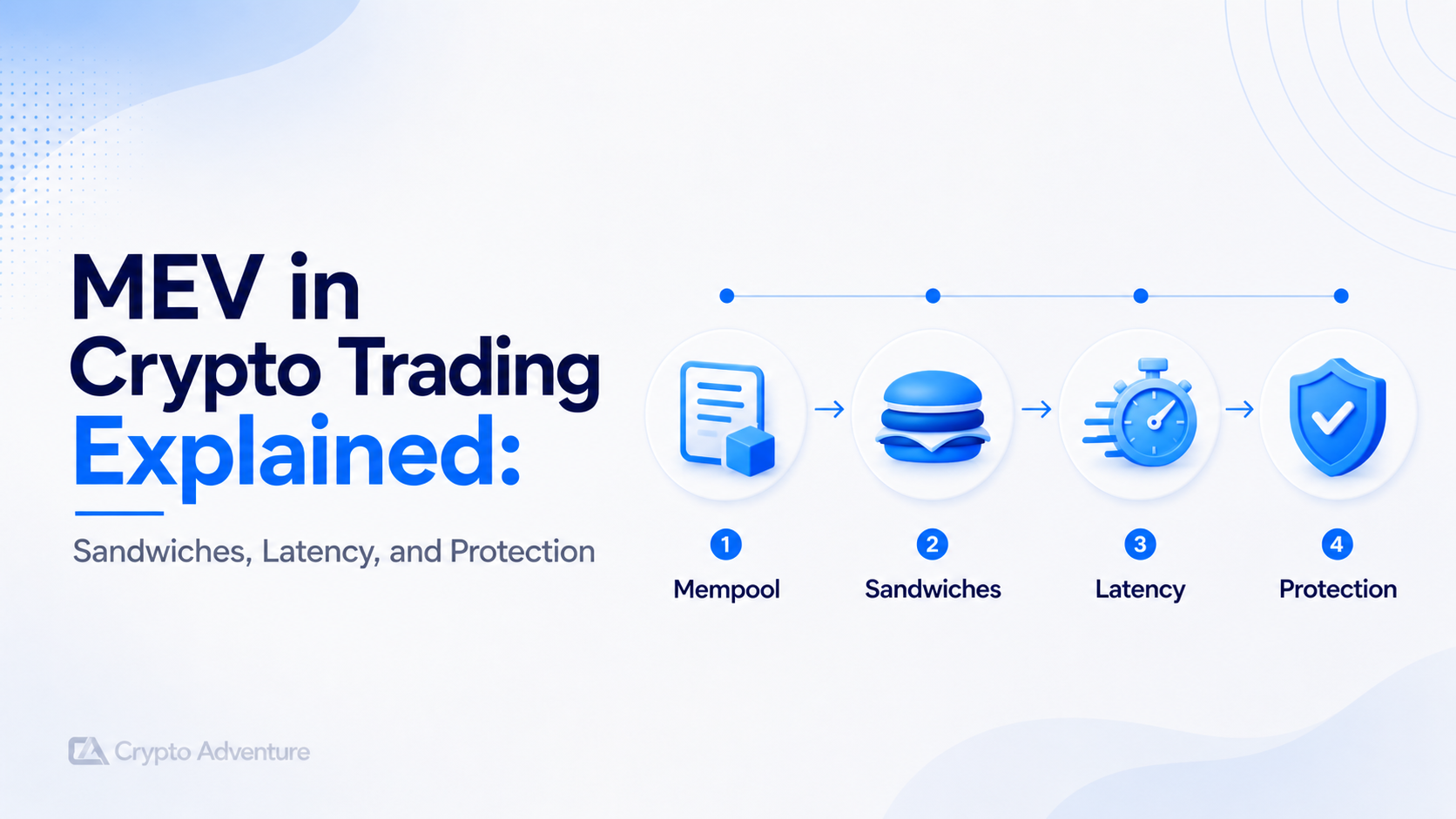
MEV stands for maximal extractable value. It is the value that block builders, validators, searchers, bots, or other infrastructure participants can capture by influencing transaction ordering, inclusion, or execution. In normal user language, MEV is the profit created when someone sees an on-chain trade before it settles and positions around it.
MEV exists because public blockchains are transparent and transaction ordering matters. A pending swap, liquidation, arbitrage, NFT mint, bridge claim, or collateral update can create a short-lived opportunity. Whoever can detect the opportunity, submit the right transaction, and get included in the right order may capture value before ordinary users react.
This does not make every MEV strategy malicious. Some MEV comes from useful arbitrage that keeps prices aligned across markets. Liquidations can protect lending protocols from bad debt. The problem is that harmful MEV can directly tax users through worse execution, failed transactions, higher gas, and sandwich attacks.
For traders using DeFi swaps, the most important lesson is simple: the trade is not final when the wallet signs it. Until the transaction is included and executed, other actors may see it, react to it, and change the price environment around it.
A sandwich attack targets a visible trade, usually a swap through an automated market maker. The attacker sees a pending transaction that will move the price. The attacker then places one transaction before the user’s trade and another after it.
The first transaction buys before the user. The user’s trade then pushes the price further in the attacker’s favor. The second transaction sells after the user. The attacker profits from the price movement created by the user’s own order, while the user receives worse execution.
The attack is most effective when the user sets high slippage tolerance, trades a low-liquidity token, or submits a large order relative to pool depth. A swap with tight slippage may fail instead of getting sandwiched, while a swap with loose slippage gives the attacker more room to extract value.
This is why slippage is not only a convenience setting. It is a protection boundary. A high slippage limit can help a trade go through during volatility, but it also tells bots how much worse execution the user is willing to accept.
MEV is also a latency game. On many chains, transactions sit in a public mempool before inclusion. Bots monitor this pending transaction flow, simulate outcomes, and submit competing transactions with stronger fee terms or private bundle routing.
The race is not only about speed. It is about infrastructure. Searchers use custom nodes, direct builder connections, simulation engines, private order flow, and optimized bidding systems. A normal trader clicking through a wallet interface is not competing on equal terms.
This is one reason MEV becomes more visible in on-chain trading than in centralized exchanges. Centralized exchanges still have latency games, but the order flow is controlled inside the exchange. Public blockchains expose pending activity in ways that make transaction ordering a market by itself.
Flashbots became one of the most important Ethereum MEV research and infrastructure groups because it focuses on the negative externalities of MEV and private transaction routing. Flashbots Protect sends transactions through a private path designed to reduce frontrunning and sandwich exposure.
Sandwich attacks get the most attention because they are easy to understand. MEV reaches further than swaps. Liquidations, oracle updates, NFT mints, bridge operations, lending-market changes, and arbitrage across DEX pools can all create extractable value.
Liquidations are a major example. In lending and perp systems, unhealthy positions must be closed quickly to protect protocol solvency. Searchers compete to execute those liquidations because the protocol offers a reward. The incentive is useful, but it also creates aggressive bot competition around user positions.
The same mechanism appears in liquidation bonus systems. Liquidators race because the reward exists to make risk cleanup happen fast. MEV is the broader market structure around that race.
Perp traders can face MEV-like effects through latency, oracle timing, liquidations, and thin liquidity. A fast execution layer helps, but no trading system fully removes ordering risk when valuable trades depend on timing.
Not all MEV is harmful. Arbitrage can bring prices back in line across DEXs. If ETH trades cheaper in one pool than another, arbitrage bots buy from the cheaper pool and sell into the more expensive one. That activity can reduce price differences and make markets more efficient.
Liquidation MEV can also protect lending protocols and perp DEXs. When accounts fall below maintenance requirements, liquidators close them and help prevent bad debt. Without that incentive, protocols would be more fragile.
The issue is distribution. Useful MEV can improve market efficiency, but harmful MEV extracts value from users who are not being compensated for the execution damage. A healthy trading stack tries to keep the beneficial parts while reducing user-toxic ordering games.
MEV affects traders through worse prices, failed transactions, higher fees, and hidden execution costs. The user may think the trade cost is only the displayed price impact and gas fee. In reality, the cost can include sandwich extraction, priority fees, failed transaction gas, and worse settlement price.
Low-liquidity tokens are especially vulnerable. A large swap in a shallow pool changes the price enough to create profit for attackers. New token launches, memecoins, thin DeFi pairs, and volatile assets are common targets because slippage is often high and users rush to execute.
MEV also affects confidence. If users repeatedly receive worse execution than expected, they may leave on-chain trading for centralized exchanges or protected routing systems. That is why wallets, DEX aggregators, RPC providers, and protocols now treat MEV protection as part of the user experience.
The first protection is tighter slippage. Users should avoid setting slippage higher than needed, especially on liquid pairs. On illiquid assets, a smaller order split into several trades may reduce price impact, although that can also increase gas and timing risk.
The second protection is private transaction routing. Private RPCs and protected swap routes reduce exposure to public mempool searchers. Uniswap Wallet swap protection sends Ethereum Mainnet swaps through a private transaction pool to reduce frontrunning and sandwich risk. Similar protection systems exist across different wallets, aggregators, and chains.
The third protection is liquidity awareness. A trader should check pool depth, expected price impact, token taxes, transfer restrictions, and trade size before swapping. A very small pool can be dangerous even when the token chart looks active.
The fourth protection is patience. Rushing into a new token with high slippage, thin liquidity, and public mempool exposure is one of the easiest ways to pay an MEV tax. Waiting for liquidity to deepen can often save more than a marginally better entry.
Perp DEXs face a different MEV profile than simple swaps. Order-book systems create latency competition around order placement, cancels, liquidations, and oracle-sensitive trades. AMM-style perp systems create opportunities around price impact, pool imbalance, funding, and liquidation timing.
Perp DEX users should understand that execution speed does not remove risk. A position can still be affected by oracle updates, liquidation races, funding changes, and liquidity gaps. Anyone using perp DEXs needs to treat market structure as part of risk management, not only as a platform feature.
This becomes more important during volatility. When many accounts approach liquidation at the same time, bots, keepers, market makers, and protocol engines all compete around the same price levels. That creates fast, mechanical trading pressure that ordinary users may interpret as random market movement.
MEV turns transaction ordering into a source of profit. Some of that profit comes from useful market functions such as arbitrage and liquidations. Some comes directly from users through sandwich attacks, frontrunning, failed transactions, and worse execution.
The risk is highest when trades are large relative to liquidity, slippage is loose, assets are volatile, and transactions are visible before execution. The protection path is straightforward but not perfect: use tighter slippage, trade deeper markets, consider private transaction routing, avoid rushed low-liquidity swaps, and understand how the platform routes orders.
MEV will not disappear from crypto trading because blockspace, ordering, and latency have economic value. The goal is better protection, cleaner routing, and smarter user habits that make harmful MEV harder to extract from ordinary trades.
The post MEV In Crypto Trading: Sandwiches, Latency, And Protection appeared first on Crypto Adventure.





