Most people who own cryptocurrencies bought them and then left them alone. That is not trading, it is investing, and for the vast majority it is the better route. Trading means something else: you try to make a profit from price moves within hours, days or weeks. It is a different activity, with different tools, different risks and a different tax position.
This piece explains the basics without telling you what to do. It sets out which order types exist and what they are for, what a chart actually displays, how position sizes are calculated, and where most beginners lose money. By the end you will know whether trading suits you. Either answer is a good result.
When you invest, you buy because you believe in the value. When you trade, you buy and sell because you expect a move. The difference lies in the holding period and in what decides the outcome; the market is the same one.
An investor needs a view that spans years. A trader needs a view that spans days, plus a rulebook for the case where that view turns out to be wrong. Beginners tend to lack exactly this rulebook, which is why the most common mistake is rarely the wrong forecast. It is the missing reaction to it.
Three terms mark out the usual styles:
That last point is rarely mentioned and it is expensive. Anyone who trades frequently gives up the tax exemption that arrives after twelve months and attaches to every single purchase. Every sale within a year counts as a private disposal and is charged at your personal income tax rate.
Three order types cover almost everything: a market order buys immediately at the next available price, a limit order buys only at the price you name, and a stop-loss order sells automatically once a loss reaches a set boundary.
The differences sound technical and decide the outcome in practice:
A fourth variant appears on almost every exchange: the stop-limit order. It combines the two, triggering at one mark and then executing only up to a limit. That guards against poor execution and carries the risk that nothing is sold at all.
Which order types your exchange offers, and what it charges for them, varies considerably. The exchange comparison lists the fees and the feature range of the regulated providers.
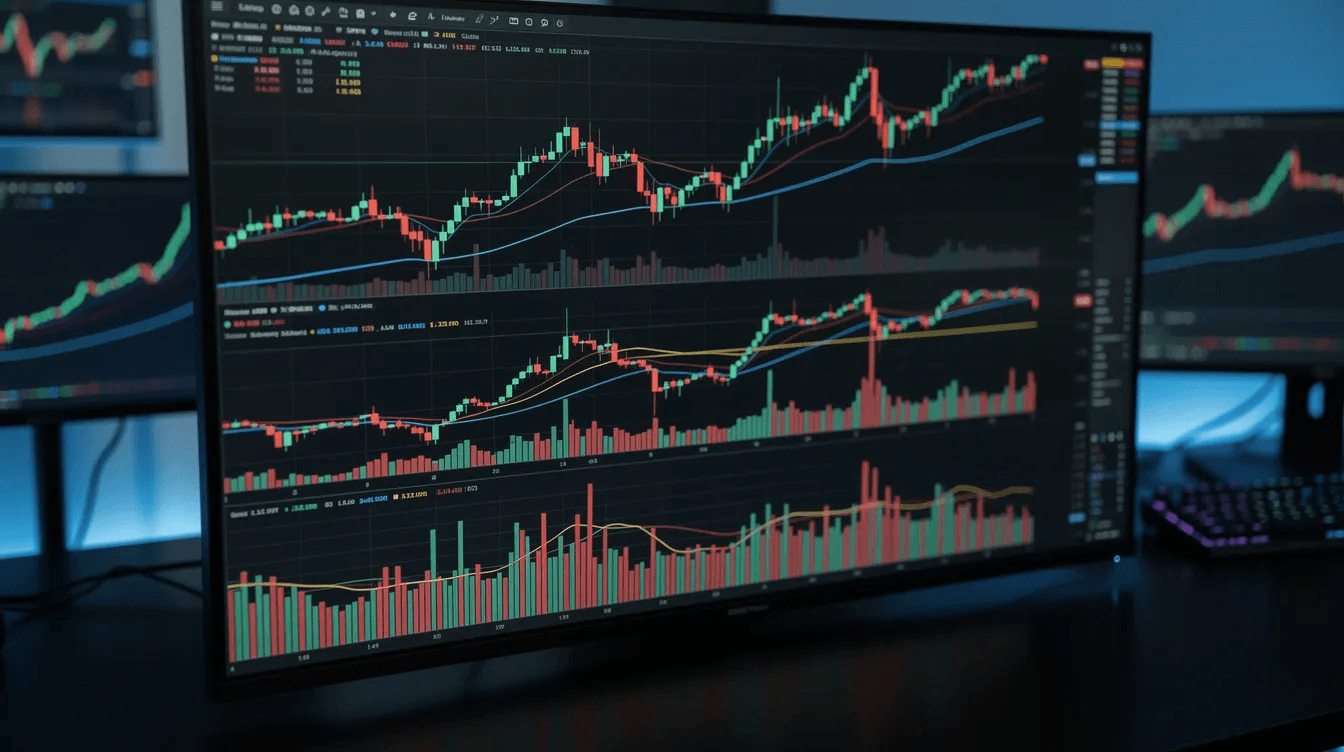
A candlestick chart shows four values per time period: the opening price, the highest price, the lowest price and the closing price. Everything else drawn on a chart is a calculation based on those values.
That is the most important sentence for beginners, because it puts the indicators in their place. A moving average is the mean of the last closing prices, nothing more. The 200-day average is so widely watched simply because many market participants look at the same line and react to it in similar ways. The number 200 carries no special power of its own.
Three tools are enough to start with:
What a chart cannot do: it says nothing about the future. It describes what has happened, in a form that makes patterns visible. Whether a pattern repeats is for the market to decide.
In spot trading you buy the coins and own them. In leveraged trading you borrow capital to move a larger position than your balance supports. Leverage magnifies gain and loss to the same degree.
An example with round numbers: with 1,000 euros of capital and five times leverage you move 5,000 euros. If the price rises by 10 percent, you gain 500 euros instead of 100. If it falls by 20 percent, your stake is gone entirely. That point is called liquidation, and it arrives sooner than most people expect.
For beginners this leads to a simple boundary: anyone who has yet to master the order types has no business on the leverage market. Spot trading maps the same moves, only without the option of losing everything in a single night.
The most widespread rule says that no single trade risks more than one to two percent of total capital. The position size follows backwards from that figure, and it is never estimated.
The calculation is short. Suppose your capital is 5,000 euros and you risk one percent of it, so 50 euros. Your stop-loss sits 5 percent below the entry. Then the position may be 1,000 euros in size, because 5 percent of that amount is exactly the 50 euros you are prepared to lose.
This calculation is the real difference between trading and gambling. It answers before the entry what a failed trade costs. Skip it, and you find out afterwards.
A demo account or a trading game reproduces the mechanics without a loss costing real money. What it does not reproduce is how a loss feels, and that is where most people come unstuck.
That is no small matter. It is the core of the problem: someone who loses 500 euros in a demo account simply clicks on. Someone who loses 500 real euros takes the next decision differently. Practice is still worthwhile, because it clears away the manual errors before they cost money: the accidental market order in place of the limit order, the forgotten stop-loss, the miscalculated position size.
Most regulated providers offer a demo account, and CryptoTicker is working on its own trading game in which you trade against others with a starting balance. The prices in it are real, the money is not. Only one thing matters here: practise with the same position size you would genuinely use later on. Playing with ten times the amount in a demo account trains the opposite of what you need.
Four mistakes turn up in almost every beginner's story, and none of them has anything to do with a wrong forecast.
In Germany, every sale within a year is a private disposal transaction under section 23 of the Income Tax Act. The gain is charged at your personal income tax rate rather than at the flat withholding tax rate.
For traders that is the least comfortable feature of German law: active trading forfeits, on every position, the tax exemption that would have arrived after twelve months of holding. There is an exemption limit of 1,000 euros per calendar year, and it is reached quickly.
Then there is the documentation duty. Every single trade needs a date, a price and a quantity, and with several hundred trades a year that can no longer be managed by hand. Which tools take this over and what they cost is set out in the comparison of tax tools.
Whether the one-year holding period survives is currently open: the budget draft of July 6, 2026 provides for a reclassification, while the Income Tax Reform Act 2027, adopted by the cabinet on September 2, 2026, contains nothing on the subject. We track the state of play in our article on the crypto holding period.
Trading is a skill with a flat learning curve at the start and a very steep one after that. The mechanics are understood in an afternoon: three order types, a chart with four values per candle, one calculation for the position size. What takes years is the discipline to stick to your own rulebook when a position runs against you.
Anyone who wants to start needs three things before the first trade runs: an exchange whose fees and order types they know, a rule for the position size, and an idea of what trading triggers in tax terms. Everything else comes with practice.
(As of September 9, 2026. This article is not investment advice. Prices and fee structures change; check the terms with the provider before you buy.)





