Most traders disappear when prices fall. The ones who stay — and have a system — find the clearest setups of the year.

Everyone loves a bull market.
Prices go up. Your portfolio turns green. Even bad trades somehow work out. It feels like trading is easy — and for a while, it actually is.
Then the market turns.
Bitcoin drops 40% in six weeks. Altcoins lose 70%, 80%, sometimes more. The group chats go quiet. The influencers stop posting. The people who were loudest during the run-up suddenly have nothing to say.
And most traders? They close their apps and wait for it to be over.
Here’s what they miss: bear markets are where the most precise, highest-quality signals are generated.
Not because falling markets are fun. Because they’re clarifying.
Fat Pig Signals has been through every major crypto bear market since 2017 — the 2018 crash, the COVID collapse of March 2020, and the brutal 2022 bear that wiped out most of the market. The signal log is public. The results through each of those periods are on the record.
This article explains why bear markets produce better signals — and how to position yourself to benefit from them instead of hiding from them.
Fat Pig Signals — crypto trading signals with a verified public track record since 2017. Through bull markets and bear markets. Use code LU20 for 20% off VIP access → fatpigsignals.com/store
A bear market is a period of sustained price decline — typically defined as a drop of 20% or more from recent highs, lasting weeks or months.
In crypto, bear markets are more extreme than in traditional finance. A 70–80% decline from peak to trough is not unusual. The 2022 bear market saw Bitcoin fall from roughly $69,000 to under $16,000. Most altcoins fell further.
Here’s the mistake most beginners make: they treat a bear market as something to survive rather than something to trade.
The logic feels sound. “Everything is going down, so why would I buy anything?”
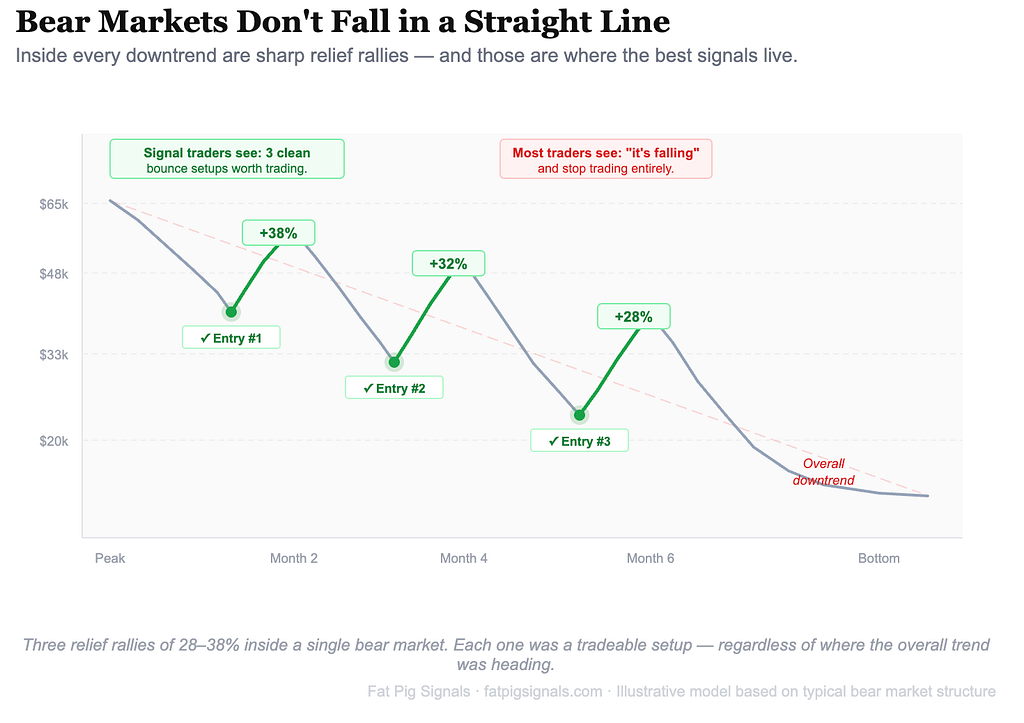
But markets don’t fall in a straight line. Even in the deepest bear markets, there are sharp relief rallies — short periods where prices bounce 20%, 30%, even 50% before the downtrend resumes. These bounces happen because:
These bounces are not random. They follow patterns — and those patterns are exactly what a well-calibrated algorithm is designed to identify.
In a bull market, almost everything works. Prices are rising, sentiment is positive, and even poorly-timed entries eventually recover. This makes it hard to know whether your analysis is actually good — or whether the rising tide is just carrying you.
Bear markets strip that away.
When the overall trend is down, only the highest-quality setups produce reliable bounces. The noise disappears. What’s left are the setups that work because of genuine technical structure — not because the market is blindly going up.
Here’s why this matters for signals specifically:
Support levels become extremely well-defined.
In a falling market, price tests the same support zones repeatedly. Each test that holds strengthens the level. By the third or fourth touch of a major support zone, there’s significant technical evidence that buyers exist there. An entry at that level carries more conviction than a random buy in a bull market.
Risk/reward ratios improve dramatically.
When Bitcoin is at $18,000 and the nearest major support is at $16,500, a stop-loss can be placed just below $16,500. If the bounce target is $24,000, the risk is roughly $1,500 per coin and the potential reward is $5,500. That’s a 3.6:1 ratio — far better than most bull market setups where price is extended and stop-losses must be placed far below.
Timing is cleaner.
Bull markets are often driven by momentum and sentiment — which are hard to time. Bear market bounces are driven by technical levels and oversold conditions — which are measurable. An algorithm that reads price structure and pattern data can identify these setups with higher accuracy than it can in a choppy, sentiment-driven bull market.
💡 Pro Tip: During a bear market, focus on the quality of the setup rather than the direction of the trend. A well-structured bounce from a major support level, with a tight stop-loss and a clear target, is a legitimate trade — regardless of what the market did last month.
The public signal log tells the story better than any claim could.
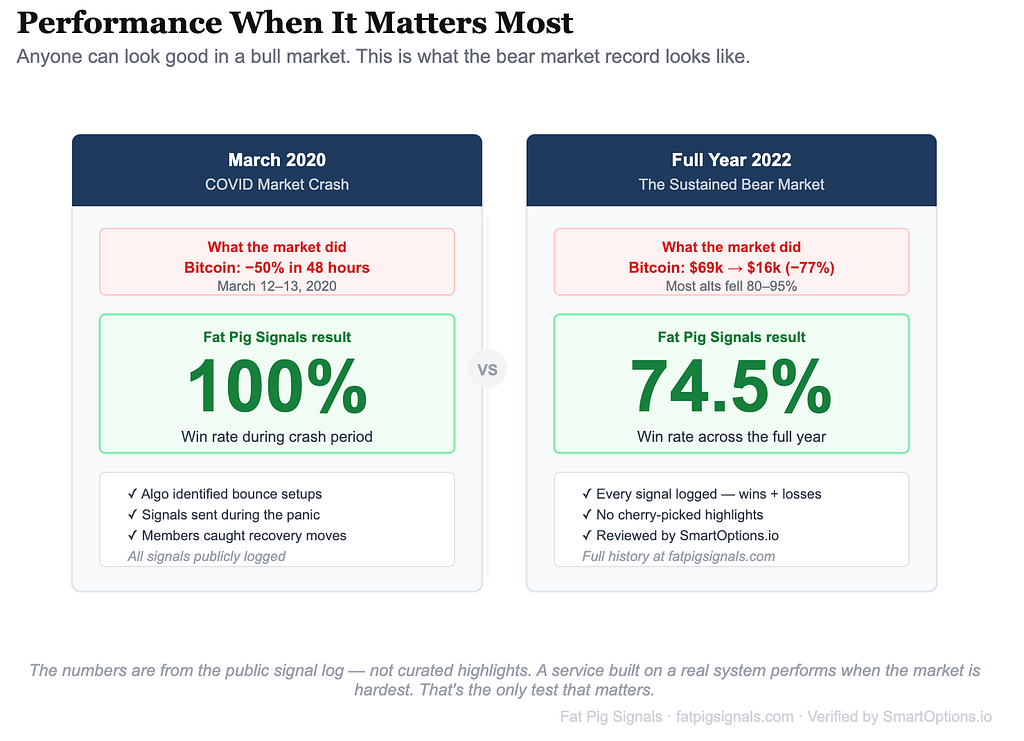
March 2020 — COVID crash: Bitcoin dropped 50% in 48 hours. Most of the market was in panic mode. Fat Pig Signals achieved a 100% win rate during that period — not by predicting the crash, but by identifying the bounce setups that followed. When price structure and volume confirmed a genuine reversal zone, the algorithm flagged it. Members who followed the signals caught some of the sharpest recovery moves of that year.
2022 bear market: The longest and most sustained bear market in recent crypto history. Bitcoin fell for most of the year. Fat Pig Signals recorded a 74.5% win rate across the full year — in a market where most traders either lost money or stopped trading entirely.
These numbers aren’t posted to boast. They’re posted because they answer a question every serious trader should ask of any signal service: what does your track record look like when the market is against you?
A service that only shows bull market performance is like a weather forecaster who only gets credit for sunny days.
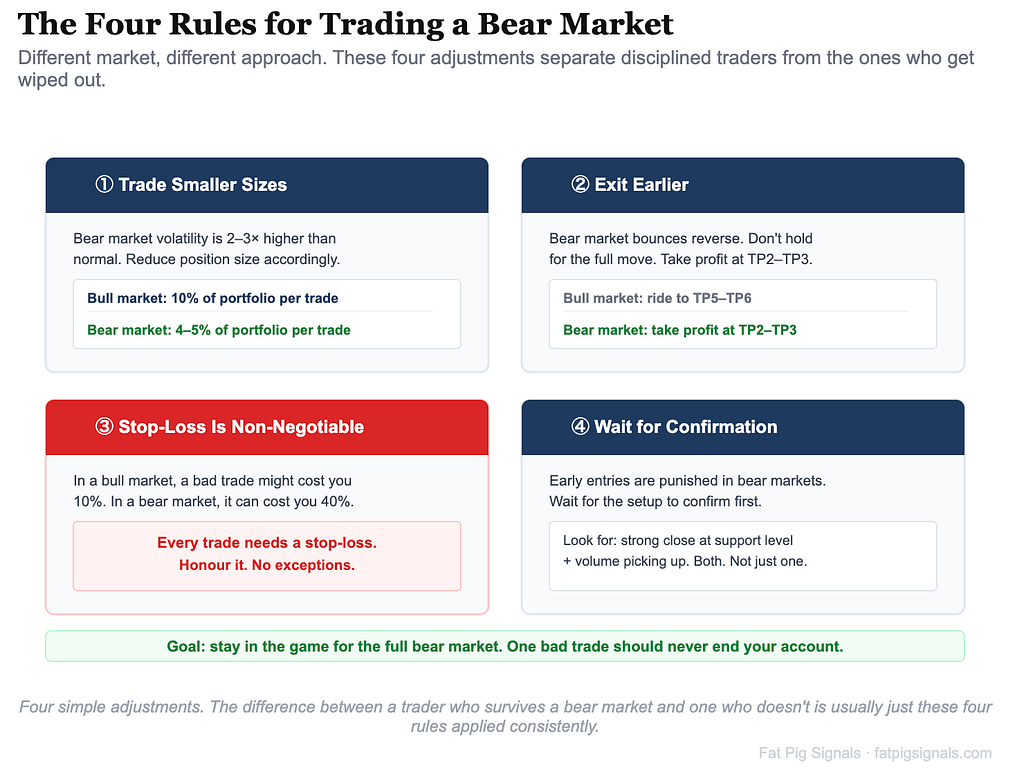
Bear market trading requires a different mindset than bull market trading. Here’s the practical framework:
Trade smaller position sizes.
Volatility is higher in bear markets. A move that might be 5% in a bull market can easily be 15–20% in a bear. Reduce your position sizes accordingly. You want to be in the game for the full bear market, not wiped out by a single trade that went against you.
Respect the overall trend.
Bear market trades are counter-trend by nature — you’re buying bounces in a falling market. This means your holding period should be shorter. Take profit earlier than you might in a bull market. The bounce you’re riding will likely reverse at some point. Getting out at TP2 or TP3 with solid gains is better than holding for TP6 and watching it reverse.
Stop-losses are non-negotiable.
In a bear market, a trade that goes wrong can go very wrong, very quickly. A stop-loss in a bull market might save you from a 10% drawdown. In a bear market, it might save you from a 40% drawdown. Every trade needs a stop — and you need to honour it without hesitation.
Wait for confirmation.
In a bull market, you can sometimes enter early and be forgiven. In a bear market, early entries get punished. Wait for the technical confirmation — a strong close at the support level, volume picking up — before entering. Patience is worth more in a bear market than in a bull.
⚠️ Common Mistake: Trying to “catch the bottom” in a bear market. Nobody consistently calls the exact bottom. The goal isn’t to buy the lowest price — it’s to buy a well-defined setup with a clear stop-loss and a realistic target. Catching a 20% bounce from a confirmed support level is a great trade, even if the price goes lower a month later.
If you’re going to follow a signal service, a bear market is the best possible time to evaluate whether it’s genuinely worth following.
Because bear markets are the ultimate test.
Any service can look good in a bull market. The ones that maintain strong performance in sustained downtrends — with public, logged results — are the ones built on real methodology, not momentum riding.
Fat Pig Signals has been through multiple bear markets with its full signal history publicly available. The 74.5% win rate across the entire 2022 bear market is not a curated highlight. It’s the logged record of every signal sent during that period — wins, losses, and everything in between.
If you’re currently watching the market fall and wondering whether now is a good time to get serious about structured trading — it is. The setups are forming. The algorithm is watching. And the track record shows what happens when those setups are traded with discipline.
→ Join the free Telegram group first: t.me/fatpigsignals
When you’re ready for full VIP access — algo-backed entries, up to 6 take-profit targets, and a verified track record through every market condition — use code LU20 for 20% off.
Here’s what we covered:
Today: Check the Fat Pig Signals public signal log at fatpigsignals.com. Filter for 2022 signals. Read through a handful of bear market entries — notice the support levels, the stop placements, and how the take-profit targets were structured.
This week: Next time you see a coin that’s fallen significantly from its high, don’t just ask “is it cheap?” Ask: “Is there a defined support level? What does the stop-loss look like? What’s the realistic bounce target?” That’s how bear market trades are evaluated.
Ongoing: Join the free Telegram group at t.me/fatpigsignals. When the next bear market hits — and it will — you’ll have a front-row seat to how a verified signal service approaches it in real time.
Bear markets aren’t the end of trading. For the traders who stay disciplined and systematic, they’re the beginning of some of the best opportunities of the cycle.
Disclaimer: This article is for educational purposes only and does not constitute financial advice. Cryptocurrency trading involves substantial risk of loss. Past performance, including bear market win rates referenced in this article, does not guarantee future results. All historical performance figures are based on publicly logged signals at fatpigsignals.com. Always conduct your own research before making any investment decisions.
Fat Pig Signals — crypto trading signals with a verified public track record since 2017. Through bull markets and bear markets. Use code LU20 for 20% off VIP access → fatpigsignals.com/store
Why Bear Markets Produce the Best Trading Signals was originally published in Coinmonks on Medium, where people are continuing the conversation by highlighting and responding to this story.





