
NEAR rallied in the latest session, with the token up roughly 13% on the 24-hour view as traders reacted to a new “private execution” feature aimed at reducing common DeFi execution risks. CoinMarketCap showed NEAR up 12.42% over the last 24 hours at the time of checking, placing it among the stronger large-cap movers for the day.
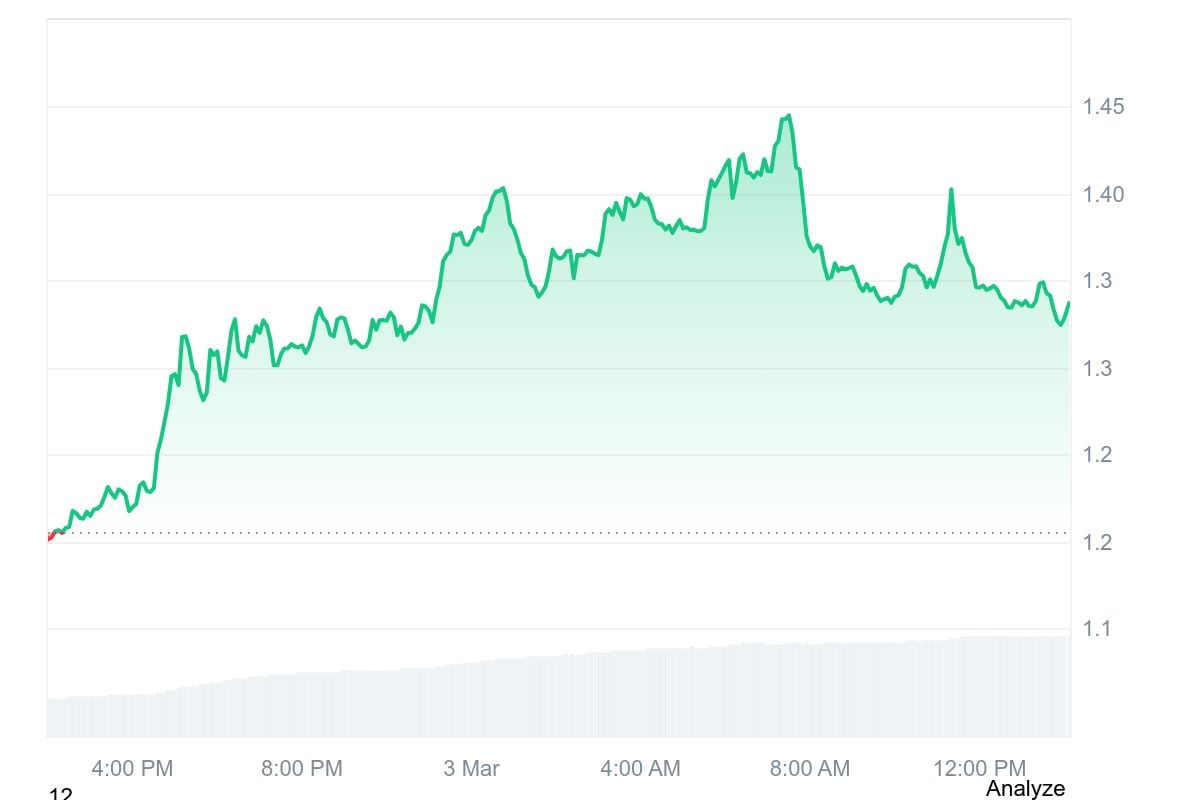
The move also extended a broader weekly run that crypto-native outlets described as a sharp recovery leg, with the privacy angle acting as a fresh narrative hook for a chain that has been pushing “intents” and cross-chain abstraction as its growth wedge.
The catalyst was the rollout of Confidential Intents, a feature built into the NEAR Intents stack that routes certain cross-chain actions through a restricted-visibility execution environment.
In a Feb. 25 press release, NEAR said Confidential Intents provides “a restricted-visibility environment for cross-chain transactions,” allowing users and institutions to opt into confidentiality across transfers, deposits, and withdrawals while keeping execution verifiable onchain.
NEAR framed the feature as a way to address a structural limitation of DeFi where transaction details are typically visible before settlement, creating room for frontrunning and strategy copying.
The “private execution layer” phrasing that circulated in market posts refers to the idea that sensitive intent data is not broadcast in the open the way it is in a typical public-mempool flow, reducing the information advantage that MEV searchers often exploit.
MEV and frontrunning are not abstract issues, they are mechanical outcomes of information leakage. When a trade’s direction, size, route, and timing become visible, sophisticated actors can insert transactions ahead of the user, sandwich the user’s trade, or copy a strategy before settlement. That does not just tax users, it changes where liquidity chooses to live.
A confidentiality layer can shift incentives in three ways.
NEAR’s messaging ties Confidential Intents to NEAR Intents, its cross-chain transaction framework, and to near.com, a consumer-facing interface that abstracts cross-chain routing into a single account experience.
For builders, the relevant mechanism is that intents are expressed as a desired outcome, and the system coordinates execution rather than forcing the user to handcraft an onchain route. The NEAR Intents documentation describes it as a multi-chain transaction protocol where users specify desired outcomes and market makers compete for best execution.
Confidential execution adds another layer to that system. Instead of broadcasting the full details of the user’s intended swap path, confidential mode aims to keep sensitive parts of the request out of public view until after execution is finalized, reducing MEV surfaces for cross-chain swaps and transfers.
The market will quickly move from “new feature” to “does anyone use it,” and usage is where the token impact becomes real.
If confidential routing attracts consistent flow, it can increase the value of being in the NEAR Intents execution path, especially if partners and distribution channels route volume through the system. NEAR’s press release also highlighted a revenue-sharing model and other value-capture mechanics tied to Intents usage, which is why traders tend to watch transaction throughput and fee pathways after product launches.
On the other hand, privacy-style narratives can fade if the feature is hard to access, limited in supported assets, or does not materially change execution quality for the average user.
The real proof is measured, not claimed. Watch for post-launch analysis showing reduced sandwiching, less adverse selection, or improved realized execution versus comparable public flows.
The post NEAR Jumps About 13% After Launching Confidential Intents to Limit MEV and Front-Running appeared first on Crypto Adventure.





