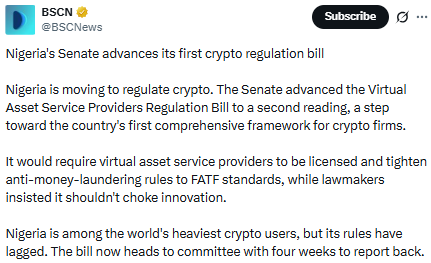
Nigeria's Senate has passed the Virtual Asset Service Providers Regulation Bill, 2026, for second reading. Lawmakers say the country has waited long enough and that the cost of not regulating crypto is already visible.
Sponsored by Deputy Senate President Senator Jibrin Barau and presented by Senator Tahir Monguno, the bill seeks to create a legal, regulatory, and supervisory framework for virtual assets, digital assets, and Virtual Asset Service Providers (VASPs) in Nigeria.
Source: X Account
It proposes mandatory licensing for crypto exchanges and digital asset operators, transparency and compliance requirements across the sector, and anti-money-laundering rules tightened to FATF standards aligned with frameworks set by the Financial Action Task Force (FATF) and the IMF.
Nigeria is among the world's heaviest crypto users and leads Africa in virtual asset adoption. Its regulatory framework, however, has not kept pace.
Senator Monguno told the Senate that Nigeria has lagged behind several African countries in regulating the fast-growing digital finance sector. Lawmakers warned that the absence of a framework is pushing billions of naira in investments, jobs, and government revenue underground away from oversight and out of Nigeria's tax base.
Senator Monguno laid out three consequences of continued inaction: the market moves into a black economy, it stays opaque and open to criminal activity, and it fails to support President Tinubu's $1 trillion economy target.
A consistent message through the debate was that this is regulation, not a clampdown.
Senator Barau addressed it in his closing remarks. "This bill does not seek to stifle innovation. Rather, it aims to create clear rules that promote order, confidence, accountability, and consumer protection."
Lawmakers described virtual assets as an unavoidable part of the evolving global economy. The argument was not whether to regulate it was that failing to act would leave the sector and the people in it without legal protection.
Senator Natasha Akpoti-Uduaghan brought a specific example to the floor.
Her son runs an online gaming platform with around 100,000 real-time players worldwide. He cannot operate it effectively from Nigeria. The backend servers his platform needs are hosted in South Africa not here because the regulatory infrastructure does not exist in Nigeria yet.
"He constantly tells me that he cannot effectively operate from Nigeria because the gaming servers that provide backend support are not hosted here. Those services are now available in South Africa but not yet in Nigeria because we lack the required regulatory framework," she said.
"There are billions of dollars flowing into virtual services globally. Young Nigerians are creating jobs and generating income through gaming and other digital platforms. It would be a mistake not to put the necessary regulations in place," she added.
Senator Adetokunbo Abiru backed the bill but flagged a risk. He urged that it be harmonised with the Investments and Securities Act and the Bank and Other Financial Institutions Act (BOFIA).
"If we regulate crypto in isolation, we risk creating confusion. We need a coordinated framework for the entire digital finance industry," he said.
Senator Adams Oshiomhole kept it short. "The benefits are self-evident. We should support the bill and allow it to proceed."
The bill has been referred to the Senate Committee on Capital Market. The committee has four weeks to submit its report.
If passed into law, Nigeria joins Kenya, South Africa, and Ghana in having a framework for crypto regulations and virtual assets with regulators empowered to license operators and act on fraud, money laundering, and terrorism financing in the sector.
Nigeria's Senate has taken its first concrete step toward bringing the country's booming crypto sector under a legal framework. With the committee report due in four weeks, the bill's next phase will determine how quickly Africa's largest crypto market gets the regulation it has long needed.
This article is for informational purposes only and does not constitute financial or investment advice. Always verify information through official sources before making any financial decisions.





