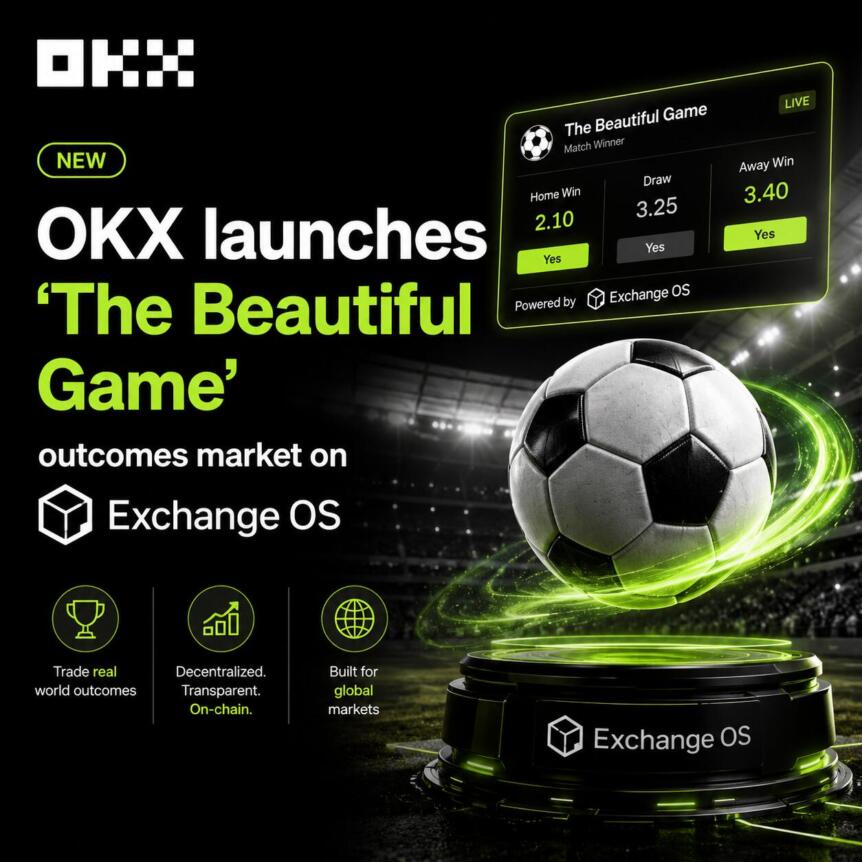
OKX has launched The Beautiful Game, a free-to-play outcomes market that lets users predict winners across all World Cup fixtures and compete for a portion of a multi-BTC prize pool. The product is powered by Exchange OS, OKX’s recently introduced open protocol that the company says provides matching and settlement infrastructure at the protocol layer.
The contest runs through July 20, 2026 and is open to eligible users of the OKX mobile app in markets where the promotion is permitted. OKX says the leaderboard-based tournament will distribute rewards proportionally at the end of the competition. Participation mechanics include daily check-ins, position commitments on matches, referral incentives and other platform activity that feed into players’ scores.
The launch comes alongside a company survey of 2,000 self-identified football fans who trade cryptocurrency, which found a substantial tilt toward crypto assets over sporting triumphs among respondents. Among the headline results: roughly three quarters said they would rather receive 1 BTC than see their favored national team win the World Cup. The survey also reported that a majority associate football more closely with crypto than other sports, and that many respondents see overlapping skill sets between sports prediction and crypto trading.
Exchange OS is presented by OKX as a permissionless infrastructure layer that sits on top of its X Layer EVM-compatible layer two. According to the company, the protocol handles trade matching and settlement so that third-party builders can deploy spot, perpetual, or prediction-market exchanges without rebuilding the low-level infrastructure.
If adopted, that pattern could reduce engineering overhead for teams hoping to launch market venues and accelerate experimentation in onchain trading products. OKX says deployers will retain control over listings, branding and user experience while relying on Exchange OS for the underlying operations.
From a market perspective, platforms that abstract matching and settlement into a shared protocol may increase interoperability and liquidity, but they also raise questions about centralization, governance and the extent to which responsibility remains with the protocol operator versus individual deployers.
The OKX survey is notable for quantifying the overlap between football interest and crypto activity among a self-selected cohort of trading fans. Key figures include:
Preference for crypto rewards: Approximately 76% of respondents said they would choose 1 BTC over their favorite team lifting the World Cup trophy.
Emotional tradeoffs: About 23% indicated they would be more upset by their national team being eliminated than by a 20% loss in their crypto portfolio.
Perceived skill overlap: A large share—reported at 84%—said the cognitive skills that support trading, such as probabilistic thinking and pattern recognition, also apply to predicting football outcomes. Nearly half said their match calls would outperform their trading performance over the same time period.
These results suggest that gamified prediction products aimed at sports fans can tap into an audience already familiar with trading concepts and risk tolerance. For exchanges and app-based platforms, seasonal sports events like the World Cup offer predictable spikes in engagement and a natural promotional window for onboarding users.
Outcomes and prediction markets operate in a crowded regulatory landscape. Different jurisdictions treat these products as gambling, financial instruments, or unregulated entertainment, depending on local law and the structure of the offering. OKX’s release emphasizes region-by-region eligibility and the absence of required payments to participate, which reflects standard compliance precautions.
Even so, operators deploying similar markets will need clear legal strategies, robust user protections and transparent terms to limit exposure. Financial regulators and gambling authorities have in the past scrutinized platforms that offer monetary returns from event-based predictions. Projects that combine onchain settlement with centralized control over listings may attract additional regulatory attention.
For OKX, The Beautiful Game serves multiple purposes: it promotes app usage during a global sporting event, showcases Exchange OS as a layer for builders, and reinforces the company’s positioning at the intersection of trading and consumer engagement. The product’s free-to-play design lowers the barrier to entry and helps sidestep some payout and licensing complications that accompany real-money betting in regulated markets.
Observers should monitor several metrics and developments to assess the launch’s wider impact: user sign-ups and retention tied to the tournament, the rate at which external builders adopt Exchange OS, any regulatory inquiries in key markets, and whether similar products proliferate among incumbent exchanges and decentralized platforms.
Ultimately, OKX’s move illustrates the continued blending of sports fandom and crypto-native product design. If the protocol-layer approach to matching and settlement gains traction, it could reshape how prediction markets and niche exchanges are launched — but it will also test operator readiness for regulatory scrutiny and the operational demands of higher-volume, event-driven traffic.
Disclosure: The information in this article is based on company announcements and a survey published by OKX. It does not constitute investment advice.
This article was originally published as OKX launches ‘The Beautiful Game’ outcomes market on Exchange OS on Crypto Breaking News – your trusted source for crypto news, Bitcoin news, and blockchain updates.





