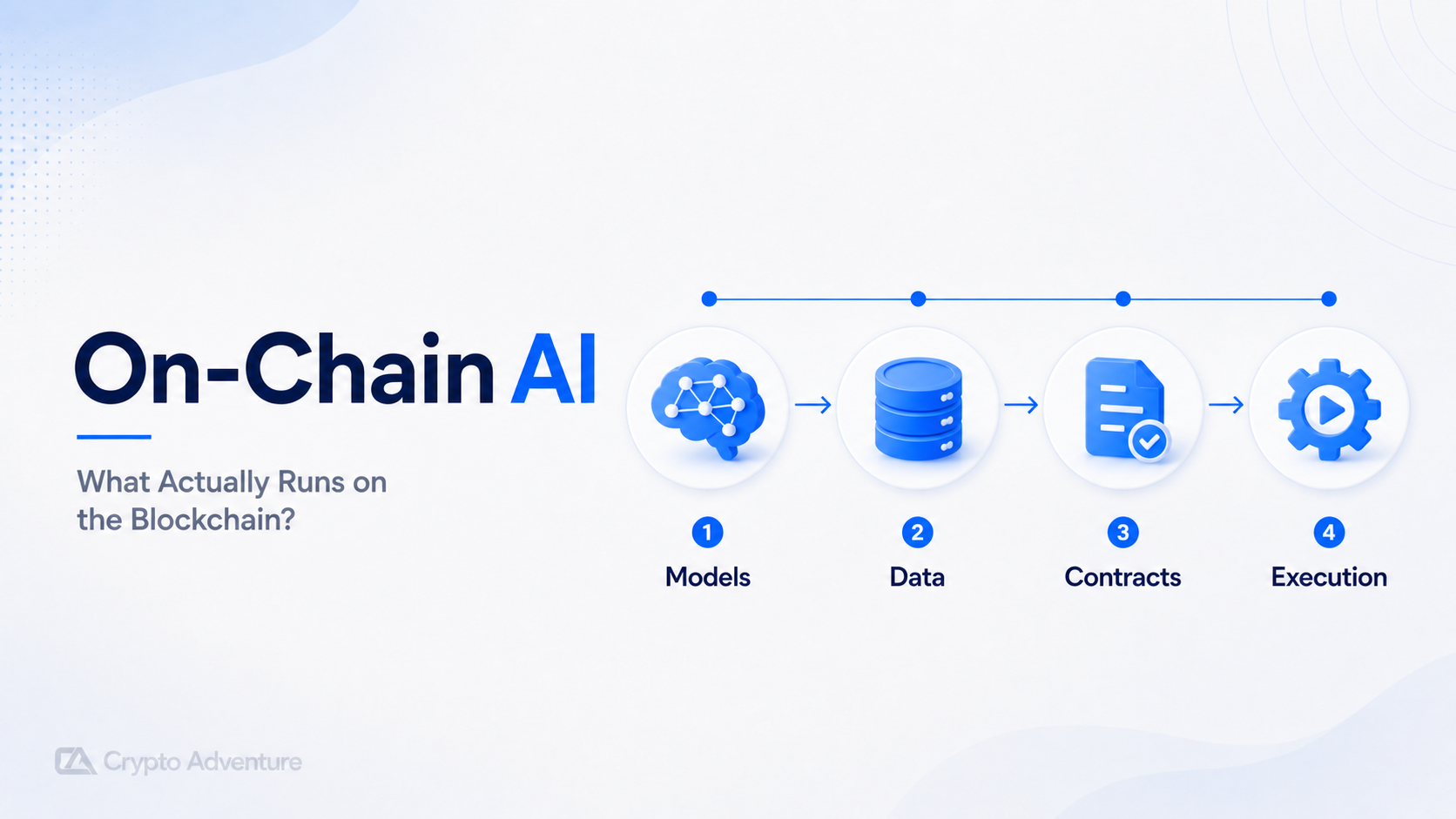
On-chain AI sounds like a model running fully inside a blockchain, but that is rarely what happens. Most AI computation is too heavy for normal smart contracts. Large models need GPUs, memory, fast data access, and many matrix operations. Public blockchains are built for deterministic settlement, not high-volume AI inference.
In practice, on-chain AI usually means that the blockchain coordinates, verifies, pays for, or consumes AI outputs. The model may run off-chain on a server, decentralized compute network, trusted execution environment, or prover system. The blockchain records inputs, commitments, payments, permissions, results, proofs, or dispute outcomes.
That distinction is important for users. A project can be “AI on-chain” without running the full model inside the smart contract. The real review question is what part is on-chain, what part is off-chain, and how the off-chain result becomes trustworthy.
The blockchain usually runs the settlement layer. That includes payments, access control, staking, slashing, reward distribution, identity checks, governance, and transaction records. Smart contracts can also store model commitments, task requests, oracle responses, proof verification, and result hashes.
A DeFi protocol might ask an AI model for a risk score. The model runs off-chain. The result comes back on-chain through an oracle, verifier, or coprocessor. The smart contract then uses that result to adjust a parameter, approve an action, route liquidity, or trigger a payment.
This is closer to on-chain AI coordination than on-chain model execution. The blockchain makes the result usable inside smart contracts, but it does not normally process the neural network directly.
The heavy work usually runs off-chain. Model inference, training, data processing, embeddings, image generation, language generation, simulations, and optimization all need more compute than a blockchain can provide cheaply.
Marlin gives a useful example of this split. Its Oyster system uses trusted execution environments to run complex workloads such as AI models over decentralized cloud resources, while blockchain applications can use the output as a coprocessor. Ritual follows a similar direction by orchestrating and exposing compute, including AI, ZK, and TEE execution, so smart contracts can consume inference outputs.
The off-chain layer gives AI the compute it needs. The on-chain layer gives the result economic finality, programmability, and auditability.
Off-chain AI creates a trust problem. If the model runs somewhere else, how does a smart contract know the output is real, correct, or produced under the right conditions?
There are several verification paths. A trusted execution environment can prove that code ran inside protected hardware. A zero-knowledge proof can prove that a computation followed specific rules, although proving large AI inference can be expensive. A cryptoeconomic network can use staking, challenge games, or validator scoring to penalize bad results.
The right method depends on the task. Cheap low-risk tasks may only need reputation and staking. High-value decisions may need stronger proofs, multiple model responses, or conservative human review.
AI can also reach smart contracts through oracle-like systems. A model or group of models produces a prediction, classification, risk score, or market estimate. The result is then delivered to an on-chain protocol.
Allora is built around decentralized AI and machine learning predictions. Its network coordinates participants that contribute model outputs, forecasts, or inferences, then uses those outputs inside a broader intelligence layer.
This model is useful when smart contracts need predictions rather than raw computation. A lending market may need risk signals. A trading app may need volatility forecasts. A game may need dynamic AI behavior. The main risk is that prediction quality can change, and on-chain protocols can become fragile if they trust weak model outputs.
AI agents add another layer. Instead of only producing a prediction, an agent can act. It can pay for data, trade, bridge assets, rebalance positions, renew subscriptions, or execute wallet transactions.
The blockchain usually handles the action, not the thinking. The agent reasons off-chain, prepares a transaction, and the wallet or smart account enforces permissions. The transaction then settles on-chain.
This design can be powerful, but it is dangerous without guardrails. Agents should have spending limits, contract allowlists, transaction simulation, revocation tools, and audit trails. A model mistake becomes more serious when it can move funds.
Some small AI-like logic can run directly on-chain. A smart contract can use simple rules, scoring formulas, finite-state machines, small models, or deterministic algorithms. These are not large language models. They are compact, verifiable functions.
Fully on-chain execution is strongest when the logic must be transparent, deterministic, and cheap. Examples include simple risk scoring, game logic, routing thresholds, governance automation, or small inference-like functions. The limitation is cost. Every on-chain computation must be paid for by users and verified by the network.
This is why most serious AI workloads stay off-chain and use blockchain for verification and settlement.
The first risk is fake decentralization. A project may use a blockchain token while the model, data, and execution remain fully centralized.
The second risk is unverifiable inference. If users cannot verify that the output was produced correctly, the smart contract may be trusting a black box.
The third risk is model drift. AI outputs can change as data, prompts, or model versions change.
The fourth risk is prompt injection. External data can manipulate agents or models into unsafe actions.
The fifth risk is overautomation. A model that works during normal conditions can fail during market stress, oracle delays, or adversarial conditions.
Users should ask what actually runs on-chain. If only the token and payments are on-chain, the project is closer to an AI service with crypto settlement. If outputs are verified, challenged, or backed by cryptoeconomic guarantees, the design is stronger.
Next comes the compute layer. Users should check whether inference runs on a centralized server, decentralized compute network, TEE, ZK prover, or validator system.
Then comes the trust path. A good system explains how outputs are generated, verified, updated, challenged, paid for, and used by smart contracts.
Finally, users should check whether the blockchain improves the product. If on-chain settlement, permissions, proofs, incentives, or auditability do not matter, the AI label may be stronger than the crypto use case.
On-chain AI does not usually mean a large model runs inside a blockchain. It usually means the blockchain coordinates AI work, pays for it, verifies it, stores commitments, or lets smart contracts consume the result.
The strongest designs are honest about the split. Heavy AI runs off-chain. The blockchain handles settlement, permissions, proofs, incentives, and execution. Users should judge on-chain AI by what is actually decentralized, what is verifiable, and whether the AI output can safely control real on-chain value.
The post On-Chain AI: What Actually Runs On The Blockchain? appeared first on Crypto Adventure.





