One is curated savings. One is a tokenized treasury. The yield looks identical. Everything underneath it is not.
Last week, two numbers sat almost on top of each other.
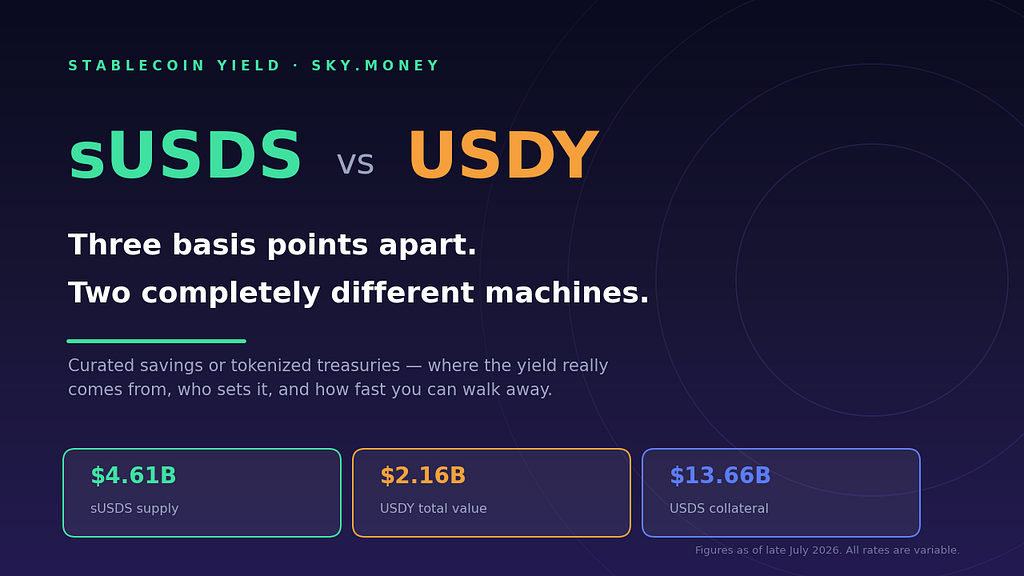
The Sky Savings Rate on sUSDS: 3.52% APY. Ondo’s USDY on RWA.xyz: a 7-day APY of 3.49%.
Three basis points apart. On a $100,000 position, that gap is about thirty dollars a year. Rounding error.
So if you searched “sUSDS vs USDY” hoping the yield would decide it for you, here is the uncomfortable part. The yield is the least interesting thing in this comparison.
What actually separates these two is who sets your rate, what generates it, and how fast you can walk away. Those three answers point in opposite directions.
Scale tells you something too. USDY holds about $2.16 billion in total value across roughly 15,500 holders. sUSDS supply sits near $4.61 billion.
One is a tokenized treasury product. The other is the largest yield-generating stablecoin in the market.
Same headline number. Two completely different machines.
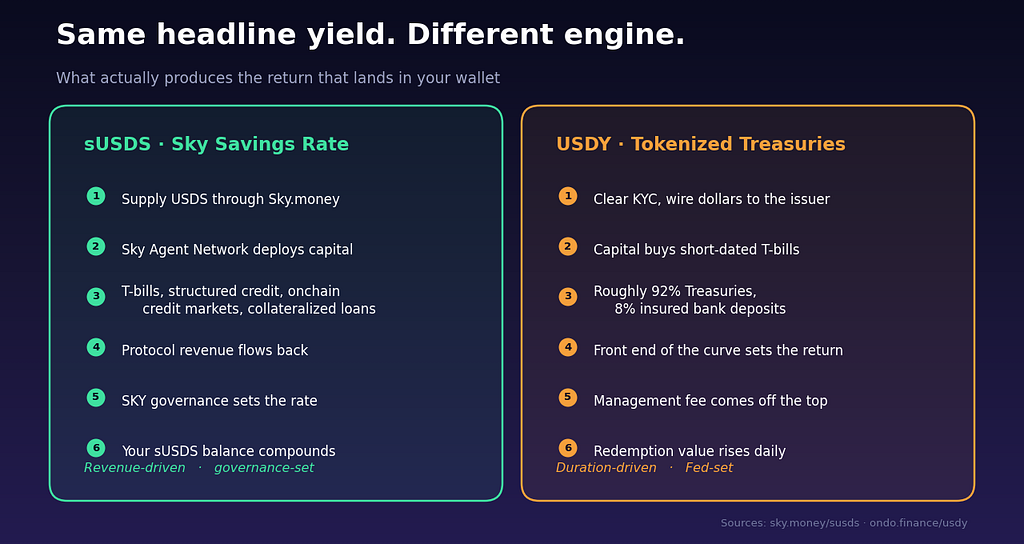
USDY is a tokenized note. You wire dollars, an issuer buys short-dated US Treasuries, and your token’s redemption value climbs daily. The portfolio runs roughly 92% Treasuries and 8% insured bank deposits.
Translation: your yield is a duration position. The front end of the Treasury curve, minus a management fee, wrapped in a token.
Which means the Fed is your rate-setter. A 25 basis point cut takes roughly 22 basis points off USDY’s APY within weeks, as the portfolio rolls into newly issued bills. Nobody at the issuer votes on that. The FOMC does.
sUSDS is built on a different premise entirely. Supply USDS through Sky.money and you receive sUSDS, which auto-compounds the Sky Savings Rate straight into your balance.
The Sky Savings Rate is not a lending rate and not a T-bill passthrough. It is funded by real protocol revenue, produced by the Sky Agent Network, an independent set of capital allocators who compete for mandates across governance-approved strategies:
Returns flow back to Sky Protocol. SKY governance then sets the rate against that revenue capacity.
The competitive part is easy to miss. Agents bid for capital mandates on performance. If one underperforms, allocations move.
You are not exposed to a single desk making a single call, and you are not exposed to a single instrument repricing on a single Thursday afternoon.
That difference shows up hardest when demand dries up. Most DeFi yield is utilization-dependent and compresses when borrowing stops. The Sky Savings Rate tracks protocol revenue instead of pool utilization.
Both rates are variable. Neither is a promise. Sky.money does not set, control, or guarantee the Sky Savings Rate, governance does, and the live figure is published in real time.
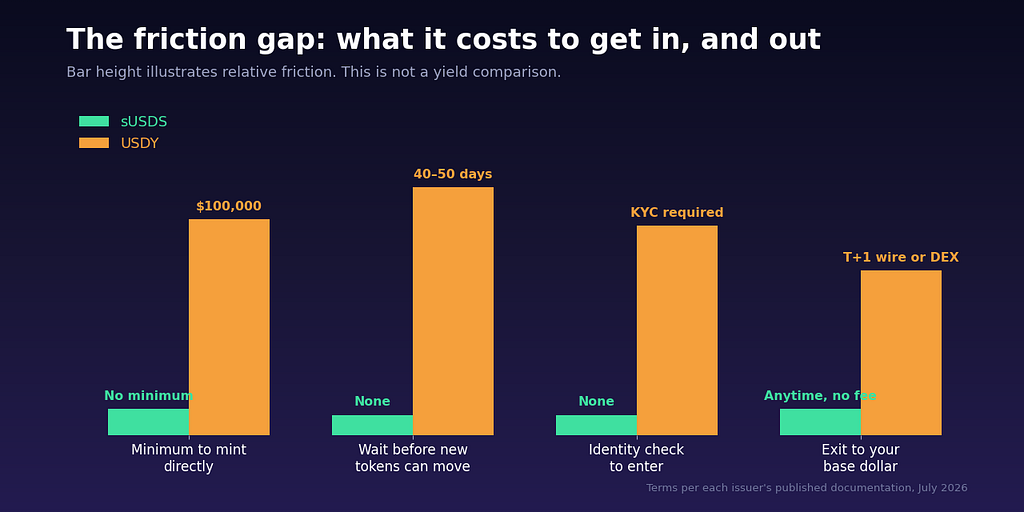
Here is where these two stop resembling each other at all.
USDY is offered under a Regulation S exemption. In practice, that means:
Under that minimum, you are dependent on secondary market liquidity to get in and out.
sUSDS has no minimum, no lockup, and no whitelist. Supply, receive sUSDS, convert back to USDS whenever you like, at zero fees.
If you are starting from USDC, it converts to USDS 1:1 with no slippage.
One product asks permission. The other asks for a wallet.
Track record is where “risk-adjusted yield” stops being a marketing phrase and starts being a receipt.
In April 2026, roughly $292 million was drained from the Kelp DAO rsETH bridge, followed by a multi-billion-dollar contraction in Aave collateral. Sky Protocol’s operations ran uninterrupted. It sustained no losses.
That is not a slogan. That is a stress test with a date on it.
Three more things worth putting side by side:
Overcollateralization is a boring word. It is also the reason a violent April was just an April.
Distribution moved in the same quarter. Binance completed its upgrade from DAI to USDS with automatic 1:1 conversion of user balances, and sUSDS became directly reachable through the DeFi section of Binance Wallet. Reach like that is hard to build behind a KYC gate.
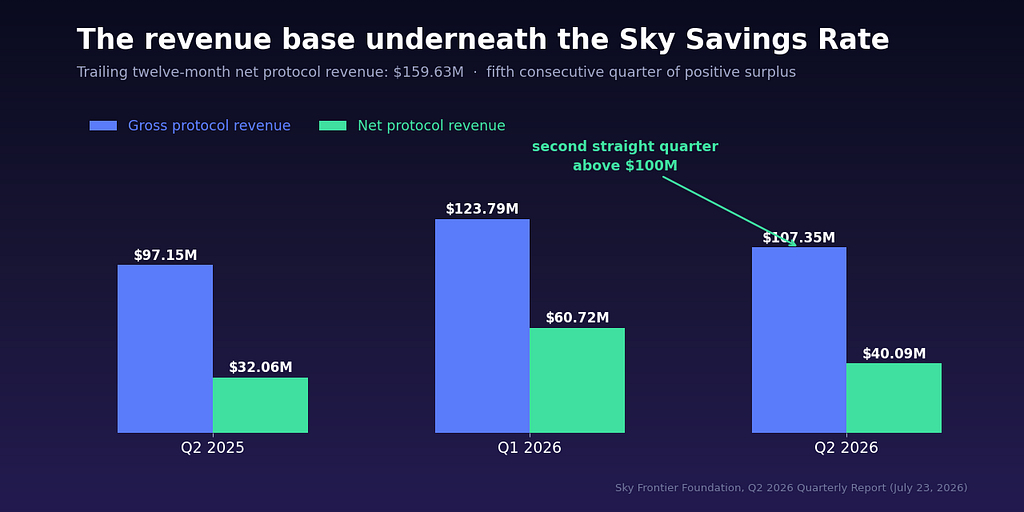
Six days ago, the Sky Frontier Foundation published its Q2 2026 report. The lines that matter for anyone holding sUSDS:
This is the engine underneath the Sky Savings Rate. When revenue capacity moves, governance adjusts the rate. Not emissions. Not incentives. Revenue.
For context, the Foundation estimates more than $300 billion in stablecoin capital is currently sitting in instruments that pay holders nothing at all.
Now the number I find hardest to ignore.
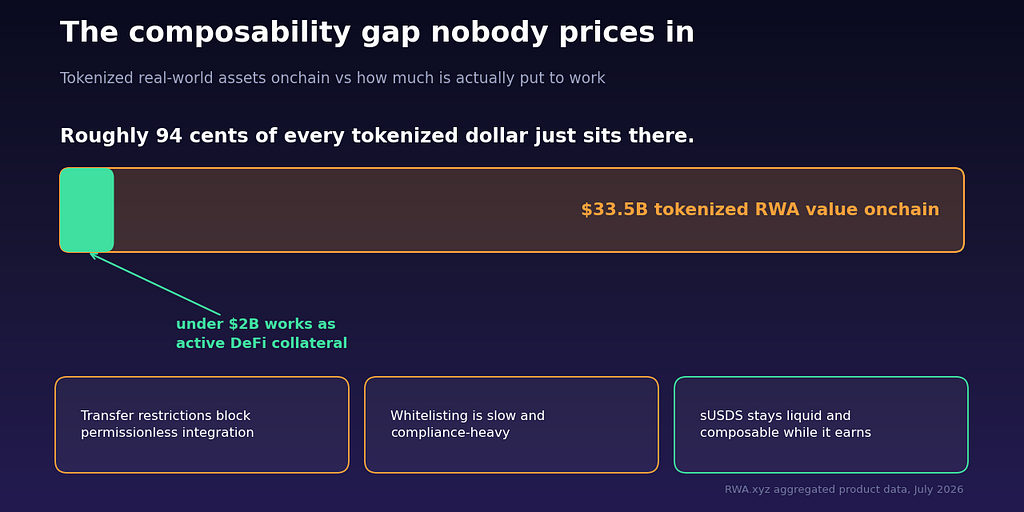
Tokenized real-world assets reached roughly $33.5 billion onchain by July 2026. Tokenized Treasuries alone account for about $15.86 billion of that.
Loans outstanding against all of that tokenized RWA collateral across every major DeFi protocol? Under $2 billion.
Roughly 94 cents of every tokenized dollar just sits there. Transfer restrictions and whitelist requirements make many of these instruments incompatible with permissionless infrastructure.
A token that can only move between pre-approved wallets cannot sit in a liquidity pool, a vault, or a lending market.
sUSDS was designed the other way around. It compounds while staying fully liquid, and it remains usable as a productive asset elsewhere without pausing yield accrual.
If you are building anything on top of your dollars, that is not a footnote. That is the entire design decision.
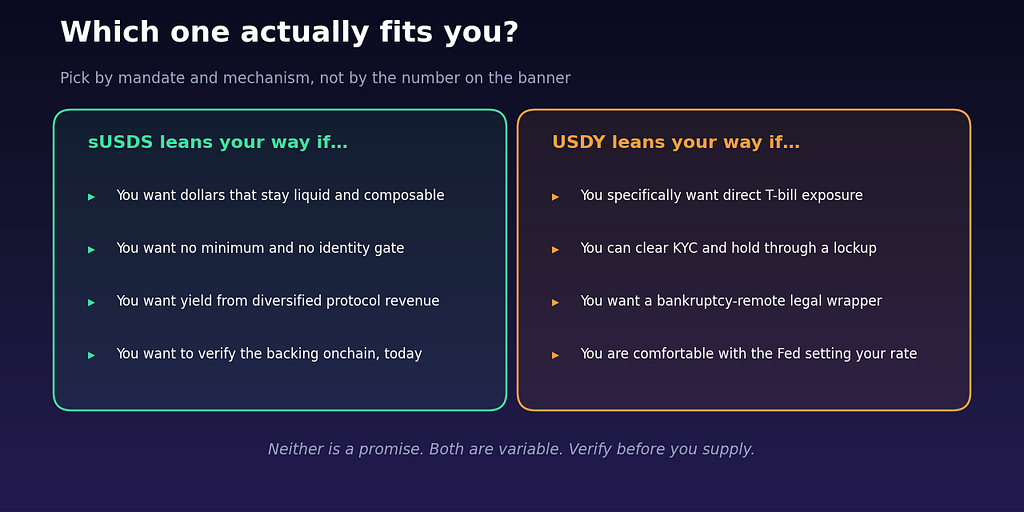
No hedging. Here is the honest split.
USDY likely fits if:
sUSDS likely fits if:
If you want a known number at a known date, Fixed Yield on sUSDS locks your rate to maturity.
If you want to sit further out on the risk curve, Sky Vaults are deployed on Morpho and available through the same interface. sUSDS stays the baseline product either way.
New to all of this? Start with what USDS is, then what sUSDS is, and come back to this piece.
The Fed just held rates again, and markets are now pricing meaningful odds of a hike in September.
Ironically, that would push USDY’s yield up while the Sky Savings Rate keeps tracking protocol revenue on its own schedule.
Which is exactly the choice in front of you.
Do you want your savings rate wired to a central bank, or to an audited revenue engine you can inspect block by block?
Neither answer is wrong. They are just different bets on what the word “safe” is doing in a sentence.
One bets on the creditworthiness of the United States, filtered through an issuer, a custodian and a settlement window.
The other bets on a diversified revenue engine that has published its numbers every quarter and has not broken in nine years.
Pick the mechanism you actually understand. Then verify it before you supply anything.
I want the other side of this. If you hold USDY over sUSDS, what is the actual reason? The legal wrapper, the direct Treasury exposure, or something I’ve missed entirely? Put it in the responses, I read all of them.
sUSDS vs USDY: Curated Savings or Tokenized Treasuries? was originally published in Coinmonks on Medium, where people are continuing the conversation by highlighting and responding to this story.





