
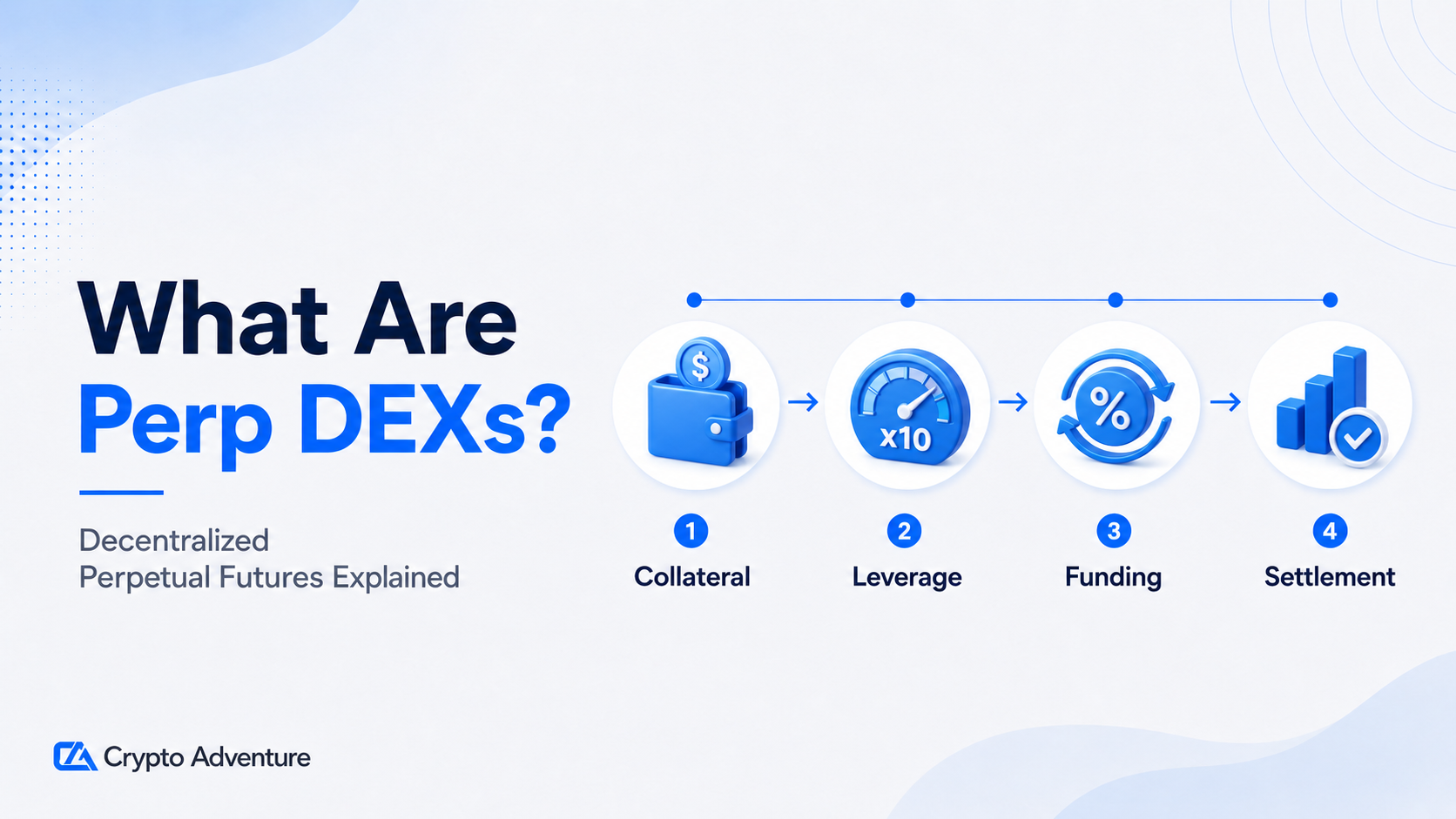
Perp DEXs are decentralized exchanges built for perpetual futures, the crypto derivatives contracts that let traders go long or short without an expiry date. Unlike spot trading, a perp position does not give the trader ownership of the underlying asset. It gives leveraged price exposure that remains open as long as the account keeps enough margin and the trader continues paying or receiving funding.
That distinction is important because perpetual futures are one of crypto’s most actively traded products. A perpetual futures contract tracks an underlying market through margin rules, funding payments, liquidation engines, and price feeds rather than through delivery at a fixed expiry date. A perp DEX brings those mechanics on-chain or partially on-chain, reducing reliance on a centralized exchange account while introducing a different set of smart contract, oracle, bridge, and liquidity risks.
The appeal is clear: users can trade directional exposure, hedge portfolios, access leverage, and interact with transparent DeFi infrastructure. The risk is equally clear: leverage magnifies losses, funding can drain accounts, liquidations can happen quickly, and decentralized infrastructure does not remove market risk.
Traditional futures expire. Perpetual futures do not. Without an expiry date, the contract needs another force to keep its price close to the underlying asset. Funding is that force.
Funding is a recurring payment between long and short traders. When the perp trades above the underlying index or oracle price, long traders often pay short traders. When the perp trades below the underlying price, shorts often pay longs. The goal is to make it costly for the contract price to stay too far away from the asset it tracks.
dYdX uses funding to keep perpetual markets close to oracle prices. Hyperliquid calculates funding around a premium index and pays funding hourly based on the model used for its markets. Different platforms use different formulas, timing, caps, and index structures, but the purpose is the same: align perp pricing with the underlying market.
Funding is often underestimated because it feels like a small recurring cost. In leveraged trading, the cost applies to notional exposure, not just account equity. That is why funding rates can quietly turn a flat trade into a losing one if the position is large, crowded, and held too long.
Perp DEXs require collateral. The trader posts margin, opens a position, and the platform tracks whether account equity remains above maintenance requirements. If the position moves too far against the trader, the liquidation system can close part or all of the position to protect the market from bad debt.
Leverage compresses the distance between entry and liquidation. At low leverage, a position can survive larger moves. At high leverage, a smaller price move can wipe out the account’s usable margin. The risk is not only direction. Fees, funding, slippage, spread, oracle movement, and execution delay can all affect the final outcome.
Hyperliquid liquidations are triggered when account equity falls below maintenance margin. In DeFi more broadly, liquidation design is a major part of risk management because unhealthy positions must be closed before losses spread. The same mechanism-first thinking behind liquidation bonus analysis applies to perp markets: someone or something must close risky exposure fast enough to protect the system.
A perp DEX that handles liquidations poorly can accumulate bad debt, punish liquidity providers, or create unfair outcomes during volatile markets. A strong liquidation engine needs reliable prices, deep liquidity, fast execution, clear margin rules, and transparent treatment of insurance funds or backstop mechanisms.
Price feeds are central to perp DEX design because trades, funding, liquidations, and settlement depend on a fair reference price. If the price feed is stale, manipulated, or too slow, traders can be liquidated unfairly or the protocol can suffer losses.
Many decentralized derivatives systems rely on oracle infrastructure. Chainlink Price Feeds aggregate market data through independent node operators, while newer low-latency oracle designs target faster derivatives execution. GMX uses Chainlink Data Stream oracles for pricing across its spot and perpetual exchange infrastructure.
Oracle design is one of the biggest differences between perp DEXs and centralized exchanges. A centralized exchange can calculate mark prices and risk internally. A decentralized system needs a reliable way to bring external market data into smart contracts or appchain logic. That makes oracle latency, data quality, update rules, fallback paths, and manipulation resistance critical.
Perp DEXs do not all use the same market structure. Some use order books, where buyers and sellers place bids and asks. Others use liquidity pools, where traders trade against pooled assets and liquidity providers take the other side of aggregate flow. Some use hybrid models that combine off-chain order matching with on-chain settlement or appchain execution.
Order-book models can feel closer to centralized exchange trading because they support limit orders, tighter execution, and professional market-making. They also require deep liquidity and fast infrastructure. Pool-based models can be easier to bootstrap because liquidity providers deposit assets into a shared pool, but LPs then carry trader profit-and-loss exposure, imbalance risk, and oracle-dependent execution risk.
GMX is an example of a pool-based DeFi derivatives design, while Hyperliquid is known for a trading-first order-book model. dYdX has evolved through multiple architectures, including appchain-based infrastructure. These design choices affect fees, spreads, latency, liquidity depth, market listings, and who absorbs trader profits or losses.
Traders use perp DEXs for several reasons. Some want self-custody instead of depositing assets with a centralized exchange. Some want transparent funding, positions, and on-chain accounting. Some want access to DeFi-native collateral, wallets, and automated strategies. Others simply want another trading platform with competitive fees, liquidity, and markets.
Perp DEXs can also support hedging. A spot holder may short a perp to reduce downside exposure. A market participant may trade funding differences. A DeFi user may hedge token exposure without selling the underlying asset. More advanced strategies overlap with spot versus perps decision-making, because the right tool depends on whether the user wants ownership, leverage, hedging, or pure price exposure.
The benefit is flexibility. The cost is complexity. A trader who does not understand funding, margin, liquidation, and oracle risk can lose money faster on a perp DEX than on spot markets.
The first risk is leverage. Even a well-designed platform cannot protect a trader from oversized exposure. High leverage gives the market less room to move before liquidation.
The second risk is funding. A crowded long trade can become expensive if funding stays positive for a long time. A crowded short trade can face the same problem in reverse. Funding can become a hidden cost when traders focus only on entry and exit price.
The third risk is smart contract and infrastructure risk. Perp DEXs depend on contracts, front ends, sequencers, bridges, oracles, liquidators, keepers, and governance. A weakness in any major component can affect funds or execution. That is why smart contract security matters even when the trading interface looks simple.
The fourth risk is liquidity. Thin markets create slippage, wider spreads, weaker liquidation paths, and worse execution. Traders should judge a perp DEX by real liquidity on the intended market, not only by total platform volume.
A serious perp DEX evaluation should start with custody and market structure. Does the trader keep control of funds until margin is posted? Is settlement on-chain, appchain-based, or hybrid? Is the market order-book based or pool-based? Who takes the other side of trades? How are liquidations handled?
The next layer is pricing. Which oracle or index is used? How often does it update? What happens during outages or volatility? Are liquidations based on mark price, oracle price, or another reference? The answers decide how positions behave when markets move quickly.
The final layer is cost. Trading fees, borrow or funding costs, spreads, price impact, gas, bridge fees, and liquidation penalties all affect net results. A platform can advertise low trading fees while funding, slippage, or liquidity makes the actual trade expensive.
Perp DEXs bring perpetual futures into decentralized market structure. They allow traders to take long or short exposure, use leverage, hedge positions, and interact with transparent infrastructure without relying fully on a centralized exchange account.
The product is powerful because it combines DeFi access with one of crypto’s most liquid derivatives formats. It is also risky because margin, funding, liquidation, liquidity, oracle design, and smart contract security all interact at the same time.
The best way to understand perp DEXs is not as “decentralized leverage” alone. They are risk engines. A strong platform must price markets accurately, liquidate positions safely, route liquidity efficiently, and keep costs transparent. Traders who understand those mechanics are better positioned to decide when perps are useful and when spot exposure is the cleaner choice.
The post What Are Perp DEXs? Decentralized Perpetual Futures Explained appeared first on Crypto Adventure.





