
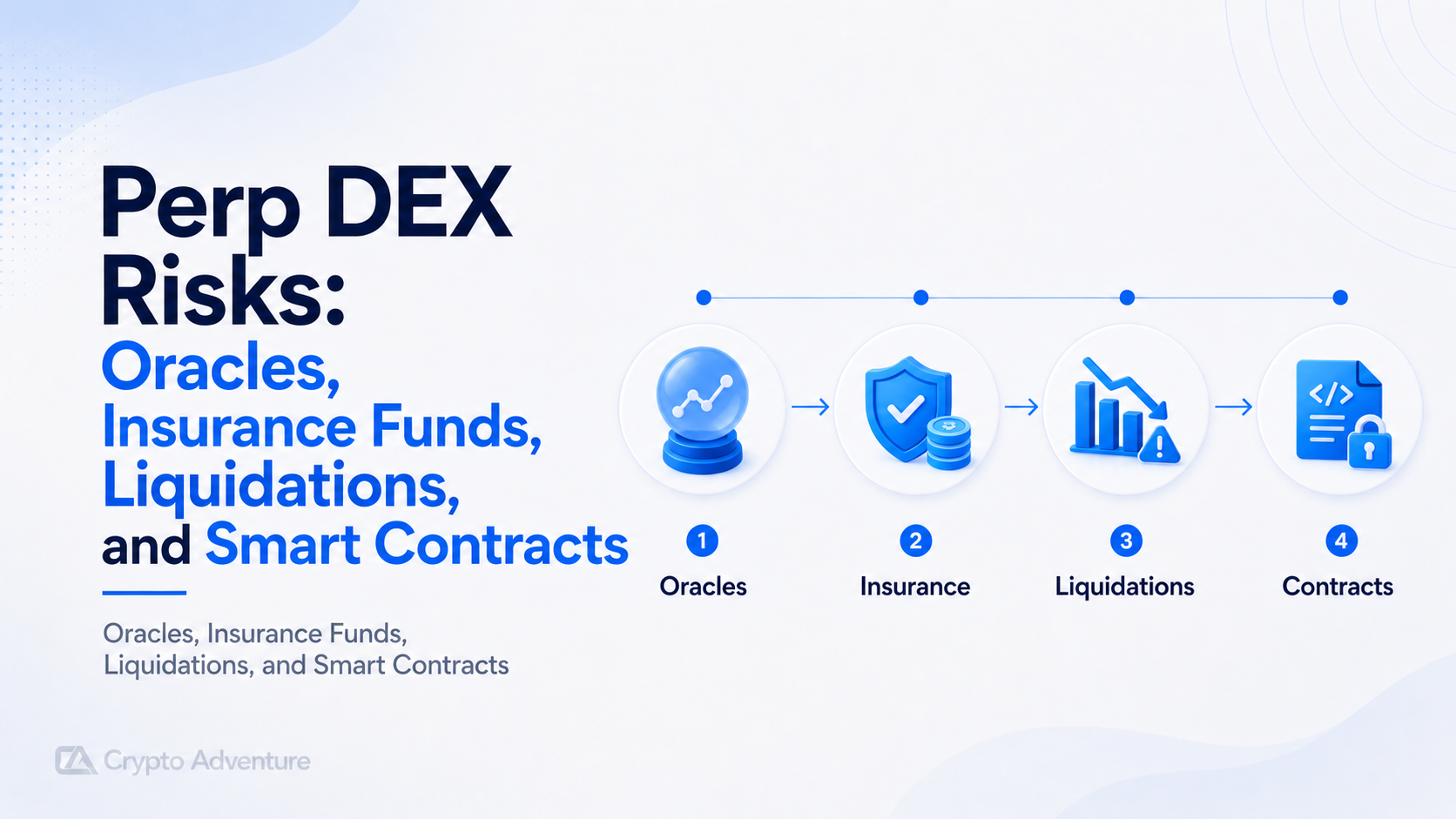
Perp DEXs give traders leveraged exposure without depositing funds into a centralized exchange account. That is the main appeal. Traders can connect a wallet, post collateral, open long or short positions, and interact with a transparent derivatives system. The trade-off is that risk does not disappear. It moves into the protocol’s market structure.
A centralized exchange concentrates custody, matching, liquidation, margin, and market data inside one company. A perp DEX spreads those functions across smart contracts, validators, keepers, oracles, order books, liquidity pools, insurance funds, front ends, bridges, and governance. That can make the system more transparent, but it also makes the risk path harder for users to understand.
Anyone trading crypto perpetual futures needs to look beyond leverage. The most important question is not only whether the trader is right about direction. It is whether the platform can price markets correctly, liquidate positions cleanly, absorb bad debt, and protect collateral when volatility hits.
Oracles bring external market prices into on-chain trading systems. Perp DEXs need them because funding, mark prices, liquidations, and settlement cannot depend only on one internal trade. If the oracle is stale, manipulated, delayed, or misconfigured, traders can be liquidated incorrectly or the protocol can take losses.
This is especially important during fast markets. A perp market can move before the oracle catches up. A thin underlying spot market can be manipulated around the oracle window. An oracle can also fail if data sources are weak, if updates are delayed, or if a fallback path behaves differently than users expect.
Chainlink Price Feeds are widely used across DeFi because they aggregate market data and publish reference prices for smart contracts. GMX uses Chainlink Data Stream oracles for its perpetual exchange pricing. Hyperliquid uses validator-published oracle prices with weighted medians across selected exchange sources inside its oracle model.
The right question is not whether an oracle exists. The better question is how the oracle behaves under stress. Update frequency, data source quality, manipulation resistance, fallback rules, and liquidation-price logic matter more than a generic claim that prices are oracle-backed.
Liquidations protect the system by closing positions before losses exceed collateral. They also create one of the biggest risks for traders. A position can be liquidated even if the trader’s broader thesis eventually proves right, because the account ran out of margin during a temporary move.
On a perp DEX, liquidation depends on collateral, unrealized PnL, maintenance margin, oracle or mark price, funding payments, fees, and liquidation penalties. Hyperliquid liquidations occur when account equity falls below maintenance margin. dYdX liquidations use oracle price to estimate account value under default settings, with accounts becoming liquidatable when value falls below maintenance margin requirements.
The exact engine matters. Some systems partially liquidate positions. Others may close more aggressively. Some route liquidations through order books. Others rely on pools, keepers, or backstop liquidity. Traders should understand whether liquidation price estimates include fees, funding, slippage, and changes in margin requirements.
The broader incentive is similar to liquidation bonus mechanics: liquidators or protocol engines are rewarded for closing risky positions fast. That protects the system, but it does not protect a trader who used too much leverage.
Insurance funds exist to absorb losses when liquidations do not fully protect the protocol. If a trader’s collateral is insufficient after a rapid market move, the shortfall has to come from somewhere. An insurance fund can cover that gap before losses spread to other users, liquidity providers, or the protocol treasury.
Insurance fund design varies. dYdX uses insurance fund mechanisms where liquidation penalties can flow to the insurance fund, and isolated markets can have segregated collateral and their own insurance fund structure. Some platforms use protocol revenue, liquidation fees, treasury support, or backstop modules to manage extreme conditions.
An insurance fund is not a magic shield. It can be too small. It can be depleted in a severe move. It can be concentrated in volatile assets. It can also create moral hazard if traders assume the fund will always absorb bad debt. The real test is fund size relative to open interest, leverage, liquidity depth, asset volatility, and the platform’s ability to liquidate positions fast enough.
Insurance fund risk is highest in long-tail markets. A BTC or ETH market with deep liquidity has more ways to unwind exposure. A newly listed or thin asset can move violently, create oracle stress, and leave the system with losses before liquidation works cleanly.
Perp DEXs depend on code. Smart contracts may custody collateral, calculate margin, route trades, handle settlement, manage liquidity pools, distribute funding, and execute liquidations. A bug in any critical component can affect user funds.
Audits help, but they do not eliminate risk. Code can be audited and still fail through edge cases, oracle assumptions, governance errors, bridge dependencies, or upgrades. A perp DEX also depends on off-chain or appchain infrastructure in many cases, including front ends, APIs, indexers, keepers, sequencers, and validator networks.
Users should look for public audits, bug bounties, clear upgrade controls, conservative risk parameters, and a history of incident response. Broader smart contract auditing and security tools are useful for understanding the security layer, but derivatives protocols require extra caution because leverage magnifies technical failure.
Smart contract risk also affects liquidity providers. In pool-based perp DEXs, LPs may be exposed to trader PnL and contract logic. A bug does not only affect traders who open positions. It can affect anyone providing collateral to the trading system.
Liquidity risk appears when traders cannot enter, exit, or liquidate positions near fair value. It can show up as wide spreads on an order book, heavy price impact in a pool, low depth near the mark price, or delayed execution during congestion.
Order-book perp DEXs need market makers to keep spreads tight. If market makers cancel quotes during volatility, execution gets worse quickly. AMM perp DEXs need deep pools and strong risk settings. If a pool is imbalanced or open interest is capped, traders may face high price impact or limited position size.
This risk matters most when the trader is wrong and needs to exit fast. It also matters during liquidations. If the protocol cannot close unhealthy positions into enough liquidity, bad debt can appear. That is why volume alone is not enough. Real depth, executable size, and behavior during volatility matter more than a headline daily volume number.
Funding is often treated as a minor detail, but it can become a major risk for leveraged positions. A trader can be directionally right and still lose money if funding costs remain high for too long. Crowded trades are especially vulnerable because the market charges the dominant side to keep the perp price anchored to the underlying asset.
This is where funding rates quietly damage accounts. The cost applies to notional exposure, not only wallet equity. At high leverage, even a small recurring funding rate can become meaningful.
Perp DEX users should also understand whether funding is paid hourly, every block, or at another interval. They should know whether funding is realized into account equity, deducted from wallet balance, or handled through another margin process. Small implementation details can change liquidation risk.
Many perp DEXs rely on governance or protocol teams to adjust risk parameters. This can include leverage caps, oracle sources, margin requirements, listing rules, funding formulas, liquidation penalties, insurance fund policy, and emergency controls.
That flexibility is useful because markets change. It also creates risk. Poor parameter changes can make markets unsafe or unfair. Emergency interventions can protect the protocol but damage user trust. Governance capture can push settings in favor of insiders, market makers, or token holders at the expense of ordinary traders.
The best systems make parameters transparent and change them carefully. Users should understand who can upgrade contracts, pause markets, adjust risk settings, or intervene during stress.
The first risk control is smaller leverage. Most liquidation disasters start with position size that leaves no room for volatility. Isolated margin can limit damage to one position, while cross margin can improve capital efficiency but put more account equity at risk.
The second control is platform selection. A stronger platform should have deep liquidity, reliable oracles, clear liquidation rules, security reviews, transparent fees, and enough market history to evaluate behavior during volatility.
The third control is cost awareness. Traders should include funding, spread, price impact, gas or execution costs, bridge costs, and liquidation penalties in the trade plan. Perps are not only an entry price and an exit price.
The fourth control is asset selection. Long-tail assets are more dangerous because liquidity is weaker, oracle manipulation can be easier, and price gaps can be larger. High leverage on thin markets is usually a poor risk trade-off.
Perp DEXs reduce centralized custody risk, but they introduce a complex protocol risk stack. Oracles must price markets correctly. Liquidation engines must close unhealthy positions before losses spread. Insurance funds must absorb shortfalls. Smart contracts must handle collateral and settlement safely. Liquidity must remain usable when volatility increases.
The safest way to approach perp DEXs is to treat them as powerful trading infrastructure, not as safer versions of spot exchanges. They can offer transparency, self-custody, and open access, but leverage makes every weak point more expensive.
A good perp DEX should be judged by how it behaves under stress. Tight spreads in calm markets matter, but oracle reliability, liquidation performance, insurance fund depth, and smart contract resilience decide whether the platform can survive the moments when traders need it most.
The post Perp DEX Risks: Oracles, Insurance Funds, Liquidations, And Smart Contracts appeared first on Crypto Adventure.





