
Perp DEXs let traders go long or short using perpetual futures without relying fully on a centralized exchange account. The basic product may look similar across platforms: deposit collateral, choose a market, set leverage, open a position, pay or receive funding, and close the trade later. Under the surface, the market structure can be completely different.
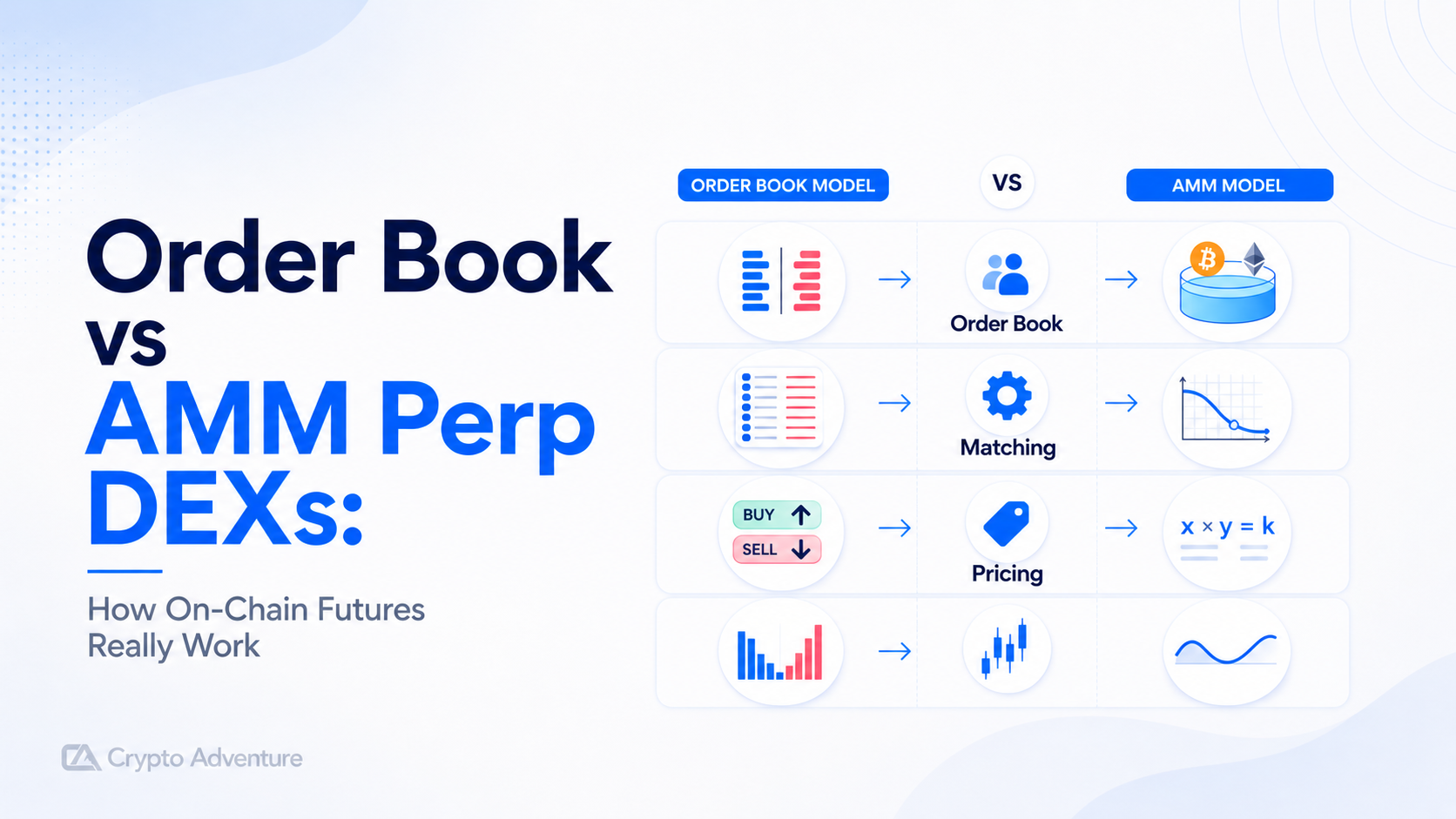
The two main models are order books and automated market makers. An order book matches buyers and sellers through bids and asks. An AMM lets traders execute against a pool, curve, or virtual pricing model instead of waiting for another trader to take the opposite side. Both models can support crypto perpetual futures, but they create different trade-offs around liquidity, slippage, liquidation risk, market-maker incentives, oracle dependence, and user experience.
This distinction matters because on-chain futures are not only about leverage. They are risk engines. The exchange has to price markets, route orders, protect collateral, manage liquidations, and keep traders solvent during volatility. The design decides who provides liquidity, who carries trader profit-and-loss exposure, and how expensive a position becomes when the market is moving fast.
An order book perp DEX uses a central limit order book, often shortened to CLOB. Traders and market makers submit limit orders at specific prices and sizes. Market orders take available liquidity from the book. Matching usually follows price-time priority, where the best price executes first and earlier orders at the same price get priority.
Hyperliquid is the clearest current example of a trading-first on-chain order book. HyperCore includes fully on-chain order books for spot and perps, with orders matched in price-time priority. dYdX Chain also uses a decentralized limit order book and matching engine for perpetual futures.
The user experience is familiar to active traders. Limit orders, market orders, stop orders, maker rebates, taker fees, spreads, and order-book depth all behave closer to centralized exchange trading than to a swap-style DeFi interface. That is why order-book perp DEXs often attract market makers, API traders, professional accounts, and users who care about precise execution.
The weakness is that an order book needs liquidity on both sides. If market makers leave, spreads widen. If a market is new or unpopular, execution can become thin. If volatility spikes, visible liquidity can disappear quickly because market makers can cancel orders faster than retail traders expect.
AMM perp DEXs do not depend on a traditional live order book in the same way. Traders execute against a pool, pricing curve, virtual AMM, or liquidity vault. The platform calculates execution price, funding, price impact, and trader PnL through smart contracts and oracle inputs.
GMX is a major pool-based perp DEX example. Traders use the platform for spot and perpetual markets, while liquidity providers supply assets that support trading. GMX uses Chainlink Data Stream oracles for pricing and supports perp trading with leverage. Older models such as Perpetual Protocol’s vAMM used a virtual automated market maker for price discovery, with collateral managed separately from the virtual curve.
AMM-based perps can be easier to bootstrap because the exchange does not need a deep two-sided order book from day one. Liquidity providers deposit assets, traders interact with the pool, and the protocol prices trades according to its rules. That can work well for broad markets when liquidity is deep and risk parameters are conservative.
The trade-off is that liquidity providers become part of the risk engine. They may earn fees when traders lose or when volume is healthy, but they can also be exposed when traders win heavily, when markets trend aggressively, or when oracle and pool design create imbalances. AMM perps move some complexity away from the trader interface and into the liquidity pool.
Order books and AMMs measure liquidity differently. On an order book, traders look at bid-ask spread, visible depth, market impact, maker activity, and how much size can be filled near the mark price. A deep book can give tight execution, especially when market makers compete aggressively.
On an AMM perp DEX, traders care about price impact, pool depth, open interest limits, skew, funding, and oracle updates. The available liquidity may look simpler from the front end, but the true execution cost depends on how the pool reacts to trade size and market imbalance.
This is why total value locked is not the same as usable liquidity. A pool may be large but still limit trade size because of open interest caps or risk settings. An order book may show impressive volume but still become thin in a fast move. Traders should judge the exact market they plan to trade, not only the platform headline.
For users deciding between spot and perps, execution quality matters because perps add more moving parts. A small spot slippage mistake is painful. A leveraged perp slippage mistake can move liquidation much closer.
Both models use funding to keep perpetual contracts close to the underlying reference price. When longs dominate, funding can make long positions more expensive. When shorts dominate, shorts may pay longs. The exact formula varies by platform, but the purpose is similar: push perp pricing back toward the underlying market.
Order-book perps often derive market pressure from the relationship between the perp market and the oracle or index price. AMM perp DEXs may also use funding to balance long and short open interest against pool exposure. In both cases, funding rates can become a hidden cost when traders hold large positions for too long.
Funding is not only a trader cost. It is part of the platform’s balancing mechanism. If too many traders are on one side, the exchange needs incentives for the opposite side or for position reduction. Poor funding design can make markets unstable, push traders away, or overpay one side of the book.
Liquidation design is where perp DEX architecture becomes most serious. If a trader’s margin falls below maintenance requirements, the protocol has to close the position before losses exceed collateral. This requires reliable prices, enough liquidity, and a liquidation process that works during volatility.
Order-book systems need liquidators or internal engines that can close positions into market depth. AMM systems need pools and risk rules that can absorb or unwind exposure without creating bad debt. In both cases, the protocol may use insurance funds, backstops, liquidation penalties, or auto-deleveraging-style mechanisms to protect solvency.
The mechanics are close to the broader DeFi liquidation problem. A liquidation bonus exists because someone has to close risky positions before they damage the system. The same incentive logic behind liquidation bonus mechanics appears in perp DEXs, even when the interface hides the complexity from the trader.
Order books are usually better for active traders who want precise orders, visible liquidity, fast execution, tighter spreads, and professional market structure. They work best when the exchange has strong market-maker participation and enough volume to keep books healthy.
AMM perps can be better for simpler access, easier liquidity bootstrapping, and markets where a pool-based design can handle flow efficiently. They can also make trading feel more DeFi-native because users interact with contracts and pools rather than a professional trading terminal.
Neither model is automatically safer. Order books can suffer from liquidity gaps, spoofing, latency games, and thin depth. AMM perps can suffer from oracle risk, pool imbalance, LP losses, and price impact. The better model depends on the asset, trader size, volatility, platform maturity, and whether the user understands the risk engine.
Order book and AMM perp DEXs both bring futures trading on-chain, but they solve liquidity in different ways. Order books match traders through bids and asks, making them familiar to serious exchange users. AMM perps route trades through pools, curves, or virtual pricing models, making liquidity easier to bootstrap but shifting more risk into the pool design.
The strongest perp DEXs are not defined only by the model they use. They are defined by execution quality, oracle reliability, funding design, liquidation performance, liquidity depth, smart contract security, and whether traders can understand the true cost of a position before opening it.
Order books may dominate professional on-chain derivatives, while AMM models can still serve markets where pooled liquidity and simpler access make sense. The real winner is not the architecture with the best slogan. It is the one that keeps prices fair, liquidity usable, and collateral protected when markets move hardest.
The post Order Book Vs AMM Perp DEXs: How On-Chain Futures Really Work appeared first on Crypto Adventure.





