Peter Schiff Statement has sparked debate across digital asset markets after the economist warned that Bitcoin may decline significantly if key price levels are broken. He suggested the asset could fall as much as 84%, potentially reaching near $20,000 per coin. The warning is based on technical levels that, if lost, could trigger stronger selling pressure.
The latest commentary highlights ongoing discussion around volatility, risk appetite, and institutional positioning within the crypto market. Analysts note that such bearish forecasts often influence sentiment, especially during uncertain macro conditions.
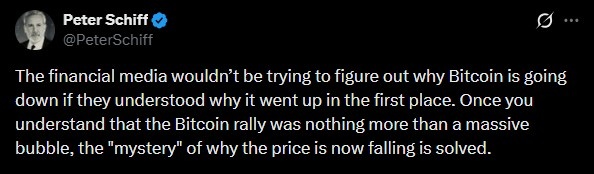
Source: X Official
Peter Schiff is an American economist, investor, and financial commentator known for his long-standing criticism of digital currencies. He is also a fund manager and founder of an investment firm focused on global markets and precious metals.
He gained major attention after correctly warning about the 2008 financial crisis, which strengthened his reputation as a macro analyst. Over time, he became widely recognized as one of the strongest advocates for gold and a persistent critic of Bitcoin.
His commentary often appears in market discussions because he focuses on macro trends such as inflation, debt cycles, currency weakness, and monetary policy — all of which influence risk assets.
The recent Peter Schiff Statement also included a broader macro argument. He believes that during a major economic downturn, investors may shift toward traditional safe assets like gold instead of crypto, which could reduce Bitcoin demand.
He also clarified that his remarks linking Donald Trump to BTC risk were not about one individual directly destroying the asset. Instead, he was referring to government policy and macroeconomic conditions.
According to his view, the United States could face economic stress driven by:
Weak dollar
Rising national debt
Tariffs leading to higher borrowing costs
He argues that this environment may reduce investor risk appetite and redirect capital into gold rather than digital assets. He believes BTC does not function as a true safe-haven during severe crises.
Understanding his perspective is important when analyzing the Peter Schiff Statement. His criticism comes from a consistent belief framework:
Gold is real money
BTC lacks intrinsic value
Speculation drives price movements
A crisis could expose structural weakness
Because of this outlook, He tends to issue bearish forecasts regardless of short-term market rallies. His position is philosophical as well as economic.
Whether his prediction becomes reality depends on macro conditions. Historically, Bitcoin has behaved both as a risk asset and, at times, as a hedge narrative. Market reactions often depend on liquidity cycles rather than a single factor.
If his scenario proves correct, the impact could be significant across the broader crypto ecosystem. A deep decline could reduce liquidity, slow venture funding, weaken altcoin performance, and shift attention toward defensive assets. Institutional flows might pause while investors reassess risk exposure.
However, many analysts argue that adoption growth, ETF access, and infrastructure improvements create a different environment compared with past cycles.
The latest Peter Schiff Statement highlights the ongoing debate about Bitcoin’s role during economic stress. While his bearish outlook reflects long-standing beliefs, actual outcomes depend on liquidity, policy direction, and adoption trends shaping the future digital asset landscape.
This content is for informational purposes only and not financial advice. Cryptocurrency investments carry risk. Always do your own research and consult a qualified financial advisor before making investment decisions.





