Your crypto doesn’t have to sit idle. Here’s every real way to make it work — ranked by risk, complexity, and what you actually earn.
Most people think crypto passive income means one of two things: staking some tokens on an exchange and forgetting about it, or chasing 3,000% APY farms that rug-pull two weeks later.
The reality is more nuanced — and more useful than either extreme.
Cryptocurrency has evolved far beyond simple buy-and-hold investing. In 2026, the crypto ecosystem offers dozens of ways to generate recurring revenue from digital assets without actively trading. Whether you hold Bitcoin, Ethereum, Solana, or stablecoins, there is a passive income strategy that fits your risk tolerance and portfolio size. KeySearch
This guide covers every major method, what you actually earn from each, the real risks that most articles gloss over, and how to build a layered strategy that matches your experience level. No yield farming fantasies. No promises of 100x returns. Just the mechanics, the numbers, and the honest risk assessment.
Join the free TG group of Fat Pig Signals and sign up with a 15% discount with the code THELUWIZZ
Before diving into methods, one distinction matters above everything else.
In traditional finance, “passive income” usually means receiving interest on money you’ve lent — and the interest rate is predictable and stable. A savings account pays 4% this year. A bond pays a fixed coupon.
Crypto passive income is fundamentally different. In all these cases, passive income comes from smart contracts and the market’s demand for liquidity, allowing investors to earn steady returns without actively trading. That means your yield fluctuates with market conditions, not with a fixed contract. Media Search Group
When trading volume is high, liquidity providers earn more. When a protocol’s demand for borrowing increases, lending rates go up. When a network is busy, staking rewards can shift. The rates you see quoted are always current snapshots — not guarantees.
This is important because every method below has a live yield that moves. The ranges I’ll give you are realistic benchmarks for May 2026, not promises.
Staking is the entry point for crypto passive income, and for good reason.
Users are widely relying on staking and similar yield-generating tools to earn passive returns on their crypto investments. As of late 2025, traders staked more than 33 million Ethereum tokens worth roughly $100 billion. The rewards come from real economic functions across the crypto ecosystem, not speculation.
Here’s how it works: proof-of-stake blockchains like Ethereum and Solana need token holders to “stake” their assets as collateral to validate transactions. In return, the network pays stakers a share of transaction fees. In 2026, staking Ethereum natively currently offers a reliable APY of around 3–4%, depending on overall network congestion and activity. Solana typically offers 6–8%. NFT Evening
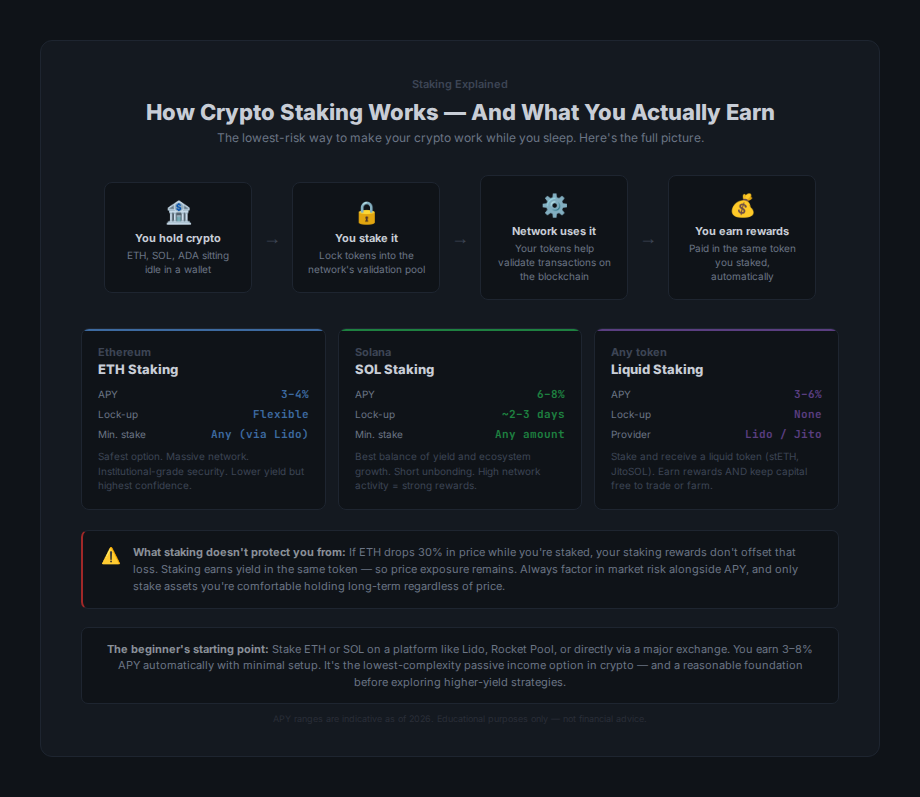
The mechanics:
Beginners can use centralized exchanges like Kraken or Coinbase for one-click convenience, though the exchange takes a small cut of the profits. Advanced users often prefer running their own validator nodes to maximize their returns and maintain absolute custody over their digital assets.
The honest risk assessment:
Staking is the lowest-risk passive income strategy in crypto — but it’s not risk-free. Some staking networks have an “unbonding” period or withdrawal queue, during which you can’t access your funds. If the market moves against you during that window, you can’t exit quickly. KeySearch
More importantly, staking earns yield in the same token you’re staking. If ETH drops 30% while your tokens are locked, your 4% APY doesn’t offset that. Staking is a yield strategy, not a hedge. Only stake assets you’re comfortable holding regardless of price.
Who should start here: Anyone. If you hold ETH or SOL and aren’t staking it, you’re leaving money on the table with essentially zero additional effort.
Traditional staking has one major flaw that frustrates active investors: it locks up your assets and renders them completely illiquid for a set duration.
Liquid staking solves this. When you stake through protocols like Lido (stETH) or Rocket Pool (rETH) for Ethereum, or Jito (JitoSOL) for Solana, you receive a liquid staking token that represents your staked position. That token accrues staking rewards automatically — and you can trade it, use it as collateral in DeFi, or sell it at any time.
When you stake through protocols like Lido, Rocket Pool, Marinade, or Jito, you receive a liquid staking token that represents your staked position plus accumulated rewards.
The yield is slightly lower than native staking (typically 3–6% versus 4–8%) because the protocol takes a small fee. But the capital flexibility is worth it for most holders — especially those who also want to participate in DeFi with the same assets.
The risk: Custody and technical risk apply — DeFi methods like staking and providing liquidity avoid custodians but rely on smart contracts, which can still be exploited or fail. Liquid staking protocols are among the most battle-tested in DeFi, but the smart contract risk is real and non-zero.
If you want passive yield without the volatility of holding ETH or SOL, stablecoin lending is the answer.
Platforms like Aave and Compound let you deposit USDC or USDT into lending pools. Borrowers pay interest to access those funds, and you receive a share of that interest continuously.
Aave and Compound allow you to lend stablecoins like USDC or USDT and earn 1–8% APY. Aave is a large protocol with over $10 billion in assets, making it a standard choice for many.
The yield fluctuates with borrowing demand. During bull markets when traders are borrowing stablecoins to leverage long positions, rates can spike to 8–12%. During quieter periods, they drop to 2–4%. Current mid-2026 rates sit around 4–7% on major platforms.
Why this is underrated: You’re earning interest on assets that have no price volatility. Your $10,000 in USDC is still $10,000 next month — plus whatever interest you accumulated. For holders who’ve already taken profits from trading and want their idle capital working, stablecoin lending is one of the cleanest passive income strategies available.
The risk: Platform insolvency or smart contract exploit. Aave and Compound have operated without incident for years, but the risk is not zero. Diversify across platforms rather than concentrating everything in one.
Liquidity providers (LPs) deposit pairs of tokens into decentralized exchange pools. When traders swap between those tokens, LPs earn a percentage of the transaction fee.
Suppose a user supplies $5,000 worth of ETH/USDT to Curve Finance. They earn a proportional share of transaction fees generated by traders swapping ETH for USDT in that pool, plus extra incentives in the form of CRV tokens. LinkedIn
Uniswap V3 pools providing liquidity for ETH/USDC pairs can yield 10–20%. However, the risk of “impermanent loss” is high due to market volatility.
Impermanent loss explained simply: If you provide ETH/USDC liquidity and ETH doubles in price, the pool automatically rebalances — selling some of your ETH for USDC. You end up with less ETH than if you’d just held. This “loss” relative to simply holding is called impermanent loss. In volatile markets, it can significantly erode the fee income you earn.
APY stability: Liquidity provision and yield farming earnings are more likely to widely fluctuate with changes in market activity and trading volume.
Who should use this: Intermediate crypto holders who understand how AMMs work and are comfortable monitoring positions. Not a set-and-forget strategy.
The most reliable yield farming strategies now focus on blue-chip protocols — protocols have matured, yields have normalized, and the emphasis has shifted from unsustainable token emissions to real yield generated from actual protocol revenue.
The problem for most people: identifying which yield farming opportunities are legitimate versus which are traps requires significant research. New protocols launch weekly with eye-watering APY rates — and many of them fail, get exploited, or simply collapse when token emissions run out.
This is exactly where professional signal services add value that most people miss.
Fat Pig Signals doesn’t just publish trading signals. Their VIP service includes dedicated yield farming intelligence — identifying DeFi opportunities that have been risk-assessed before they’re recommended. That means you get the upside of higher-yield strategies without spending 10 hours researching each protocol’s audit history, tokenomics, and smart contract risk.
They’ve been doing this since 2017 — through the DeFi summer of 2020, the yield farming mania of 2021, and the protocol collapses of 2022. That cycle experience is exactly what you want behind the recommendation when you’re deciding whether to commit capital to a new farm.

The right approach isn’t choosing one method. The best results come from diversification, combining high-yield strategies with safer, stablecoin-based options to balance growth and security. LinkedIn
Here’s a practical allocation framework by experience level:
Beginner (0–12 months in crypto):
Intermediate (1–3 years, comfortable with DeFi):
Active (3+ years, understands smart contract risk):
The key principle across all levels: instead of concentrating in a single high-yield strategy, diversify across multiple methods, choose reputable platforms, and apply risk management techniques to balance opportunity with safety.
Mistake 1: Chasing the highest APY
If a protocol is offering 500% APY, that number exists for one of three reasons: massive inflationary token emissions (which dilute your returns), unsustainable liquidity mining rewards, or it’s a scam. High potential returns from yield farming can offer much higher APYs compared to traditional finance or even staking — sometimes exceeding 100% in newer pools — but APY stability is much lower, and earnings are more likely to widely fluctuate. Start with protocols that have been operating for years, not weeks.
Mistake 2: Not accounting for gas fees
On Ethereum mainnet, claiming staking rewards, moving liquidity positions, or compounding your yield can cost $5–50 in gas fees per transaction. On small positions, these fees consume the entire yield. Use Layer 2 networks like Arbitrum or Optimism, or Solana, where gas is negligible. Arbitrum is popular right now because gas fees are very low — under $0.01 — which helps maximize profits.
Mistake 3: Ignoring smart contract risk
Every DeFi protocol carries the risk that a bug in the smart contract could result in loss of funds. This isn’t theoretical — billions have been lost to DeFi exploits. Mitigate it by using only audited, battle-tested protocols, diversifying across multiple platforms, and never putting more than 10–20% of your portfolio in any single DeFi position.
Mistake 4: Not tracking your actual returns
Many people calculate their APY in token terms and forget to account for price decline. Earning 15% APY on a token that drops 40% in price means you’ve lost 25% net. Track your returns in stablecoin or fiat terms to get an honest picture of actual performance.
Most passive income guides end at “stake your ETH and use Aave.” That’s fine advice — but it leaves the most interesting opportunities on the table.
The DeFi space generates new yield opportunities constantly. Real protocol revenue, legitimate liquidity incentives, cross-chain yield strategies — the opportunities exist, but identifying the ones worth your capital requires analytical infrastructure most individual holders don’t have.
Fat Pig Signals’ VIP service includes their yield farming intelligence as part of the package — sitting alongside their trading signals, market analysis, and portfolio building guidance. You get the research done for you, with risk assessed by analysts who’ve navigated every DeFi cycle since the beginning.
Their free Telegram channel is open right now. You can evaluate the quality of their analysis before committing to VIP — and specifically watch how they approach DeFi opportunities alongside trading signals.
If you’re building a passive income stack in 2026, the foundation is solid: stake ETH or SOL, lend some stablecoins, and let those positions compound quietly. The edge comes from knowing which opportunities beyond that are worth pursuing — and having professional intelligence to evaluate them.
Join the Fat Pig Signals free Telegram channel
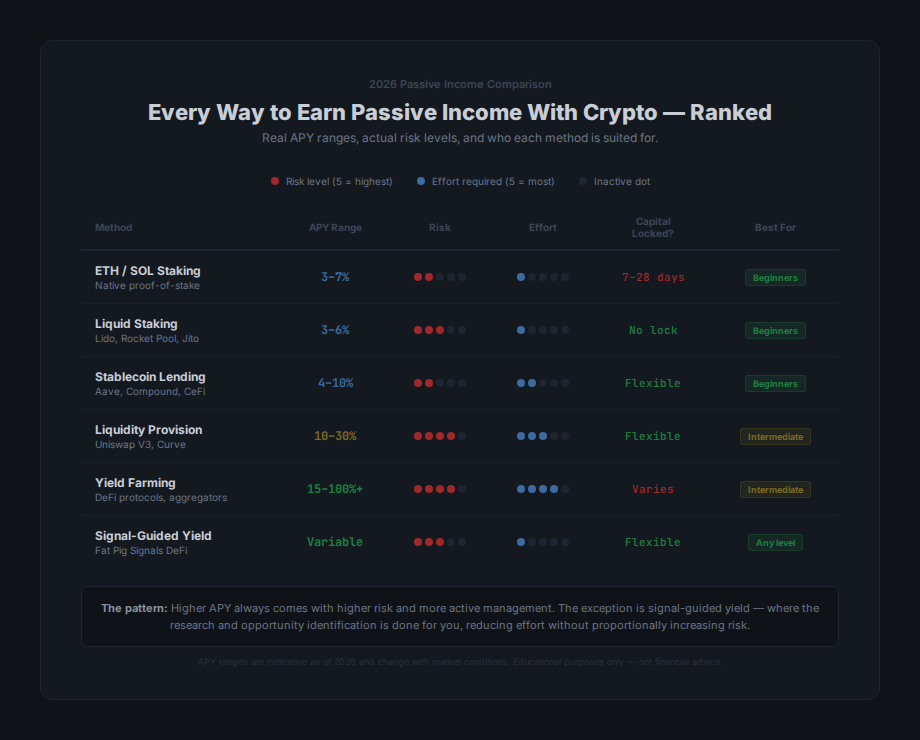
MethodAPYRiskBest ForETH / SOL Staking3–8%LowBeginners — start hereLiquid Staking3–6%Low–MediumThose who want flexibilityStablecoin Lending4–10%Low–MediumZero price exposure yieldLiquidity Provision10–30%Medium–HighIntermediate DeFi usersSignal-Guided YieldVariableMediumAny level with expert guidanceActive Yield Farming50%+HighExperienced only
The bottom of that table is where the highest returns live. It’s also where the highest losses live. Build the foundation first. Add complexity only when you understand what’s beneath it.
Disclaimer: This article is for educational and informational purposes only. It does not constitute financial advice. Cryptocurrency investments carry substantial risk including total loss of capital. APY rates quoted are indicative as of May 2026 and change with market conditions. Always conduct your own research and never invest more than you can afford to lose.
How to Earn Passive Income With Crypto in 2026 — The Complete No-Hype Guide was originally published in Coinmonks on Medium, where people are continuing the conversation by highlighting and responding to this story.





