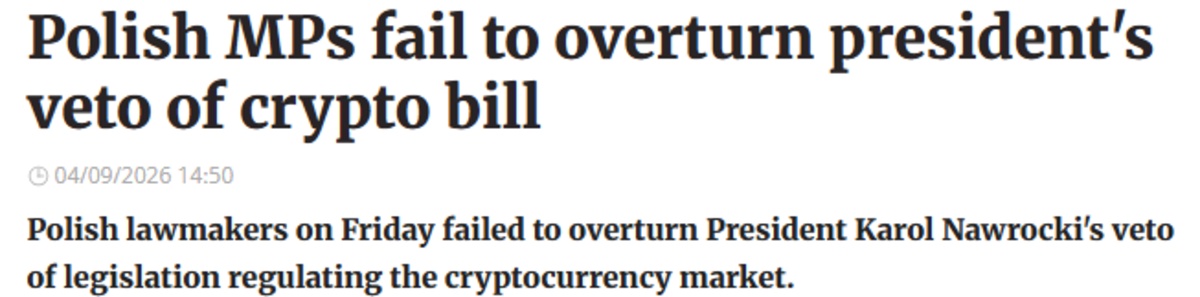
Lawmakers could not overturn the Poland crypto bill veto on September 4, 2026. The Sejm needed a three-fifths majority to cancel President Karol Nawrocki's rejection of the cryptocurrency regulation measure.
That threshold was not met. The legislation now stays blocked for a third time. This story is one of the top items in crypto news today, given the country's large digital asset market in the European Union.
Source: Polish Radio Report
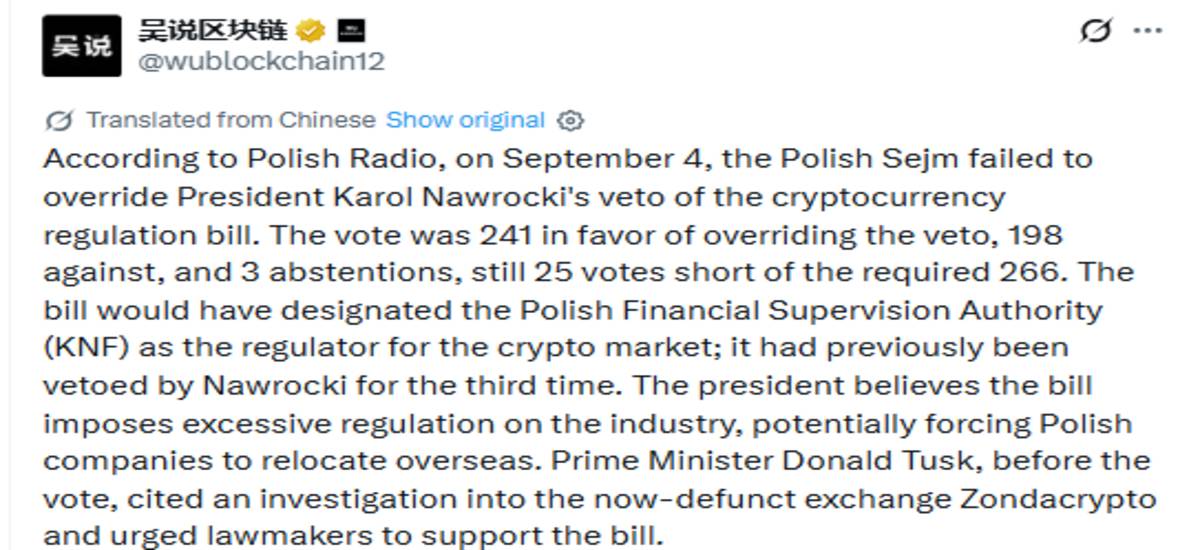
Of 442 lawmakers present, 241 voted in favor of overriding the veto. A total of 198 lawmakers voted against the move, and three abstained. The Sejm needed 266 votes to succeed, so the override fell 25 votes short of that mark.
This was the third time President Nawrocki had vetoed the same piece of legislation. The measure would have named the Financial Supervision Authority, known as KNF, as the official regulator for the sector. Since the Sejm could not reach the required votes, the Poland crypto bill veto remains legally valid for now.
Vote Outcome | Count |
In favor of override | 241 |
Against override | 198 |
Abstained | 3 |
Votes needed | 266 |
Votes short | 25 |
Source: Wublockchain Official X Post
Nawrocki has said the legislation places too much regulatory weight on the digital asset industry. He has argued that strict rules could push local firms to move their operations to other countries.
This concern has shaped all three of his vetoes on the matter since the measure was first introduced. The Poland crypto bill veto leaves the market without a single named supervisor. Other European Union states have already set up regulators under the bloc's MiCA framework.
This ongoing delay puts the country behind several neighboring markets on this front. Industry groups may now wait for lawmakers to draft a revised version that answers the president's concerns directly.
Prime Minister Donald Tusk urged lawmakers to back the Poland crypto bill veto override just before the vote took place. He pointed to an ongoing investigation into the collapsed exchange Zondacrypto as a reason for urgency.
Tusk read out parts of witness testimony connected to former Justice Minister Zbigniew Ziobro during his address to the chamber. According to Tusk's statement, the testimony described a payment tied to Ziobro that was routed through a foundation linked to his brother.
Tusk also criticized lawmakers who continue to support politicians connected to the Zondacrypto case. A formal request for Ziobro's extradition from the United States has separately been made on other charges.
Tusk framed the legislation as a needed response to gaps exposed by the Zondacrypto collapse.
He accused some lawmakers of shielding those linked to the case.
The extradition request against Ziobro remains a separate legal matter from that dispute.
The repeated Poland crypto bill veto shows a clear gap between the presidency and parliament on how to handle digital asset rules. Analysts following the story today point out that a formal market regulator is still missing here, unlike in many other EU members.
A revised version of the law that answers the president's stated concerns may be the more realistic path toward passage. Until such a draft appears, local firms in this sector are likely to keep operating without a dedicated national supervisor, which may affect how banks and payment partners treat the industry.
Sejm: The lower house of Poland's parliament.
KNF: Poland's Financial Supervision Authority, its financial regulator.
Veto-Override: A parliamentary vote to cancel a presidential-veto, needing a three-fifths majority in this case.
The Poland crypto bill veto stands after the Sejm's override attempt fell 25 votes short on September 4. The digital asset sector is left without a named regulator for now. Further action will likely depend on lawmakers drafting a revised measure that addresses the president's concerns.
YMYL Disclaimer: This article is for informational purposes only. It does not constitute financial, legal, or investment advice. Readers should verify details from official sources before making decisions.





