

Polkadot is back in focus after a widely shared financials screenshot placed the network’s chain revenue at just $0.1841, with an average transaction fee of $0.02302, a market cap near $2.3 billion, and DOT trading around $1.36.
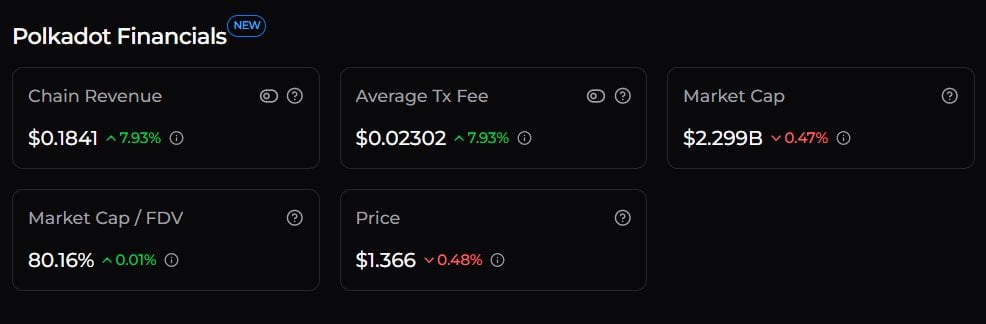
The figure triggered a familiar question for DOT holders: how much economic activity is Polkadot actually turning into network revenue? The answer depends on the data source and the exact metric being used. A live CoinGecko panel powered by Token Terminal showed Polkadot with about $24.26 in 24-hour fees and $24.22 in 24-hour project revenue, while Token Terminal’s Polkadot overview listed around $1.1K in 30-day fees and $1.1K in 30-day revenue. DeFiLlama’s Polkadot chain dashboard, meanwhile, showed $0 in 24-hour chain fees and $0 in 24-hour chain revenue.
That spread does not make the discussion irrelevant. It makes the definition of “revenue” the center of the story. Polkadot is not a standard fee-heavy smart contract chain where network demand can be read mainly through gas burned by DeFi trades, NFT mints, or memecoin speculation. Its architecture is built around a Relay Chain, parachains, shared security, staking, governance, and a long transition toward more flexible blockspace markets.
The low revenue readings still matter because market capitalization reflects expectations, not only current fees. With DOT valued around $2.26 billion and 24-hour trading volume near $138 million on CoinGecko, the market is still assigning meaningful value to the network despite limited direct fee capture.
Polkadot’s long-term economic argument increasingly rests on whether blockspace demand can become more visible through Polkadot 2.0 mechanics. DOT is used for governance, staking, and access to secure computation, including coretime purchases. That makes the shift toward coretime important because it aims to turn network resources into a more flexible market rather than relying mainly on older parachain-slot economics.
The network’s treasury model also shows why fee interpretation needs care. Polkadot’s official treasury documentation says 80% of transaction fees from submitted extrinsics go to the Treasury, while 20% goes to block producers. The Treasury is also funded through inflation, slashing, and other inflows, which means ecosystem financing is not driven by transaction fees alone.
That structure helps explain why the debate around Polkadot’s coretime, OpenGov, JAM, and network economics has become more important than a single daily revenue snapshot. If coretime markets create consistent demand for DOT-denominated resources, Polkadot’s economic model could look stronger than today’s fee charts suggest. If usage remains thin, low revenue numbers will keep feeding criticism that the network’s valuation is disconnected from direct onchain demand.
The current data gives both sides material to work with. Polkadot still has a multichain architecture, active governance, staking security, and a roadmap built around resource markets. At the same time, the live revenue readings are small relative to the network’s market cap, and different dashboards are not presenting the same daily figure. For DOT, the pressure point is whether upcoming blockspace demand shows up in measurable fees, coretime activity, and sustained user transactions rather than only in roadmap expectations.
The post Polkadot Revenue Data Reopens Debate Over DOT Network Demand appeared first on Crypto Adventure.





