
Prediction markets are trading platforms where users buy and sell contracts tied to real-world outcomes. A market may ask whether Bitcoin will close above a certain price, whether a political candidate will win, whether a central bank will cut rates, or whether a sports team will win a match. The contract price moves as traders update their views.
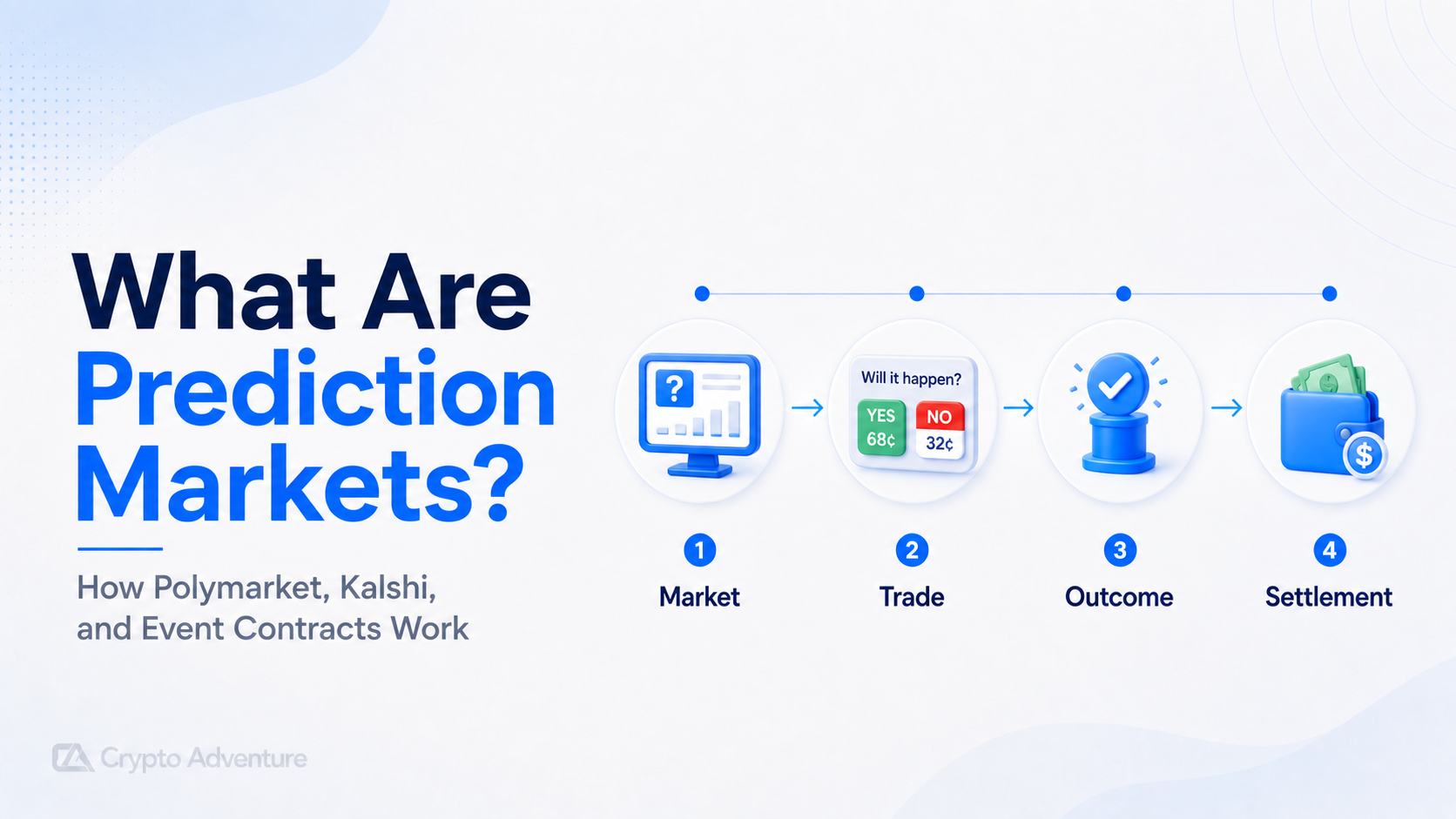
The core mechanism is simple. A binary contract usually has two sides: YES and NO. If the outcome happens, YES settles at $1 and NO settles at $0. If the outcome does not happen, NO settles at $1 and YES settles at $0. A YES contract trading at $0.62 can be read as an implied probability near 62%, although fees, spreads, liquidity, and trader bias can make the displayed price imperfect.
That probability signal is the main reason prediction markets have become important. Instead of only reading polls, analyst notes, or social media sentiment, users can watch a live market where people risk money on their view. The result is not guaranteed truth. It is a live price for uncertainty.
An event contract converts a question into a tradable instrument. The contract needs a clear outcome, a settlement date, defined rules, a payout structure, and a process for resolving edge cases. A clean market asks a question that can be answered with outside evidence. A weak market uses vague wording, subjective judgment, or unclear data sources.
A simple example would be: “Will BTC trade above $100,000 before December 31?” A trader who buys YES at $0.40 risks $0.40 per contract. If YES wins, each contract pays $1, creating $0.60 of gross profit before fees. If NO wins, the YES contract expires worthless. The trader can also sell before resolution if the market price changes.
This structure makes prediction markets different from normal spot trading. Buying Bitcoin gives exposure to Bitcoin itself. Buying a BTC outcome contract gives exposure to a specific event linked to Bitcoin. That difference matters for risk. Users comparing event contracts with spot and perps should understand that prediction markets are bounded outcome trades, not asset ownership.
Polymarket is the best-known crypto-native prediction market. Its markets are built around tradable outcome tokens, and each binary market has YES and NO tokens. Those tokens can be bought, sold, merged, and redeemed after settlement. The trading experience uses a central limit order book, so prices come from bids and asks rather than from a house bookmaker.
Polymarket’s market structure is important because it makes the platform closer to an exchange than a fixed-odds betting site. Traders do not only take a price from the platform. They can place limit orders, provide liquidity, exit before resolution, and trade around changing probabilities.
The platform’s outcome tokens are fully backed by collateral. A complete YES/NO set is backed by $1 of pUSD collateral, and winning tokens redeem after a market resolves. That makes the payout path clean, but the user still carries market risk, liquidity risk, resolution risk, and rule-reading risk.
Polymarket has also become a major data product. Prices on political, macro, sports, cultural, and crypto-linked events are widely watched because they update quickly. That does not mean prices are always right. Thin markets can be noisy, and large traders can move odds faster than casual users can react. The same caution around prediction-market profit concentration applies here: simple interfaces can hide professional-level competition.
Kalshi is a U.S.-regulated prediction market and event-contract exchange. It operates as a Designated Contract Market under CFTC oversight, which puts it inside the U.S. derivatives framework rather than outside it. Each market lets users trade contracts tied to future events, with contract prices reflecting trader views about the probability of the outcome.
Kalshi’s structure is also built around YES/NO contracts. A correct contract settles at $1, while an incorrect contract settles at $0. Traders can enter at the market price, place orders, sell before settlement, or hold until the event resolves. The product may feel simple, but it is still a derivatives market with exchange rules, market surveillance, settlement procedures, eligibility restrictions, and regulatory obligations.
Kalshi’s biggest difference from Polymarket is regulatory positioning. Polymarket grew as a crypto-native, globally visible prediction-market platform. Kalshi built around regulated U.S. event contracts. That difference affects onboarding, compliance, market listing, user eligibility, and enforcement.
Prediction-market prices move when traders update their view of the outcome. News, data releases, polls, injuries, court rulings, weather forecasts, economic numbers, crypto prices, and social-media signals can all shift market odds. The more liquid the market, the faster those updates usually appear in price.
Market makers also matter. A market with tight spreads and deep order books gives users better execution. A market with wide spreads may show an implied probability that is not easily tradable. Buying YES at the ask and selling at the bid can be expensive when liquidity is thin.
This is why price is not the same as pure probability. A 70-cent YES price may reflect probability, but it can also reflect fees, spreads, hedging demand, inventory pressure, information gaps, and trader emotion. Prediction markets are useful signals, not perfect forecast machines.
Prediction markets are no longer only standalone apps. Hyperliquid HIP-4 brings outcome markets into a high-performance onchain trading environment, making event contracts feel closer to crypto derivatives. That matters because traders can compare BTC outcomes, spot exposure, and perpetual futures inside a more unified trading stack.
HIP-4 shows where the sector may be heading. Prediction markets can become a separate consumer app, like Polymarket. They can become regulated event-contract exchanges, like Kalshi. They can also become trading primitives inside perp DEX ecosystems, where outcome contracts sit beside perpetual futures and spot markets.
That does not make all three models identical. Each has different custody, settlement, liquidity, legal, and oracle assumptions.
Prediction markets create public probability signals around events that would otherwise be argued about through opinions. They can help traders hedge specific risks, let users express views directly, and give researchers a live measure of market expectations.
They also compress complex information into one price. A market on an election, inflation print, court ruling, or token listing can absorb news faster than a normal article cycle. That makes prediction markets useful as information tools even for people who never trade.
The risks are serious. A market can resolve differently than a trader expected because the rules were narrower than the headline. A trader can buy the right view at the wrong price. A thin order book can make exit difficult. Insiders may have better information. Regulators may challenge certain categories. Casual users may underestimate how competitive these markets are.
Prediction markets also sit near the border between finance, gambling, and information markets. That border is still being tested across jurisdictions. Users should not assume that platform access equals local legal approval.
Prediction markets turn uncertainty into tradable contracts. Polymarket shows the crypto-native version, with onchain outcome tokens and order-book trading. Kalshi shows the regulated U.S. exchange version, with event contracts inside the derivatives framework. Hyperliquid HIP-4 shows how outcome markets can become part of a broader onchain trading stack.
The product is powerful because it produces live probability signals and gives users direct exposure to event outcomes. It is risky because prices can be distorted by liquidity, rules, insider information, settlement disputes, and regulatory pressure.
The best way to use prediction markets is to treat them as competitive trading systems, not simple opinion polls. The contract price may express the crowd’s view, but the outcome still depends on rules, resolution, liquidity, and the quality of information behind the trade.
The post What Are Prediction Markets? How Polymarket, Kalshi, And Event Contracts Work appeared first on Crypto Adventure.





