Imagine getting a word permanently tattooed on your forehead — then finding out it was spelled wrong. That's exactly what happened with one of Solana's wildest recent stories. It started with a simple Pump.fun Go Bounty task. It ended with a real-money dispute, a misspelled tattoo, and a brand-new memecoin.
Pump.fun recently launched a bounty marketplace called GO. It lets users pay others to complete almost any task. Think of it like a gig platform — but built entirely around crypto tokens and internet stunts.
One bounty caught everyone's eye. It offered 40 SOL — worth about $2,570 — for someone willing to tattoo a token ticker on their forehead.
An Indian X user named Arivu, who posts as @Arivulife, accepted the challenge. He got the tattoo. He uploaded proof. He expected his 40 SOL.
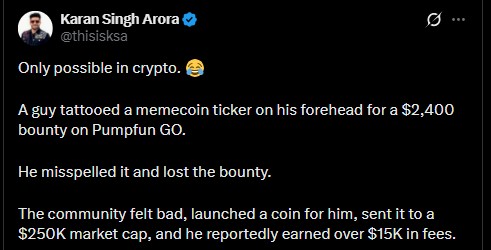
Source: X Post
Then things got messy.
The bounty asked for the ticker $Bountywork. But Arivu's tattoo read $Boutywork — missing the letter 'n.'
Arivu argued he copied the wording exactly from the bounty post itself. In other words, the typo wasn't his — it was already in the task.
The bounty poster, @ayushquantt, took the dispute public. He asked openly: should he pay for a tattoo that used the wrong ticker?
That question turned into a live test for Pump.fun's new platform. Do you pay when the task is technically done — but the result is wrong because you wrote the wrong words?
Solana traders didn't wait for an answer. Within hours, someone launched the BOUTYWORK token on Pump.fun — using the misspelled tattoo as the story behind it.
The token hit hundreds of thousands of dollars in market cap. DEXScreener tracked heavy early trades across PumpSwap liquidity. Traders weren't interested in who was right. They were interested in the meme.
That's how fast this platform moves. It gone wrong became a tradeable asset faster than the dispute could be resolved.
This wasn't an isolated moment. Pump.fun has faced serious problems before — and they're worth knowing if you're thinking of joining.
Here are the key incidents:
These are real events, not rumours. Each one points to the same underlying problem: very little protection for the average user.
Despite the controversies, Pump.fun keeps growing. It recently added USDC pairs for new coin launches. That gives creators more pricing options. Earlier market data also showed traders returning to profit after a rough stretch.
The platform is transparent about how tokens trade — they use a bonding curve, which means prices move based on buying and selling activity, with no hidden liquidity pools. That part, at least, is straightforward.
But transparency in price discovery doesn't equal safety for participants.
Expert Opinion: The Pump.fun Go Bounty case highlights a structural gap in decentralised task markets: there is no neutral dispute resolution. When the poster writes the wrong ticker and the completer follows those exact instructions, who bears responsibility? Traditional platforms have arbitration systems. Pump.fun does not. Until that changes, both posters and completers carry unequal, unresolved risk. The rapid rise of the BOUTYWORK token shows the community is more interested in the meme than the money — but for people with real stakes, that's a serious problem.
The Pump.fun Go Bounty story is entertaining on the surface. A tattoo, a typo, a new token — it's the kind of thing that only happens in crypto. But beneath the meme, there are real risks. From a co-founder's past to collapsed tokens and a mismanaged livestream, the platform's track record raises genuine questions. If you're new to crypto, treat every bounty and every token launch here with extreme caution. The speed of the market is exciting. The lack of accountability is not.
YMYL Disclaimer: This content is for informational purposes only. Nothing here is financial, investment, or legal advice. Cryptocurrency markets are highly volatile and largely unregulated. You can lose all the money you invest. Always do your own research and consult a qualified financial advisor before making any crypto-related decisions. The incidents referenced here are based on publicly available reports and user accounts.





